

In Trump’s orbit, praise is never just praise. Every public compliment, every half-serious joke, every warning wrapped in laughter is dissected for what it says about the future — about who is rising, who is drifting too close to the spotlight, and who President Donald Trump might one day anoint as his successor.
With Secretary of State Marco Rubio and Vice President JD Vance both looming as potential heirs, even routine moments can carry outsized meaning.
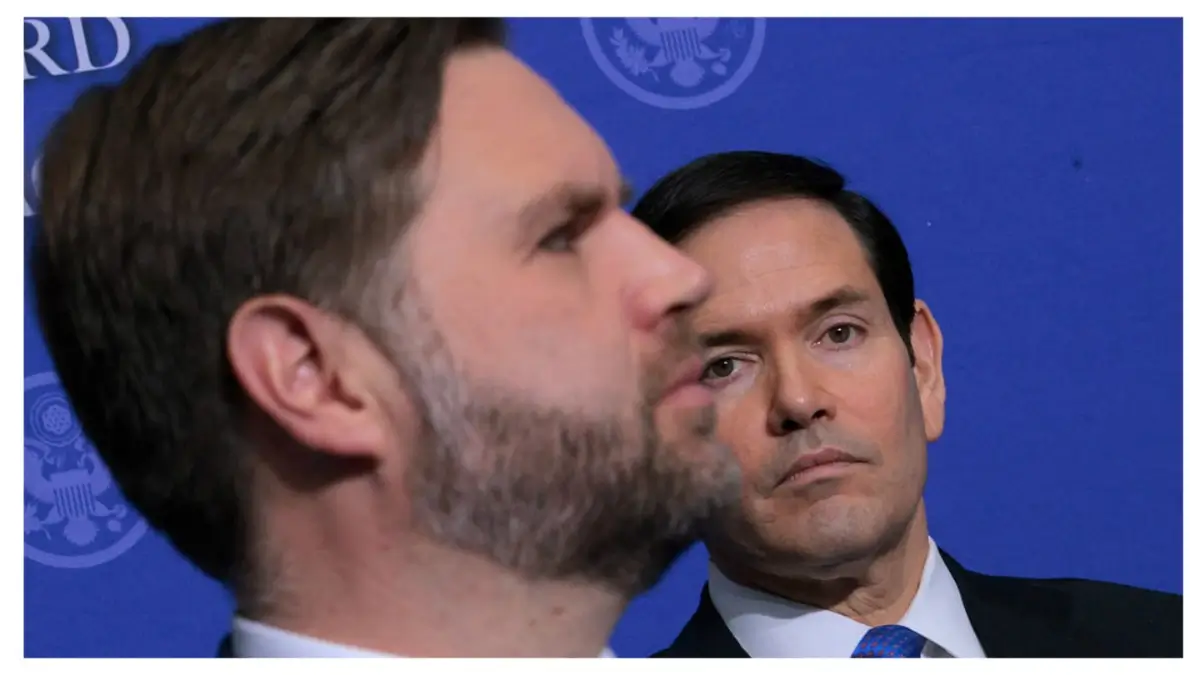
That tension flared after Rubio delivered a high-profile speech overseas that drew applause and briefly shifted attention in his direction — attention that, inside Trump’s world, is always conditional.
Rubio’s speech in Germany on Feb. 14 was widely celebrated by conservatives who applauded his defense of tighter borders, national sovereignty and what he framed as Western civilizational values. He reassured European leaders that the U.S. remains committed to partnership, telling the conference, “We belong together.”
“And so, this is why we Americans may sometimes come off as a little direct and urgent in our counsel,” Rubio said convincingly during his 30-minute speech. “This is why President Trump demands seriousness and reciprocity from our friends here in Europe. The reason why, my friends, is because we care deeply.”
The tone was diplomatic and measured and drew a standing ovation.
But as The Guardian later observed, the speech amounted to “an offer of friendship — but on white, Christian, Maga terms.”
Beneath the velvet language were the same Trump-era themes Vance delivered more bluntly at the conference a year earlier: mass migration as civilizational erosion, skepticism of international institutions, and warnings that Europe was drifting from “fundamental values.”
In other words, Rubio was advancing Trump’s worldview — just with polish.
That polish may have pleased conservatives at home, but it also risked something else inside Trump’s inner circle: the appearance of outshining the man at the top.
Trump’s friends and foes alike know better than to try to upstage the president, even unwittingly, and Trump made that clear to Rubio several days later at the first meeting of his newly formed Board of Peace in Washington on Thursday, Feb. 19.
“And Marco, you really did yourself proud two days ago in Munich, in fact, so proud that I almost terminated his employ because they were saying, “Well, why can’t Trump do this?’” an envious president said, clearly not joking.
“I do, but I say it differently,” Trump continued before landing a veiled threat and the camera catching Rubio’s nervous reaction.
“But Marco, don’t do any better than you did, please cause if you do, you’re outta here. But no, I want my guys to do great,” he continued.
Social media saw through Trump’s comments.
“As with everything he says, this is not a joke. Tread carefully, Little Marco,” X user Gisele warned, using a nickname Trump coined for Rubio during the 2016 presidential campaign.
This X user chimed in, “Marco gave one of the most nervous laughs I have ever seen.”
Another remarked on Trump’s jealousy, “Normal leaders like when their team shines. He hears applause and starts measuring it against himself.”
One viewer poked fun at the not-so-secret rivalry for the president’s attention between Vance and Rubio with a teary eyed meme, “I’m sure that JD Vance’s eyeliner just ran a bit after hearing how well Lil Marco did in Munich.”
But the tension did not exist in isolation.
At the same Board of Peace event, Trump openly praised both Rubio and Vance, calling them an “extraordinary” duo who achieve the same result through very different approaches.
Vance, Trump said, is “a brilliant guy” who can be “a little bit tough on occasion,” adding, “We gotta slow him down just a little bit on occasion. He says his mind.”
Rubio, by contrast, was “the opposite extreme.”
“Marco does it with a velvet glove, but it’s a kill, right? The result is the same.”
Trump’s framing reinforced the contrast — hammer and velvet glove — while reminding everyone that proximity is conditional and the hierarchy can shift without warning.
The fluidity of that approval was evident days earlier aboard Air Force One, when Trump was pressed about the 2028 presidential ticket and refused to lock anyone in.
Asked directly whether he would support Rubio “on the top of the ticket” after the Munich speech drew praise, Trump declined to commit.
“It’s something I don’t have to worry about now,” he first responded. Then added, “JD is fantastic, and Marco is. They’re both fantastic, I think, really. And I think Marco did a great job in Munich.”
It was the second time in two weeks Trump refused to fully back either Vance or Rubio for 2028.
That triggered a separate round of social media reaction, this time focused on what many saw as Trump playing the two against each other.
And social media took note.
“He’s trying to make the 2 fight with each other. That’s all he does is cause chaos, never solves any issues for Americans,” Threads user Jeng Burke stated.
Another replied, “Trump plays one against the other.”
Conservatives may have celebrated Rubio’s Munich performance but in Trump’s orbit, momentum can be fleeting and praise can quickly morph into warning.
The latest Pew Research Center polling shows 58 percent of Americans disapprove of Trump. Vance’s unfavorable rating stands at 52 percent. Rubio fares slightly better, with a 34 percent favorable rating, though 19 percent of respondents said they had never heard of him.
Within Trump’s circle, the numbers that matter most are not found in polls.
Great Job Shelby E. & the Team @ Atlanta Black Star for sharing this story.