

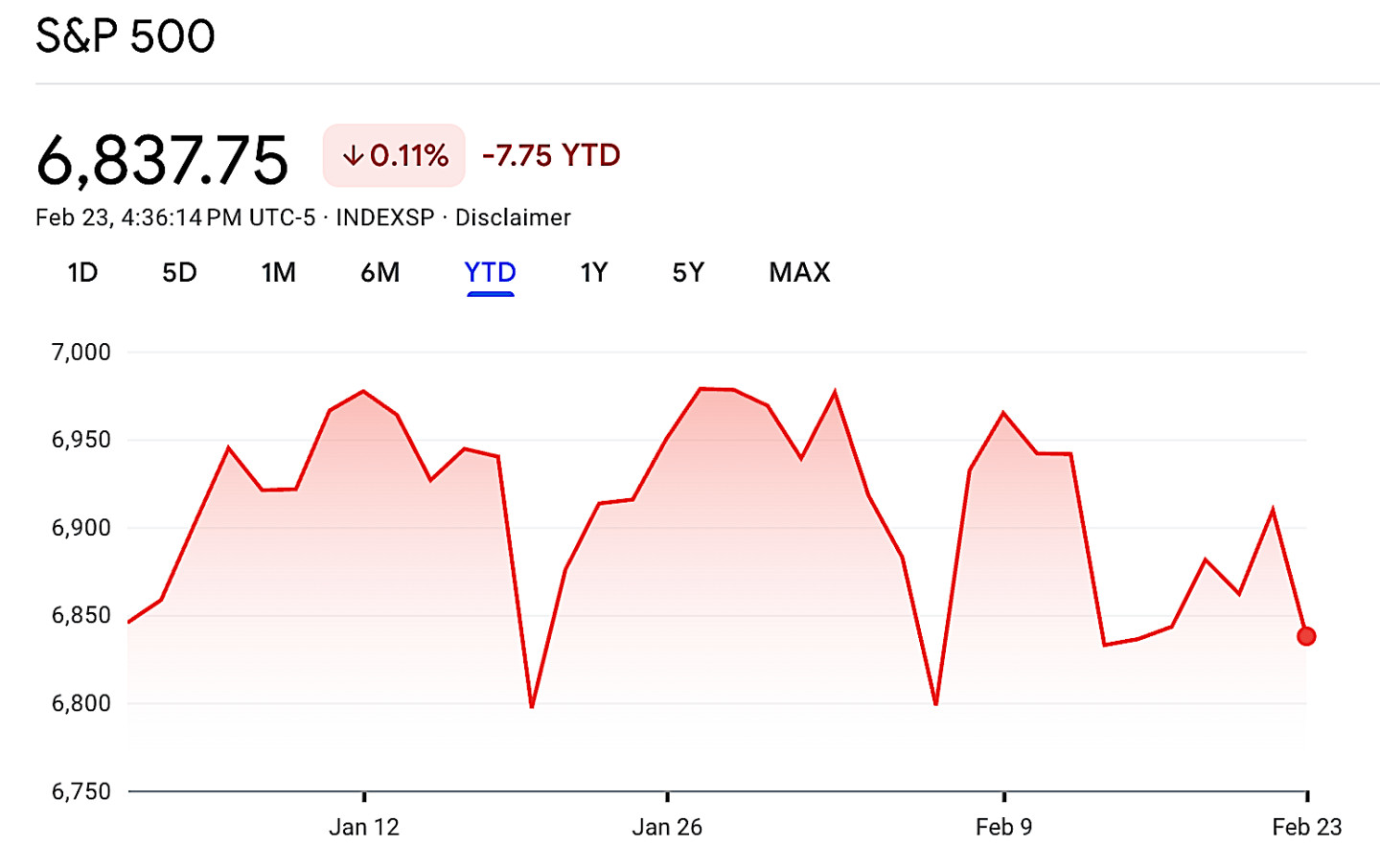
The S&P 500 lost 1.04% yesterday as the VIX “fear index” for volatility spiked 10%, but futures were up 0.16% this morning, suggesting traders may be putting a temporary pause on the panic selling that has gripped markets over the last 24 hours.
- The real source was the U.S. Supreme Court’s ruling that President Trump’s “Liberation Day” tariffs are illegal, temporarily reducing the U.S. trade tariff rate to zero, and Trump’s chaotic reaction to it. Trump immediately insisted he would impose a global rate of 10%, then hours later said it would be 15%, and then shortly after that the White House said it would be 10%, possibly followed by 15% at some point in the future. In the last 24 hours, Trump has also vowed “terrible” things to come in trade policy, which he believes he can impose “in a much more powerful and obnoxious way.”
- The fictitious source was the Citrini Research post on Substack, which imagined a future in 2028 in which AI destroys so many jobs that it sends the economy into a doom spiral. Software stocks declined 3.82% yesterday, in large part because of the fear, uncertainty, and doubt in the note. “The declines included IBM [down 13.15%] posting its worst day since the 2000 tech bubble burst,” Jim Reid and his team at Deutsche Bank told clients this morning.
This morning, more sober heads on Wall Street and in the City of London are pointing out that maybe the stock markets shouldn’t be selling off based on a blog post that opens by denying it is “AI doomer fan-fiction.”
As the Financial Times put it: “The stock market has reached the point where blog posts cause significant stock moves, or at least where people think that they do…the Citrini fuss is further evidence that we are in an expensive market that is looking for an excuse to fall, for reasons that are probably wider than just AI.”
The Wall Street Journal had a similar take: “Nothing underlines the sensitivity of stocks right now quite like what happened on Monday, when one of the factors behind the Dow’s 800-point drop was a 7,000-word hypothetical.”
Today, analysts are more focused on the fast-moving, unpredictable tariff scenario
Foreign trade partners of the U.S. are losing their patience with the White House. Countries that thought they had low-level tariff deals of 10% or so are now potentially looking at 15%. And countries that fought the White House and got higher tariffs may now see only a 10% tax level. “The perversity of what happened at the weekend was that those who got good deals, the allies, have been most disadvantaged,” Andy Haldane, the former central economist and current president of the British Chambers of Commerce, told the BBC.
The CEO of Etihad Airways said this kind of uncertainty is harder to deal with than war.
Trump peppered his trade partners with threats yesterday.
“Any Country that wants to ‘play games’ with the ridiculous supreme court decision, especially those that have ‘Ripped Off’ the U.S.A. for years, and even decades, will be met with a much higher Tariff, and worse,” he said in a string of posts on social media.
“The supreme court (will be using lower case letters for a while based on a complete lack of respect!) of the United States accidentally and unwittingly gave me, as President of the United States, far more powers and strength than I had prior to their ridiculous, dumb, and very internationally divisive ruling. For one thing, I can use Licenses to do absolutely ‘terrible’ things to foreign countries…The court has also approved all other Tariffs, of which there are many, and they can all be used in a much more powerful and obnoxious way, with legal certainty, than the Tariffs as initially used,” the president said, without citing legal evidence for his beliefs.
It’s not clear what basis Washington will use next to impose new tariffs, or whether those tariffs will survive a legal challenge. Joseph Brusuelas of the consulting firm RSM said one option could be under Section 122 of the trade act, which allows the president to impose tariffs up to 15% in the event of “serious” balance-of-payments deficits or a dramatic currency depreciation. “Do the new tariffs meet the definition? No matter how one looks the current circumstances—the condition of the U.S. economy, its balance of payments or its currency regime—none of these meet the standards outlined under section 122,” he said.
Another option is Section 232 of the Trade Expansion Act of 1962, which allows the president to impose tariffs for national security reasons. But the administration would have to conduct investigations prior to imposing those tariffs.
And then there are Section 301 tariffs, which BNP analyst William Bratton warns “have no upper limit, have proved to be highly sticky once implemented (as with those imposed on China in 2018), and could, in theory, be applied to any country that does not agree to a trade agreement with the U.S. that embeds higher tariffs.”
New tariffs will come at a cost to the economy and maybe the stock market
All of the above, and the uncertainty around them, are likely drags on trade, GDP, and thus—inevitably—the stock market.
Goldman Sachs analyst Pierfrancesco Mei estimated some numbers for that this morning: “Tariff rates could rise further or the share of the costs that fall on consumers could rise more than we expect. We estimate that an additional 5pp [percentage point] increase in the effective tariff rate would boost core PCE inflation by 0.5pp relative to our baseline and reduce 2026 GDP growth by 0.4pp, mainly through its tax-like impact on consumers and businesses,” he told clients.
And if the markets are further spooked by invective from the Oval Office or AI bearishness, “A potential stock market correction could weigh on consumer spending and business confidence. We estimate that a 10% decline in equity prices sustained through 2026Q2, for example, would reduce 2026 GDP growth by about 0.5pp relative to our baseline,” he wrote.
Here’s a snapshot of the markets this morning prior to the opening bell in New York:
- S&P 500 futures were up 0.16% this morning. The index closed down 1.04% in its last session.
- STOXX Europe 600 was down 0.14% in early trading.
- The U.K.’s FTSE 100 was down 0.2% in early trading.
- Japan’s Nikkei 225 was up 0.87%.
- China’s CSI 300 is down 1.25%.
- The South Korea KOSPI was up 2.11%.
- India’s NIFTY 50 was down 1.12%.
- Bitcoin declined to $63K.
Great Job Jim Edwards & the Team @ Fortune | FORTUNE for sharing this story.