

Representatives from Graduate Student Solidarity host a press conference outside the University of Houston on Tuesday, Feb. 17, 2026, in Houston, Texas. | Oscar Herrera/The Cougar
Struggling to shoulder the full cost of health insurance, graduate students are turning to organizing and advocacy to protest their work conditions.
When fifth-year chemistry doctoral candidate and international student Y.A.N., whose name is withheld to protect her identity, came to UH, health insurance was not top of mind. She expected to pay a few hundred dollars per semester. Instead, she was charged more than $1,000 each semester for the University health insurance plan, which is mandatory for international students.
“Once I realized how much I was going to be paid and how little I was going to be paid, that’s when I thought maybe I should have gone somewhere health insurance would be covered,” said Y.A.N. “I don’t know if I would have changed my mind because UH is a very good school, but maybe.”
Unlike other Texas flagship universities such as the University of Texas and Texas A&M University, UH does not subsidize health insurance for graduate student employees.
Y.A.N. said what is especially frustrating is that when safety incidents occur in chemistry labs like the one she works in, workers’ compensation, not student health insurance, covers the costs.
“In that case, what was the purpose of having health insurance at all?” Y.A.N. said. “If it’s not covering these kinds of work issues, you’re just forcing a student to pay money back into the institution that’s barely giving them anything.”
Without financial aid from TAFSA, she said she does not know how she would manage. She knows students who have had to ask their parents for help to cover living expenses.
For third-year mathematics doctoral candidate Ricardo Gloria, it is simply difficult to “make a life here in Houston.”
“The rents are really high near UH. If you want to get a car, it’s expensive,” Gloria said. “At the same time, if you don’t have a car, you need to live somewhere where the rent is really high. The money’s not enough.”
Although graduate students across departments attempted advocacy efforts, none were successful in moving the needle with the administration.
As a result, fifth-year mathematics doctoral candidate Łukasz Krzywon said Graduate Student Solidarity, along with the Graduate & Professional Students Association, became the primary driver behind the Cover Care for Coogs campaign.
“The goal of GSS was to say, all you graduate students across the University and all of the colleges, this is an issue that’s affecting most of us,” Krzywon said. “The goal is to get everyone together from across the University to help each other out and pressure the University to do the right thing.”
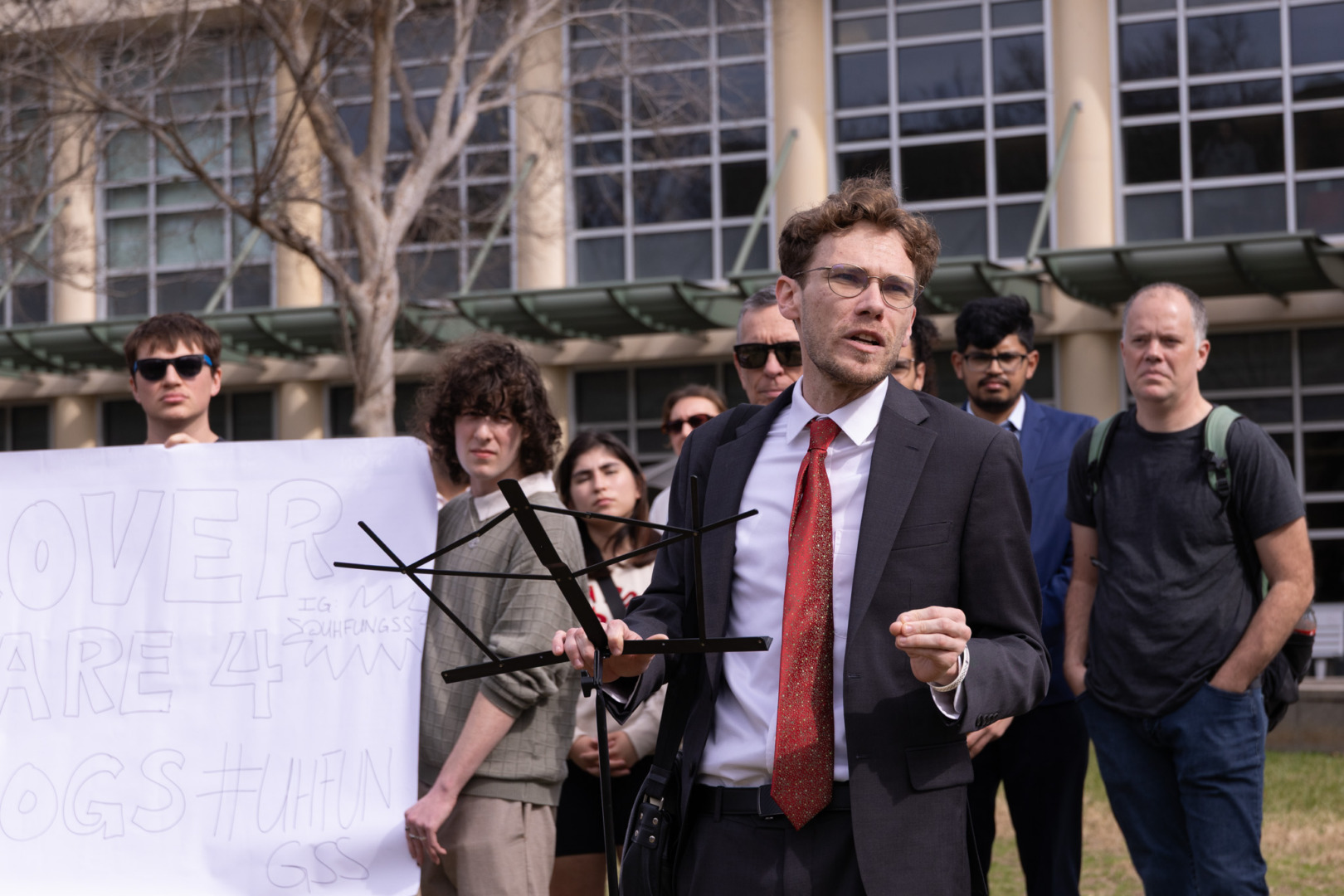
Representatives from Graduate Student Solidarity host a conference outside the University of Houston on Tuesday, Feb. 17, 2026, in Houston, Texas. | Raphael Fernandez/The Cougar
Last year, during the State of the University address, organizers handed out flyers to faculty and donors in attendance.
By the end of the night, physics doctoral candidate Lars Walker said all 200 flyers had been distributed.
“Most people generally don’t like when people come up to you with flyers, but once they figured out what we were about, it was pretty well received,” Walker said. “Most of the faculty and donors were like ‘oh, student health care, of course that’s a great thing.’ More or less, there was pretty much no pushback interpersonally.”
GSS efforts culminated in a Feb. 17 press conference held with the GPSA. Third-year history doctoral candidate Seth Uzman delivered opening remarks rejecting what he described as a two-tiered health care system for domestic and international students.
Uzman and other organizers criticized not only the financial strain graduate students face but also what they described as an atmosphere of fear on campus.
“The University exploits international student labor and yet does not create an environment in which the majority of the graduate student body can feel safe to exercise agency, to advocate, to organize,” Uzman said. “Anytime there is activism around this issue, anything that the University is seeing is really only the tip of the iceberg.”
The campaign has drawn faculty support, including from history professor David McNally, who spoke at the press conference.
“If everyone self-censors, if everyone decides they’re not going to speak out, then those who are trying to repress free speech are winning, aren’t they?” McNally said. “My own view is that these are exactly the moments in which we must speak up. And I’m a senior scholar, not a young untenured faculty member. If I won’t speak out, what does that say to my younger colleagues?”
McNally said the Cover Care for Coogs campaign has the “moral right” on its side and that it is the administration’s “moral duty” to address students’ concerns.
“One of the things that can happen when you are in your plush offices in administrative quarters is that you lose sight of the priority that your students and your faculty ought to be for your operation,” McNally said. “You start to treat requests and even demands from your own constituencies as a nuisance, as voices to be shut down. It’s a very, very bad practice for senior administrators, and I hope they’ll get out of their silos and begin to listen to what their own graduate students are saying.”
Y.A.N. said there is a stereotype that graduate students are “scrappers,” whose research brings acclaim to the University, but who can endure financial strain temporarily before leaving.
“I think they think everything’s going to be okay, and if there’s any problem, then they can suffer for a couple of years and then get out and they’ll get a good job,” Y.A.N. said. “So it just gets passed on to the next generation, and the next generation after that. The root of the bigger problem is that abuse is okay because it’s temporary.”
Graduate students, organizers say, are indispensable to UH’s growth.
“In order for UH to see itself as a competitive University on par with A&M, UT and others, which I think it’s trying to do, this is definitely a necessary step,” Walker said. “Until then, it’s just construction projects and celebrations. A University without nice buildings is still a University, but a University without grad students is a collection of donors or something.”
Many of the current organizers may not see the results of their advocacy during their time at UH. For now, they say they are speaking for those who cannot.
“I am proud to wear a UH t-shirt and talk about UH and promote it,” Y.A.N. said. “I love the lessons I’ve learned here. With that said, I also have no problem discussing the issues that should be improved. If I’m going to talk well about my school, I want to be able to minimize the amount of flaws over time, and that starts by actually voicing them.”
The Cougar has chosen not to release identifying information on sources due to safety concerns and a student media alert from the Student Press Law Center.
news@thedailycougar.com
Great Job Karen Wei & the Team @ The Cougar for sharing this story.