

Milestones: Dr. Jennifer Piscopo‘s bookThe Impact of Gender Quotas is published (2012); Alice Paul led the Women’s Suffrage Parade in D.C. (1913); Florence Prag Kahn became the first Jewish woman member of Congress (1925); Frances Perkins became the first woman to serve as a Cabinet secretary (1933); the first Women’s History Week takes place (1981); and the inaugural International Women’s Day was held (1914).
Birthdays: Beth Silvers, co-host of Pantsuit Politics; Kathryn Garcia, former NYC mayoral candidate; Eleni Kounalakis, lieutenant governor of California; Connie Britton, actor; Amy Kroll, founder of the LBJ Campaign School; Jessica Bombardier Shaw; Amanda Gorman, poet; Amber McReynolds, election system expert and author of When Women Vote; Glynda Carr, co-founder of Higher Heights; and Laura Liswood, secretary general of the Council of Women World Leaders.
How Do We Build a Democracy Where Women Can Run, Win and Lead?
March is one of my favorite times of year. Women’s History Month always offers a moment to reflect on how far we’ve come and how much work still lies ahead in advancing women’s representation in our democracy.
Over the past century, women have steadily reshaped American political life. From the suffragists who fought for the right to vote to those who pushed through the Voting Rights Act and Title IX to the record number of women serving in public office today, each step forward has expanded what leadership in this country can look like.
But one lesson from history stands out clearly: Progress doesn’t just happen on its own. It happens because people are willing to challenge the systems that shape political power and imagine how they can work better. That spirit is exactly what inspired us to create the Democracy Solutions Summit, and why I’m so excited for next week’s gathering.

Now in its fifth year, the Summit brings together researchers, advocates, elected officials and movement leaders from across the United States and around the world to talk about one essential question: How do we design democracies where women can run, win and lead?
Across three afternoons of conversations, we’ll be exploring where we’ve been, where we are today and where we’re going when it comes to women’s political power.
We’ll hear from historians reflecting on the breakthroughs that opened the doors of political leadership to women in the first place. Experts will dig into the realities women face today, including political violence, declining trust in institutions and the structural barriers that still shape who participates in politics.
We’ll also take a global look at how the United States compares with other democracies on women’s representation and what lessons we can learn from countries that have made faster progress.
And importantly, we’ll talk about solutions. One of the things I love most about the Democracy Solutions Summit is that it’s not just about diagnosing problems. It’s about sharing practical insights from people who are actively working to build leadership pipelines, reform political systems and create pathways for more women to step into public life.
Throughout the event, we’ll hear from an incredible group of speakers—researchers, advocates, elected officials and global leaders—all bringing their perspectives on how we can accelerate progress toward gender-balanced governance.
In the spirit of Women’s History Month, we’re also reflecting on the women who paved the way. RepresentWomen’s communications director, Alana Persson, recently sat down with author and historian, and Summit speaker, Lorissa Rinehart, to give a preview of what to expect from the Summit. One highlight of next Tuesday will be Lorissa’s participation for a fireside chat about the life and legacy of Jeannette Rankin, the first woman ever elected to Congress. Rankin’s election was once considered impossible. Today, her story reminds us how much can change when people are willing to push democracy forward.
Every advance in representation was once a bold idea. The Democracy Solutions Summit is an opportunity to explore the ideas, insights, and solutions shaping the next chapter of women’s political power, and I hope you’ll join us for the conversation.
Revisiting “The Hill We Climb” in an Unfinished Democracy
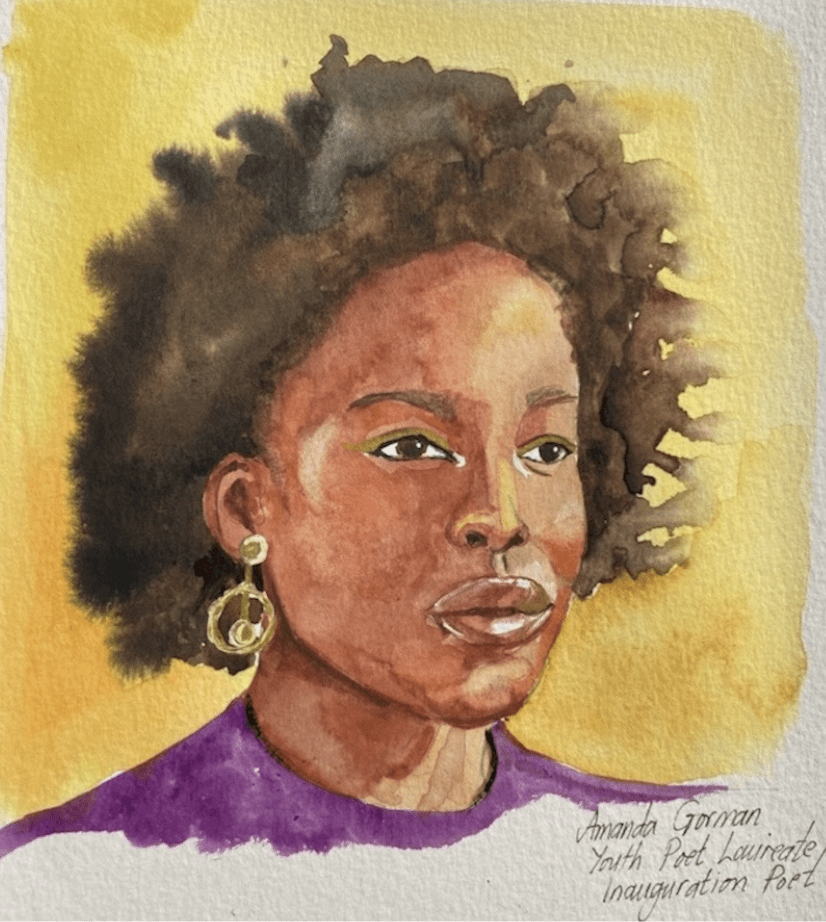
Amanda Gorman wrote and recited “The Hill We Climb.” It seems like a timely reminder of the times we find ourselves in:
When day comes we ask ourselves:
where can we find light
In this neverending shade?
The loss we carry, a sea we must wade.We’ve braved the belly of the beast.
We’ve learned that quiet isn’t always peace,
And the norms and notions of what “just is”
Isn’t always justice.And yet the dawn is ours before we knew it.
Somehow we do it
Somehow, we’ve weathered and witnessed
A nation that isn’t broken, but simply
unfinished.We, the successors of a country and a time
Where a skinny black girl,
Descended from slaves and raised by
a single mother
Can dream of becoming president,
Only to find herself reciting for one.And, yes, we are far from polished,
far from pristine,
But that doesn’t mean we are striving to
form a union that is perfect
We are striving to forge a union with
purpose,To compose a country committed
To all cultures, colors, characters,
And conditions of man.
And so we lift our gazes not
To what stands between us,
But what stands before us.
We close the divide,
Because we know to put
Our future first, we must first
Put our differences aside.We lay down our arms
So that we can reach out our arms to one
another.
We seek harm to none and harmony for all.Let the globe, if nothing else, say this is true:
That even as we grieved, we grew,
That even as we hurt, we hoped,
That even as we tired, we tried.
That we’ll forever be tied together.
Victorious,
Not because we will never again know
defeat,
But because we will never again sow
division.Scripture tells us to envision that:
“Everyone shall sit under their own vine and
fig tree,
And no one shall make them afraid.”
If we’re to live up to our own time, then
victory
Won’t lie in the blade, but in in all of the bridges
we’ve made.
That is the promise to glade,
The hill we climb, if only we dare it:
Because being American is more than a
pride we inherit—
It’s the past we step into and how we
repair it.We’ve seen a force that would shatter our
nation rather than share it,
Would destroy our country if it meant
delaying democracy.
And this effort very nearly succeeded.
But while democracy can be periodically
delayed,
It can never be permanently defeated.In this truth, in this faith, we trust.
For while we have our eyes on the future,
History has its eyes on us.This is the era of just redemption.
We feared it at its inception.
We did not feel prepared to be the heirs
Of such a terrifying hour.
But within it we’ve found the power
To author a new chapter,
To offer hope and laughter to ourselvesSo while once we asked: How could we
possibly prevail over catastrophe?
Now we assert: How could catastrophe
possibly prevail over us?We will not march back to what was,
But move to what shall be:
A country that is bruised but whole,
Benevolent but bold,
Fierce and free.We will not be turned around,
Or interrupted by intimidation,
Because we know our inaction and inertia
Will be the inheritance of the next
generation.
Our blunders become their burden.
But one thing is certain:I
f we merge mercy with might, and might
with right,
Then love becomes our legacy,
And change our children’s birthright.So let us leave behind a country better
than the one we were left.
With every breath from my bronze-
pounded chest,
We will raise this wounded world into
a wondrous oneWe will rise from the gold-limned hills
of the West!
We will rise from the windswept
Northeast, where our forefathers first
realized revolution!
We will rise from the lake-rimmed cities
of the Midwestern states!
We will rise from the sunbaked South!We will rebuild, reconcile, and recover,
In every known nook of our nation,
In every corner called our country,
Our people, diverse and dutiful.
We’ll emerge, battered but beautiful.When day comes, we step out of the
shade,
Aflame and unafraid.
The new dawn blooms as we free it,
For there is always light,
If only we’re brave enough to see it,
If only we’re brave enough to be it.
Primary Season Launched—With Few Advances for Women

Arkansas, North Carolina and Texas kicked off the 2026 primary season with federal and state primary elections. Gina Hinojosa earned the Democratic nomination for governor of Texas in an uphill race against incumbent Greg Abbott, but women at best treaded water in major offices. We expect to dig deeper into state legislative results next week at the Democracy Solutions Summit.
The Center for American Women and Politics is tracking results helpful. Here are highlights from CAWP’s periodically updated analysis:
From Texas:
No woman has advanced as a nominee for the U.S. Senate. Incumbent U.S. Representative Jasmine Crockett (D) was unsuccessful in her bid for the Democratic nomination, which means that she will leave Congress in 2027.
Five (3D, 2R) of 7 (5D, 2R) women incumbents representing Texas in the U.S. House won their nominations and are currently favored to win re-election in November. In addition to Crockett’s departure to run for U.S. Senate, incumbent U.S. Representative Julie Johnson (D) has advanced to a runoff.
Fourteen (12D, 2R) non-incumbent women won their primaries for U.S. House; all but one are in contests that currently favor their opponent according to the Cook Political Report. The exception is Jessica Hart Steinmann (R), who won in Texas’ 8th Congressional District, rated “Solid Republican” by Cook Political Report.
From North Carolina:
No woman has advanced as a nominee for the U.S. Senate. No woman has served in the U.S. Senate from North Carolina since 2015.
Four (3D, 1R) women U.S. House incumbents won their primaries and are strongly favored to win re-election in November.
Of the 4 (3D, 1R) non-incumbent women nominees for U.S. House, only 1 (1R) – Laurie Buckout – is currently favored (“Lean Republican”) by Cook Political Report. All 3 (3D) non-incumbent Democratic women nominees are in contests currently rated as “Solid Republican” by the Cook Political Report.
From Arkansas:
Incumbent Governor Sarah Huckabee Sanders (R) and Lieutenant Governor Leslie Rutledge (R) were unopposed in their primaries and are favored to win re-election in November.
Kelly Grappe (D) secured the Democratic nomination for Secretary of State,
Hallie Shoffner (D) will challenge incumbent U.S. Senator Tom Cotton (R). In the U.S. House, Terri Yarbrough Green (D) will challenge incumbent U.S. Representative Rick Crawford (R). Both contests are currently rated as “Solid Republican” by the Cook Political Report. No woman has served in Congress from Arkansas since 2011, when Senator Blanche Lambert Lincoln (D) left the U.S. Senate.
Tracking Endorsements from EMILY’s List in Illinois and Beyond
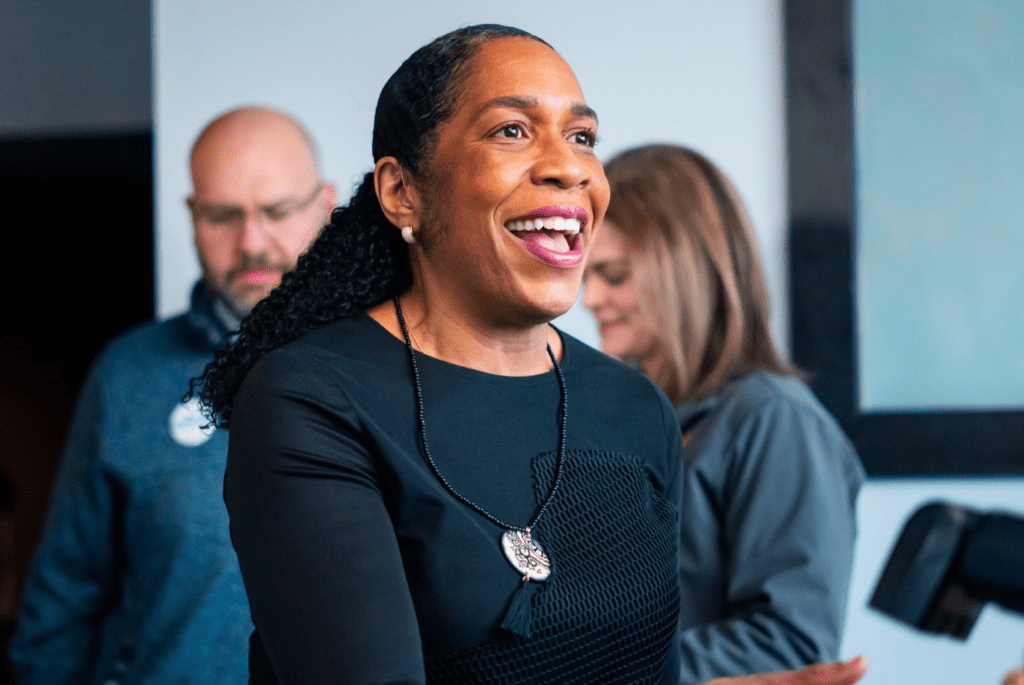
As explained last month, EMILY’s List has provided a model for intentional action on behalf of Democratic pro-choice women candidates that Republicans have largely failed to emulate. It’s been making endorsements in key races, which you can review here in this helpful tool, where you can search by office and state. It underscores the challenge of relatively few elections being competitive in our hyper-polarized politics—but there are women to watch. It issued this Feb. 26 update on the U.S. Senate Democratic primary on March 17 in Illinois, where Lt. Gov. Juliana Stratton has been gaining in the polls, even with the lack of ranked choice voting creating complications:
A new poll from Public Policy Polling (PPP) released yesterday shows Lt. Gov. Stratton surging. The poll shows the race essentially tied and the LG within the margin of error. That’s a nine-point swing towards Juliana in the last three weeks—despite more than $25 million in paid media spending from her opponent. The data signals a clear growing appetite among voters for proven statewide leadership over Washington-style politics. In a hypothetical two-way head-to-head, LG Stratton leads the Congressman 37 percent to 32 percent.
Donald Trump’s Endorsements Mattered—and Were Overwhelmingly Male
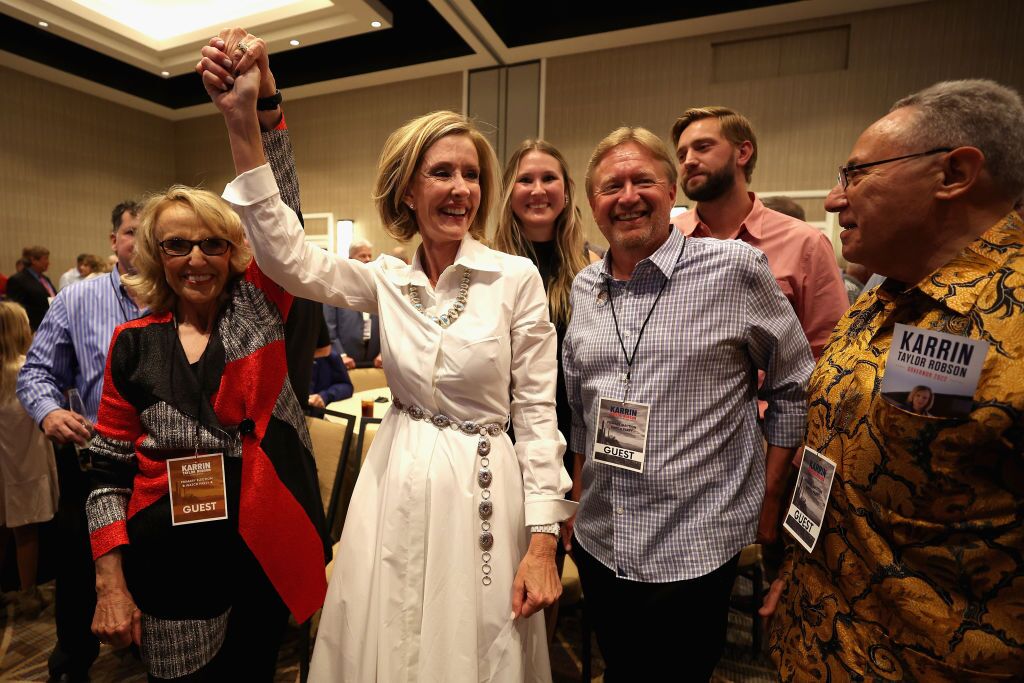
Republican women are not as poorly represented as Black Republicans (the only Black Republican in the U.S. House is stepping down this year), but they face challenges.
Last month, after being attacked by conservative activists like Turning Point USA, Karrin Robson dropped out of the Republican governor’s primary despite early signs of viability.
Republican women senators are retiring at relatively young ages in Iowa (Joni Ernst, age 55) and Wyoming (Cynthia Lummis, age 71), while Republican women governors retiring include Kim Reynolds in Iowa and Kay Ivey in Alabama. With controversies surrounding men like Howard Lutnick, Pete Hegseth and Kash Patel, Donald Trump’s first high-profile firing in this second term this week was Homeland Security Secretary Kristi Noem.
To visualize the problem, see The New York Times‘ summary of how Trump-endorsed candidates did on the March 3 primaries. Of the 30 Republicans he endorsed in competitive primaries on March 3, only three were women. Here’s more on why Karen Robson dropped out of the Arizona governor’s race:
The rejection of Ms. Taylor Robson—whose campaign had been attacked relentlessly from the beginning by Trump allies like Turning Point USA, the conservative group based in Arizona—could also serve as a warning sign for Republicans.
[Kari] Lake went on to lose the general election in 2022 to Katie Hobbs, a Democrat, and Arizona has elected two Democratic senators and a Democratic attorney general and secretary of state in recent years after long being a solidly Republican bastion. The state’s Democratic leadership is widely seen as a product of Republicans nominating candidates perceived as too extreme by a general electorate. Some Republicans fear they are repeating the same mistake this year by elevating Mr. Biggs, a member of the hard-line Freedom Caucus.
LA Charter Commission Recommends Ranked-Choice Voting and More Seats

Hats off to the Los Angeles City Charter Commission and reform allies like Cal RCV on the commission’s decision last week to recommend two changes that RepresentWomen finds help women candidates: going from punishing runoff elections to a single round of election with RCV and increasing seats to create more chances for representatives to work together and represent their constituents. Here’s coverage from LAist:
A city commission on Thursday recommended increasing the size of the Los Angeles City Council from 15 to 25, a change long sought after by advocates who said the panel was too small for a city of nearly 4 million people.
The Charter Reform Commission also recommended moving to a ranked-choice voting system for city elections, a method in which voters choose multiple candidates in order of their preference. If no candidate wins a majority of votes, then the last-place finisher is eliminated and their supporters’ second choice is counted.
Each of those moves would require changing the city’s charter, the basic set of rules and procedures by which the city operates. And any change to the charter would require voter approval. The recommendations will go to the City Council, which will decide whether to place the proposals on the June ballot.
A Big-Tent Approach to Proportional Representation Reform
My husband, Rob Richie, provides a thoughtful overview and sage advice about the future of the growing movement that has been a career-long goal: changing winner-take-all elections in the United States. Read Rob’s piece on the Expand Democracy Substack and this excerpt below—and a thanks to Expand Democracy’s Eveline Dowling for her interview of our Alana Persson on the Democracy Lab podcast last week!
A vision of a multi-party democracy can be attractive, but I’ve learned a lot in my years of advocacy for PR and adjacent reforms like ranked choice voting (RCV) and cumulative voting. In 2023, my wife and reform partners Cynthia Richie Terrell of RepresentWomen coauthored two detailed Fulcrum pieces here (Part 1) and here (Part 2) on our learning in commemorating the 30th anniversary of New Zealand adopting PR. Those analyses are generally consistent with this 2024 analysis by Sightline’s Alan Durning, writings by Steven Hill at Democracy SoS, along with the lead piece Steven and I wrote for the Boston Review in 1998 that became the book Reflecting All of Us.
It’s a theory of change that combines making the national case—with the north star being the Fair Representation Act in Congress—and bottoms-up advances like the great news last week that Newburgh, N.Y., adopted the proportional form of RCV (PRCV) to settle a state voting rights case. It encompasses the work of groups like: More Equitable Democracy in the spirit of the process that led to Portland (OR) adopting PRCV; the conversations among elected leaders and organizations being catalyzed by RepresentWomen; the voting rights litigation by groups like the Campaign Legal Center and Harvard Legal Clinic; and the advocacy at all levels of government by FairVote and Rank the Vote, often with state and local partners. It factors in my experience that reform-minded leaders in legislatures are more likely to support measures to diversify its “big tent” of representatives than embrace a multi-party system that may end the ability of one party to run a legislature on its own.
German Women Opposing Online Hate Speech Banned from U.S.

The New York Times covers a remarkable story of how, in the name of protecting free speech, Secretary of State Marco Rubio has banned German women activists leading efforts to take on online hate speech that is often particularly directed at women. Here are excerpts from its publicly linked story this week:
Secretary of State Marco Rubio announced that Ms. Ballon and her colleague Anna-Lena von Hodenberg were indefinitely barred from traveling to the United States, accusing them of being part of a “global censorship-industrial complex.” If they entered the country, it could have “serious adverse foreign policy consequences for the United States,” Mr. Rubio said….
HateAid is one of Europe’s most influential proponents of social media regulation, which the organization says is critical to reducing online hate and vitriol…. Rooted in the history of the Holocaust, strict laws are in place to prosecute people for publicly insulting others or targeting people based on their race, religion, ethnicity or sexuality… HateAid provides legal support, privacy advice and emotional counseling to politicians, journalists, activists and others who, the nonprofit argues, are being driven from public life by online abuse.
Don’t Look to China for Models of Women’s Leadership

Chinese leaders may not be careening from one military conflict to another, but they provide no model of inclusive leadership. The near-complete absence of women from top government positions is telling. This is from the summary of a December 2023 report from the U.S.-China Economic and Security Review Commission (and no, things haven’t been getting better for women since then):
- According to data from China’s National Bureau of Statistics for 2022, China’s population comprises approximately 689.69 million females and 722.06 million males. Although women represent roughly 48.9 percent of the population, they occupy less than 8 percent of senior leadership positions.
- Leadership turnover following the 20th Party Congress in October 2022 resulted in no women in the Politburo for the first time in 25 years.
- The Chinese Communist Party (CCP) leadership has a stated commitment to equal opportunity but has recently shifted rhetorical focus toward traditional gender norms.
- The absence of women in Party leadership parallels low female representation among Chinese nationals holding leadership positions in international organizations. Of the 39 Chinese nationals serving in top leadership positions in key international organizations, only eight are women.
As a reminder, I will be interviewing noted author Lorissa Rinehart about her book Winning the Earthquake on Friday, March 6 at 7 P.M. at the Politics & Prose at the Wharf—see event details here. It was such a treat to hear Lorissa speak about her book on Jeannette Rankin this week at the American Women’s News Club and chat with former member of Congress Connie Morella, who is pictured below with Lorissa!

Do you know someone who would be interested in this weekly roundup of news stories on women’s representation and democracy? Have them click this link to subscribe to RepresentWomen’s Weekend Reading via email.
Great Job Cynthia Richie Terrell & the Team @ Ms. Magazine for sharing this story.