
On the eve of America’s 250th anniversary, Ms. reclaims the revolution by centering the women and gender-nonconforming people whose words, labor and resistance built—and keep rebuilding—democracy.
Two hundred and fifty years ago, a new nation came into being. Amid the hard-fought war for independence against the British Crown, certain leading men residing in its 13 colonies came together to sign off on a document proclaiming, “All men are created equal.”
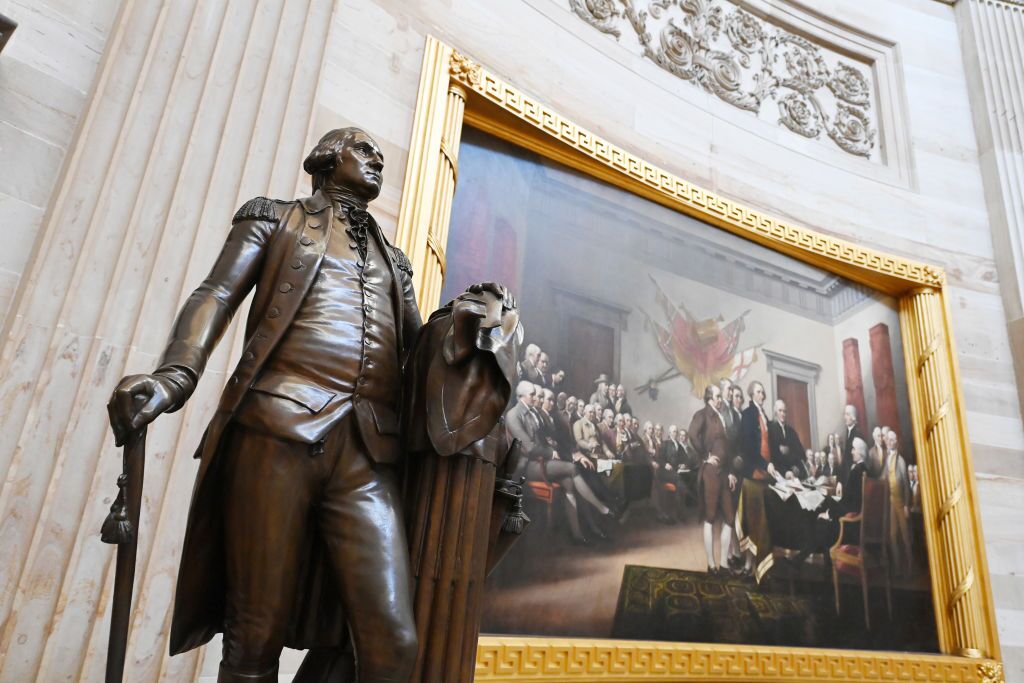
The document would be called the Declaration of Independence—authored by Thomas Jefferson and signed by 56 men now recognized as the nation’s founding fathers, immortalized in John Trumbull’s painting that hangs in the rotunda of the U.S. Capitol.
They had exchanged ideas about liberty, justice, at the height of this Age of Reason; they even thought to add a statement to abolish slavery. However, they eventually decided against it, given the lucrative profits that came from the chattel institution as slaveholding individuals. And the comfort of their domestic abodes, which fell under the purview of their wives and servants, rarely induced a sense of reciprocity and full equality for the ones enabling their material surroundings.
One of the signees—John Adams (who would later serve as the nation’s vice president before succeeding George Washington, the first president of the United States)—had received admonition from his wife Abigail Adams to “remember the ladies” in their declarations for freedom and equality; however, one woman at least ensured that her name would be included on the document: Mary Katherine Goddard from Baltimore, the first woman postmaster in the colonies, printed the official documents and added her name at the bottom in typeset.
Interestingly, Goddard is rarely remembered (if at all) as founding mother in her own right—in contrast to, say, Betsy Ross, whose more feminine, domestic role in sewing the first flag of the new nation secured her position in national memory. However, Goddard’s bold addition of her name to the Declaration of Independence is a prime example of how women throughout history persist and insist on their inclusion. In families. In communities. Even in nation building. Sometimes she held a pen to write her inclusion into existence, even if she remained anonymous or hid under a man’s name (a gender transition of sorts).
… There is no nation without women at its core, ready to advance beyond the strictures and limits of gender and its attending intersections, even if they had to redefine their roles and strive beyond societal expectations
When she did use her own name—“written by herself”—as the enslaved poet Phillis Wheatley did, some dared to question her skill and prowess to call herself, let alone nations and worlds, into being. Despite the restrictions of slavery, Wheatley found freedom first through the pen before her eventual manumission.
And when the enslaved woman could not write—indeed, deprived of this literacy by law, so potent was the knowledge it could produce—she still left a record of her existence. In the Pulitzer-Prize-winning novel Beloved by wordsmith master and Nobel laureate Toni Morrison, the former slave Sethe lamented, “I made the ink”—those indigo marks set to paper that made legible the means of her raced and gendered oppression.
Reaching through history to rescue the obscure women discounted as political subjects, Morrison did with fiction what other feminist historians like Gerda Lerner, Deborah Gray White, Paula Gunn Allen, Darlene Clark Hine, Paula J. Giddings, Kate Clifford Larson, Catherine Clinton, Annette Gordon-Reed, Stephanie M. H. Camp, Martha S. Jones, Keisha N. Blain and Edda Fields-Black, among others, had done with facts and evidence. They told the simple truth that there is no nation without women at its core, ready to advance beyond the strictures and limits of gender and its attending intersections, even if they had to redefine their roles and strive beyond societal expectations.
On this semiquincentennial of the United States, Ms. magazine will explore these politics of inclusion through a series on America’s “Founding Feminists.”
Such an anniversary—set during a time of immense backlash against the progress made in advancing gender equality, racial justice, and various inclusions across gender diversity, sexual orientation, the differently abled and aged, religious, national, and ethnic groups—invites a reckoning with this democratic project that began as a work in progress. We have yet to complete it (even after 250 years) in the quest for a “more perfect union.”
We especially have an opportunity through this series to address these issues from a feminist framework, examining the past to better understand our present and to plan more inclusive visions for our collective future.
So, we ask: What did freedom and equality mean for those in the past—especially when co-existing alongside chattel slavery, Indigenous dispossession, women’s subordination and class hierarchies. Ad what will it mean 250 years from now, or even 50 years from now?
Because the Declaration of Independence left a record stating the potential of equality—regardless of the status of the author and signees as enslavers with unfettered access to both wives and bondspeople in their possessions—it set for the nation a vision of what it could be.
This is the vision that made room for the eventual abolition of slavery and women’s voting rights, even if civil rights leaders like the Reverend Dr. Martin Luther King Jr. chastised the nation for delivering a “promissory note” that African Americans could not deposit when widespread discrimination on the basis of race rendered the Declaration of Independence null and void.
The First Amendment to the U.S. Constitution—which grants freedom of speech, freedom of religion, freedom of the press, and freedom of the right to assemble—gave way to additional amendments, as the growing nation moved towards the promise of equality, with the passage of the 13th Amendment abolishing slavery, the 14th granting birthright citizenship and equal protection under the law, the 19th granting women the right to vote, and the yet-to-be ratified Equal Rights Amendment, penned by suffragist Alice Paul, that would establish gender equality across all spheres.
This existing foundation also made it possible to expand other rights into law: from the Americans with Disabilities Act, to marriage equality across sexual orientations, the latter recognized by the U.S. Supreme Court.
That these rights could still be chipped away—based on the election or appointment of individuals invested less in democracy and more in demagoguery—demonstrate that freedom and equality cannot be taken for granted. We must work toward their promise as “we the people” (or “we the women,” according to Nora O’Donnell) are still very much a work in progress.
In her seminal work, Our Declaration, Danielle Allen declares, “The Declaration of Independence matters because it helps us see that we cannot have freedom without equality.”
We are still, 250 years later, striving for these twin goals. This series helps us to look back at the journey and determine the best direction to take us toward the fulfillment of these goals.
Why “Founding Feminists”?
With its focus on women’s history, the series could easily have been titled America’s “Founding Mothers.” Except some women are not invested in motherhood—at least not the biological kind. History shows that such women have existed across the different eras.
In this series, historian Jen Manion writes of individuals like Jemima Wilkinson who—the same year that the nation came into being—changed their gender identity to take on a genderless persona with a new name: the Public Universal Friend. Revolutions don’t just spawn new nations but new ways of embracing individual freedoms.
Do such historical figures qualify as “feminists” instead of “mothers”?
The word “feminist” did not even exist until the 19th century—as was first used in French to describe someone of a feminine appearance or who exhibited feminine behavior. The word has evolved overtime to describe a person advocating for gender equality—whether this takes on a liberal edge, such as advancing social and political reforms, or the more radical efforts to dismantle systems of power altogether in the weakening and eventual elimination of patriarchy.
Therefore, the term “founding feminist” risks being anachronistic, given our return to the women—those born or transitioned as such—living at a time before the word formulated its political meaning.
Indeed, in the series, Oneida Wolf Clan member Michelle Schenandoah argues that the Haudenosaunee, who based their societal structure around matrilineage and subsequently spawned the democracy we now celebrate today, predates feminism since their gender-based egalitarianism is the standard, not the outlaw status that surrounds feminism within patriarchal societies.
Yet how could we not define those Haudenosaunee as “founding feminists,” given the blueprints they provided to those who found their way on the soil of Turtle Island? Paula Gunn Allen reminds us, “Hardly anyone in America speculates that the constitutional system of government might be as much a product of American Indian ideas and practices as of colonial American and Anglo-European revolutionary fervor.”
In the same essay, Allen recounts the great rebellion of Haudenosaunee women who organized a women’s strike (or sex strike) in 1600, then gained veto powers over wars and conflicts (a North American version of Lysistrata the ancient Greek playwright Aristophanes wrote about and that exists in different versions in more contemporary times—think of the efforts of the Women of Liberia Mass Action for Peace, spearheaded by Nobel Peace Laureate Leymah Gbowee, which brought an end to Liberia’s Civil War in 2003).
The first recognized women’s protest on the North American continent occurred in the same vicinity of Seneca Falls, N.Y., which launched the first women’s rights convention in 1848. That the great liberator Harriet Tubman would settle her life in freedom less than 30 miles away in Auburn, N.Y., suggests that such feminist lineage is more than coincidental.
These time loops connect us through the past, present and future. If only we remember.
Feminist Formations in a Time of Revolution
As Allen suggests, these early Indigenous influences provide “the same vision repeated over and over by radical thinkers of Europe and America, from Francois Villon to John Locke, from William Shakespeare to Thomas Jefferson, from Karl Marx to Friedrich Engels…”
The Age of Reason, or Enlightenment, which imagined social contracts, natural rights, and equality beyond divine monarchical rule, flourished in the wake of European contact with the Americas. Will we remember the “founding feminists” who planted these democratic seeds?
Some of our founding feminists also wrote letters, like Abigail Adams, or manifestos—as occurred across the Atlantic with French abolitionist feminist Olympe de Gouges and her Declaration of the Rights of Woman and of the Female Citizen (1791) and English abolitionist feminist Mary Wollstonecraft with A Vindication of the Rights of Women during this Age of Reason and Revolutions. They wrote specifically at the height of the French Revolution, triggered after France’s support of the American Revolution, which left the country financially bankrupt.
Other founding feminists presided over religious ceremonies, like the Vodou mambo—sometimes identified as Cecile Fatiman—who helped to ignite the enslaved uprising on the island of San Domingue, which became known as the Haitian Revolution (or the War for Haitian Independence). That this uprising took place in 1791 while European women simultaneously issued feminist statements suggests a transatlantic relational bond that must be interrogated for their cross-racial feminist potential, which extends to other women breaking their chains—such as Solitude, the Guadeloupean rebel (recently commemorated in Paris with a monument in 2022) who resisted slavery’s return on the Caribbean island in 1802 after Napoleon issued its reinstatement post-Revolution.
In the Founding Feminists series, historian Vanessa M. Holden notes how founding feminists also left their mark through freedom-seeking actions, such as those Black women who escaped slavery during the Revolutionary War period, from Elizabeth Freeman who successfully sued for her freedom, to enslaved Black women running to the British lines on the promise of freedom, to Ona Judge who boldly fled from her enslavement by George and Martha Washington.
In our myth-making national narratives, few will remember Judge’s history alongside President George Washington.
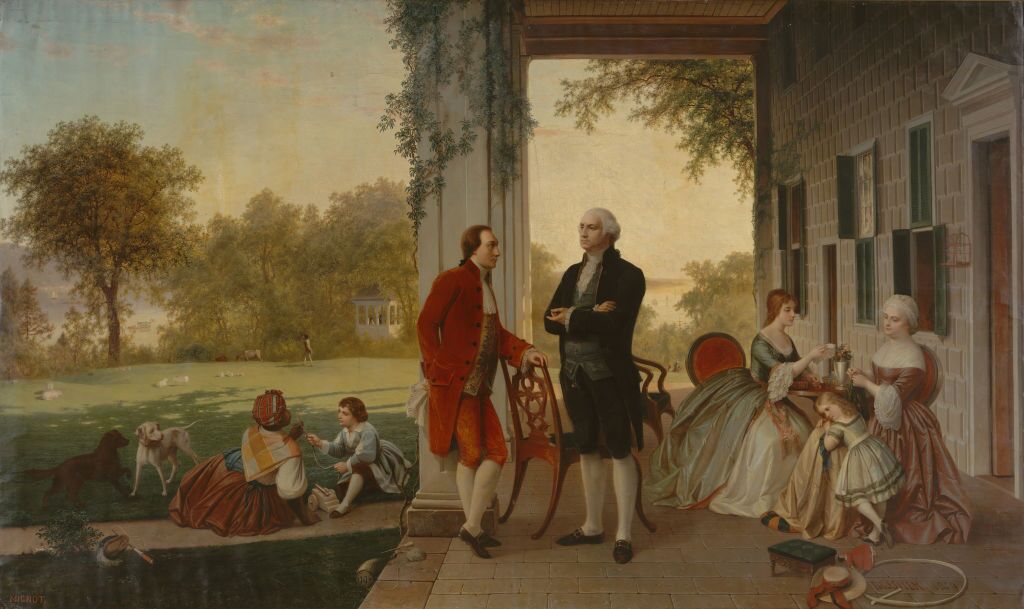
In their 1859 painting of Washington at his home in Mount Vernon, which hangs at the Metropolitan Museum of Art, Thomas Pritchard Rossiter and Louis Remy Mignot establish the raced and gendered hierarchies: Washington and Lafayette standing at the divide between the private sphere of home and the public sphere of the exterior yard, while the white women and girl child are seated within the domestic realm, the Black woman in a literal lowered position on the ground, alongside the pet dog, while she tends to the white boy child—the latter in the yard and prepared to explore the public sphere, in comparison to his sister on the verandah consigned to her eventual domestic status.
The painting appeared at a time of great political divide between pro-slavery and anti-slavery advocates, two years before the start of the Civil War. The painting creates by contrast the domestic tranquility of women—both free and enslaved—knowing their “rightful place.”
Even then, the painters could not imagine the existence of an Ona Judge, who when the moment came, chose freedom for herself by running away with the help of the free Black community in Philadelphia, as Holden documents. It is this imagination—once called an “imperial queen” by Phillis Wheatley (Peters), as Dana Ellen Murphy reminds us in her essay for the series—that artist Nettrice Gaskins galvanizes with some generative AI technological enhancements to conjure the series frontispiece artwork, Founding Feminists.
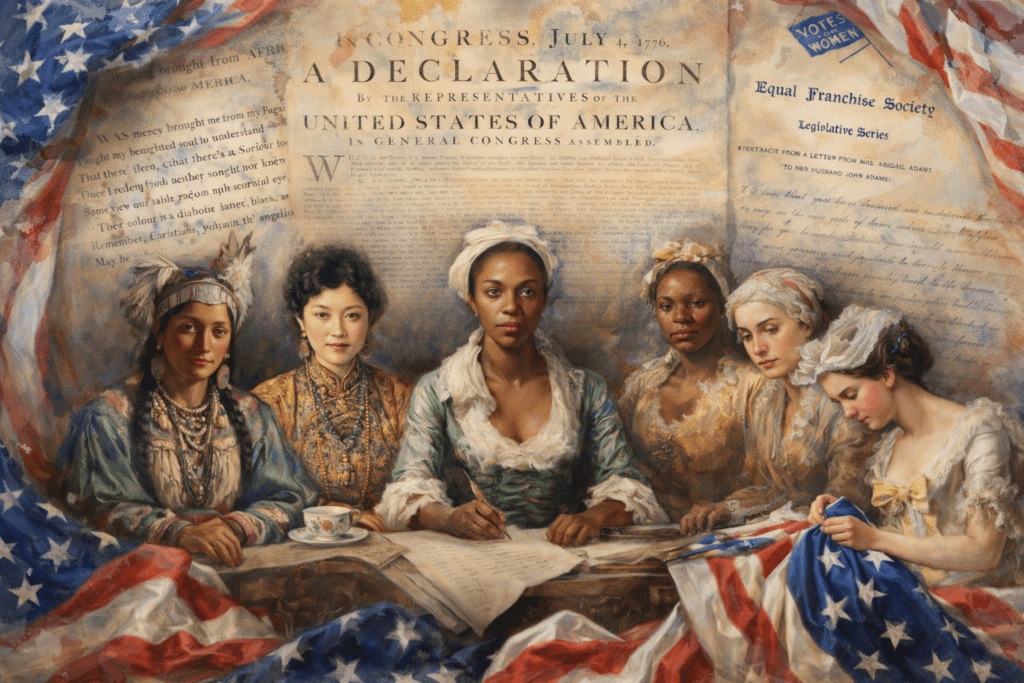
Having captured a similar portrait rendering Harriet Tubman among the stars for her 200th birthday in our previous series for The Harriet Tubman Bicentennial Project, Gaskins reconfigures Trumbull’s painting to reimagine those originally excluded now having a literal seat at the table.
A Phillis-like writer sits at the center while an Indigenous woman and a Betsy Ross-like woman sewing the US flag take a seat at either end. The vision imagines a multiracial collective of women—including an Asian woman whose complicated inclusion in the U.S., from the spectacle of Afong Moy, to the exclusion of Chinese women in the Page Act of 1875, to Patsy Mink breaking barriers as the first woman of color elected to Congress who also authored Title IX, perpetually questions the meanings of national belonging.
These imagined women—less the “imperial queens” of Phillis Wheatley’s imagination and more the “democratic divas” of our contemporary digital dreams—assemble in a bold vision of what has already existed and what must continue as we build on the foundations they have already laid.
The series, launching at the start of Women’s History Month, unfolds over two months, and features 12 articles.
We begin with Schenandoah’s “Haudenosaunee Governance: Matrilineal Legacies and Democracy from Turtle Island,” which recognizes the Indigenous roots of U.S. democracy and argues that it is incomplete precisely because of its “foundational omission” of the values outlined among the matrilineal Clan nations, notably “women, children, all genders and peoples, the natural world, and the generations yet to come.”
Following is Allyson M. Poska’s article on the legacy of Spanish-speaking women, who settled on the continent more than half a century before the establishment of English settlements, a history that contradicts the targeted deportations of Latinas currently taking place and that reminds us this is “their country too,” as was already heightened with Bad Bunny’s halftime show earlier this year, and before him, Lin-Manuel Miranda’s literal recasting of the founding fathers through the multiracial hip-hop generation in his Broadway musical Hamilton.
Charles Upchurch’s “Claiming the Revolution: Sexual Politics and 1776” provides the wider historical context for the development of the Revolutionary period and how it generated new ideas about gender and sexuality, while Murphy ruminates on the poetic legacy and “imagination” of Phillis Wheatley (Peters), who became the first African American of any gender to publish a book of poetry.
Jacqueline Beatty explores how women of the period petitioned for their rights, using the language of traditional femininity, and argues for its radical potential—rather than its retrenchment.
Manion, as previously mentioned, examines “queer possibilities” during the era, when those born as women found opportunities to change genders and engage in same-sex relationships at a time when social upheavals allowed for social change.
Holden examines these themes of freedom through the history of Black women changing their status from enslaved to free.
Jessina Emmert looks specifically at the legacy of Sally Hemings—the enslaved mother of six of Thomas Jefferson’s children—and argues for her status as the nation’s Founding Mother because of the “reproductive governance” she exercised to ensure the freedom of her children, if not for herself, thereby putting into practice the goals of freedom about which her enslaver emphatically wrote.
Manisha Sinha, author of the award-wining The Slave’s Cause, details “The Abolitionist Origins of American Feminism,” while Anne Anlin Cheng explores “The Curious Case of Afong Moy,” a pop-culture figure believed to be the first Chinese woman to enter the United States. A conversation with feminist disability studies scholar Rosemarie Garland-Thomson examines the significance of making the category of “disability” visible in these histories, and Nimisha Barton, a historian on the subject of diversity, equity and inclusion, closes out the series with a reminder that our own contemporary period of regression is an echo of the past in “Educating Women: A History of Elevation – and Backlash.”
In all, the series articles illuminate and interrogate the meanings of inclusion across the intersections of gender, race, class, sexuality, nationality, and disability among other social factors. They reveal untold stories and re-examine the more well-known ones. They center those who otherwise were excluded from the original documents founding this nation. In this way, they help us to commemorate the feminist foundations on which a more inclusive feminist democratic future can emerge.
Other features include a timeline, public syllabus, and interactive haiku. The public haiku is included to invite readers to imagine what our future will be, beginning with the opening line “Fifty years from now…” Does U.S. democracy have another 250 years, or have we reached a point of no return as “strongman” politics with fascistic tendencies advance globally? How might we recapture a different vision as we move forward during this semiquincentennial?
A political cartoon from 1897 once depicted a “Future Inauguration,” articulating the fears of the supposed logical outcome of the women’s suffrage movement: one in which women have assumed positions of power while men are busy taking care of the children. (The horror!)
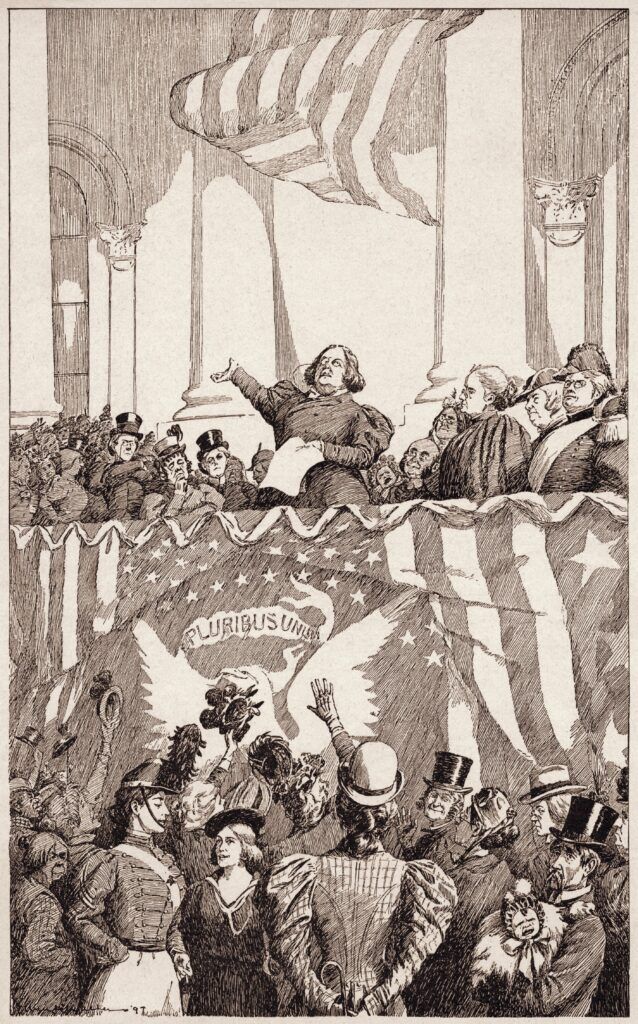
As dated as this vision seems, such fears recirculated when the nation came close to electing a woman for president of the United States—first with Hilary Rodham Clinton who won the popular vote back in 2016, then with Kamala Harris who won 75 million votes in 2024 but came up short, both losing to a man who ran on openly sexist and racist campaigns. These fears, therefore, hardly seem outdated, as we are currently where we are because the nation failed to imagine and trust women’s leadership.
We certainly have made ardent strides in the past 250 years, but where we go from here is anyone’s guess. Let us hope that we remember and recall the founding feminists who left us a guide as we plan our next moves for this ongoing and unfolding democracy.
Great Job Janell Hobson & the Team @ Ms. Magazine for sharing this story.