

LOUISVILLE, Ky.—Nearly a foot of snow has melted. The deep freeze that sent temperatures across the region plummeting to below zero has warmed to a balmy 55 degrees on a sunny February day.
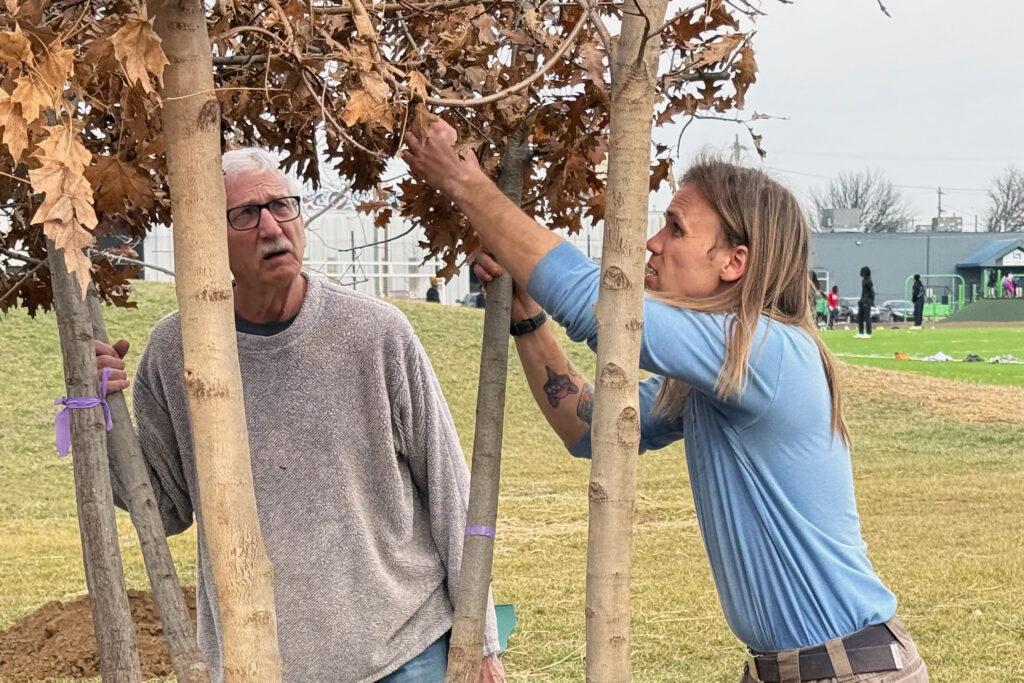
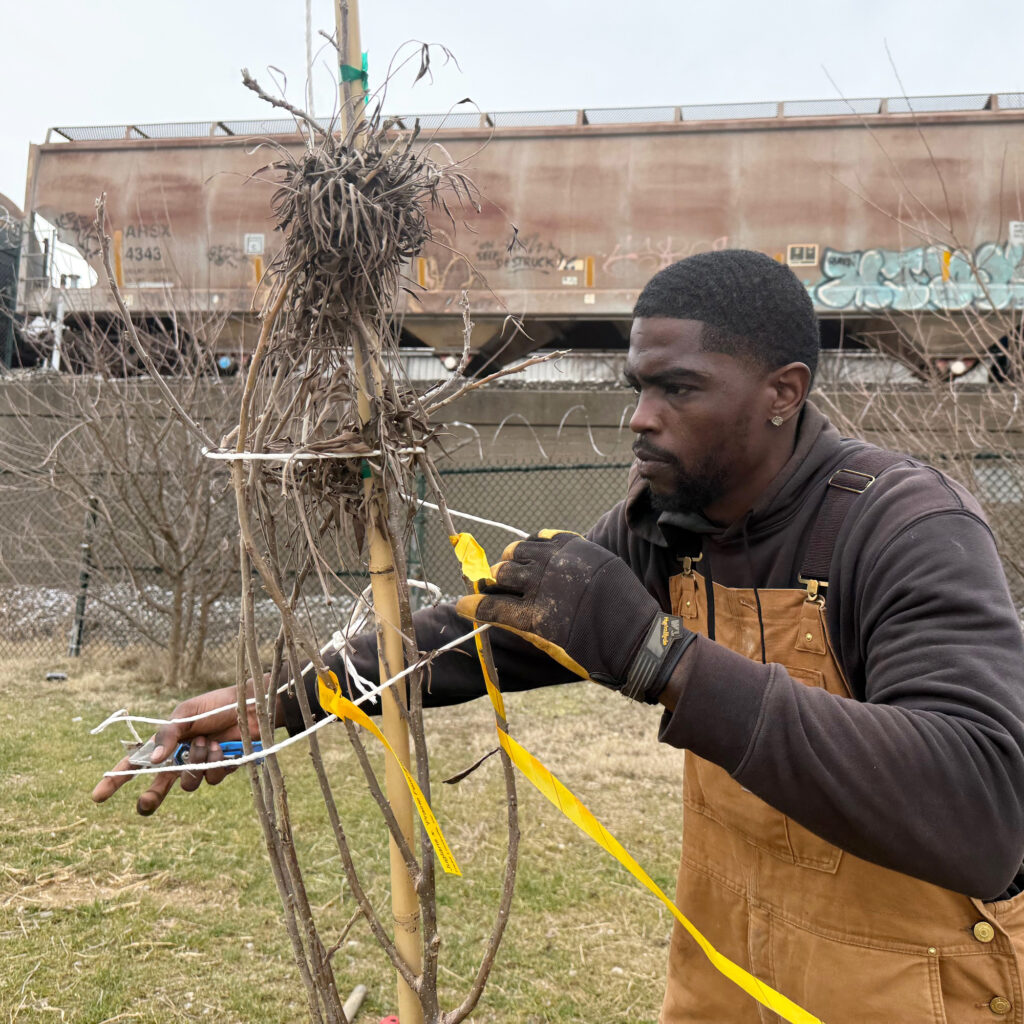
As Matt Thomas augers a three-foot-wide hole into the ground at a city park in the shadow of downtown, Mike Hayman lets out a small groan when the cork-screw turns up reddish-colored clay where one of a dozen oak trees from Arkansas is about to be planted.
“I’m sure they can handle our cold,” said Hayman, the special projects manager for TreesLouisville, a nonprofit that’s planted or given away for planting 25,000 trees since it launched a decade ago. “But will they do well in our clay soil?” With Louisville’s humidity in the summer, he said, “there’s also more risk of fungal disease.”
Still, to Hayman and his colleagues at TreesLouisville, the risks are worth it and the potential rewards are huge. In recent months, the group brought to Louisville 60 young trees from nurseries in Arkansas and Georgia as part of a local experiment in what arborists and foresters call “assisted migration.”
As humans continue to heat the planet with greenhouse gases, potentially locking the Earth into a “hothouse” trajectory, according to new research, scientists worry that nature won’t be able to keep up with climate change.
“Forests have migrated and adapted to long-term changes in climate over thousands to millions of years; however, natural migration rates and adaptive responses of tree populations cannot match the rapid pace of current climate change,” according to a U.S. Forest Service study published in 2024. Relying on locally sourced trees for planting “may no longer be adequate.”
In Louisville, assisted migration involves planting tree species native to the area, such as the mighty bur oak, which can grow to over 100 feet tall, but sourcing them from further south and west in their North American range. Some species are different there, more suited to a hotter and harsher environment.
Assisted migration in Louisville can also mean planting tree species that are not native locally, such as the smaller but beautiful Lacey oak, with its delicate bluish-green foliage, from seed sources in Texas.
In either example, the idea is that these Southern-sourced trees from hundreds of miles away are likely to be better suited to the climate conditions anticipated in Louisville’s Ohio River Valley in 50 to 100 years.
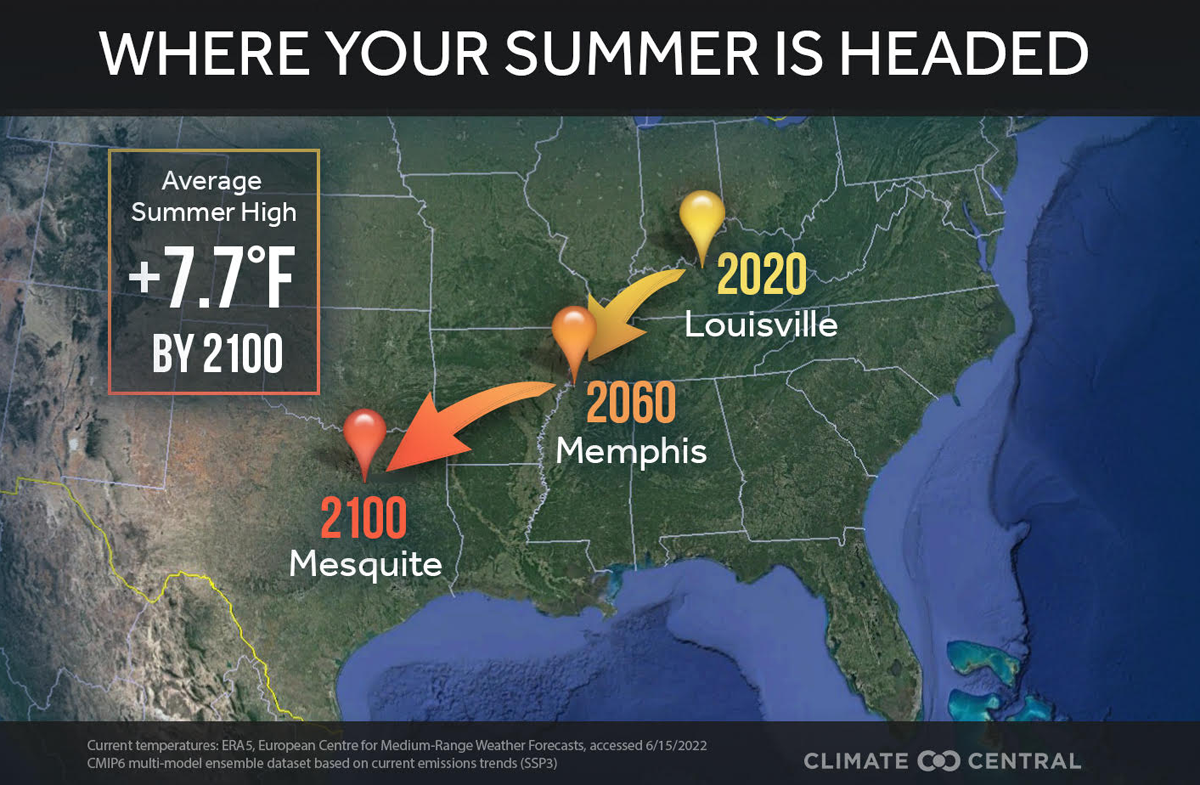
Experts have said that Louisville by 2100 could be much more like today’s northeast Texas.
Sixty years out, average summer temperatures in Louisville could be nearly 8 degrees warmer, the New Jersey-based nonprofit science and communication group Climate Central has projected. In such a climate, trees will be increasingly important for the many ways they benefit communities, including shade, said Cindi Sullivan, the executive director of TreesLouisville.
“One of our adages is, it’s not just about the trees, it’s about the people and improving the quality of life and the health of this community,” she said.
Studying Assisted Migration
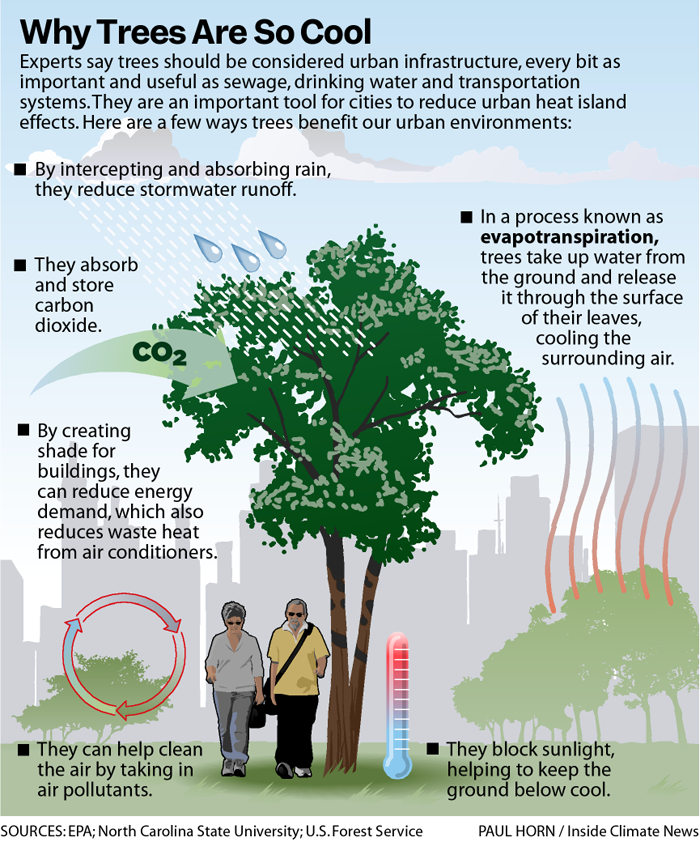
Trees are carbon sinks, absorbing and storing carbon dioxide, a major heat-trapping gas. In cities, they soak up rain, taking pressure off stormwater management systems while reducing flooding and polluted runoff. They also help clean the air while cooling neighborhoods.
But climate change threatens trees through intense heat, extended drought and other severe weather. Urban trees also face some of the harshest growing conditions, their roots constrained by sidewalks and fed by water contaminated with salt and other pollutants, their branches hemmed in by power lines.
The science and practice of assisted migration as a way to offset the effects of climate change on urban or rural forests has grown in the last decade, said Christopher Riely, a research associate and forestry specialist at the University of Rhode Island.
He helped introduce some trees from Maryland into a forest owned by the city of Providence for that purpose. He is now participating in a U.S.-Canadian study looking at how to help forests adapt to climate change, a collaboration called the Adaptive Silviculture for Climate Change Network, which has been supported in part by the U.S. Forest Service.
The research is occurring at 14 sites from Rhode Island to British Columbia, all of which incorporate some aspect of assisted migration. The peer-reviewed scientific journal BioScience this month published a 10-year review of that long-running study, and the authors wrote that assisted migration “is becoming a common forest adaptation practice.”
It shows promise, but the science is still developing, Riely said.
“We need to test it,” he added, “and that’s what we’re doing to see how well it works. There’s a lot about climate change that’s depressing, and with forest adaptation, forests have the potential to be part of the solution, keeping them around for their climate benefits, but also, they’re stressed by climate themselves, so [we’re] trying to help them adapt.”
This story is funded by readers like you.
Our nonprofit newsroom provides award-winning climate coverage free of charge and advertising. We rely on donations from readers like you to keep going. Please donate now to support our work.
Plant Hardiness Zones on the Move
Weather data illustrates how Louisville’s climate is already changing, like it is globally, with significant warming since 1970.
But it can still get cold, so arborists have to be thoughtful in the kinds of trees they decide to move north. This winter’s polar vortex fueled a deep freeze in January that dropped temperatures across the Louisville region to below zero. Summers are getting hotter, too, according to Climate Central, whose research includes studying climate change at the local level.
Louisville is not unusual.
In fact, plant hardiness zones—based on the coldest temperatures of the year and used by gardeners, farmers and arborists to select suitable flowers, shrubs and trees—have been moving northward in much of the country.
Of the 243 U.S. locations Climate Central analyzed, two-thirds have already shifted to warmer planting zones since the 1950s. With continued heat-trapping pollution, Climate Central expects 90 percent of locations to shift by the middle of this century.
Like most urban areas, Louisville is also affected by the urban heat island effect, where buildings and pavement in urban centers can elevate temperatures by 10 or more degrees, compared to surrounding suburban or rural areas. Fifteen years ago, a Georgia Tech professor, Brian Stone, identified Louisville as having one of the most significant urban heat island problems in the country, prompting local and national media attention.
His findings spurred tree advocates and city officials to take a close look at the city’s long-ignored tree canopy. Louisville was losing 54,000 trees a year at that point, and it had stark tree-cover disparities between poor and wealthy neighborhoods, where health and life spans are also widely divergent. Tree cover by neighborhood can vary from as low as 5 percent to over 70 percent, according to the city’s 2025 urban forest master plan.
Given the impact of heat on public health, tree advocates pushed the city to do better and won modest improvements in tree ordinances and policies.
Countering Tree Canopy Disparities
Out of this, TreesLouisville emerged a decade ago. In addition to the 25,000 trees it has planted or given away, the city and other organizations have planted thousands more. Much of the focus has been on neighborhoods with the fewest trees.
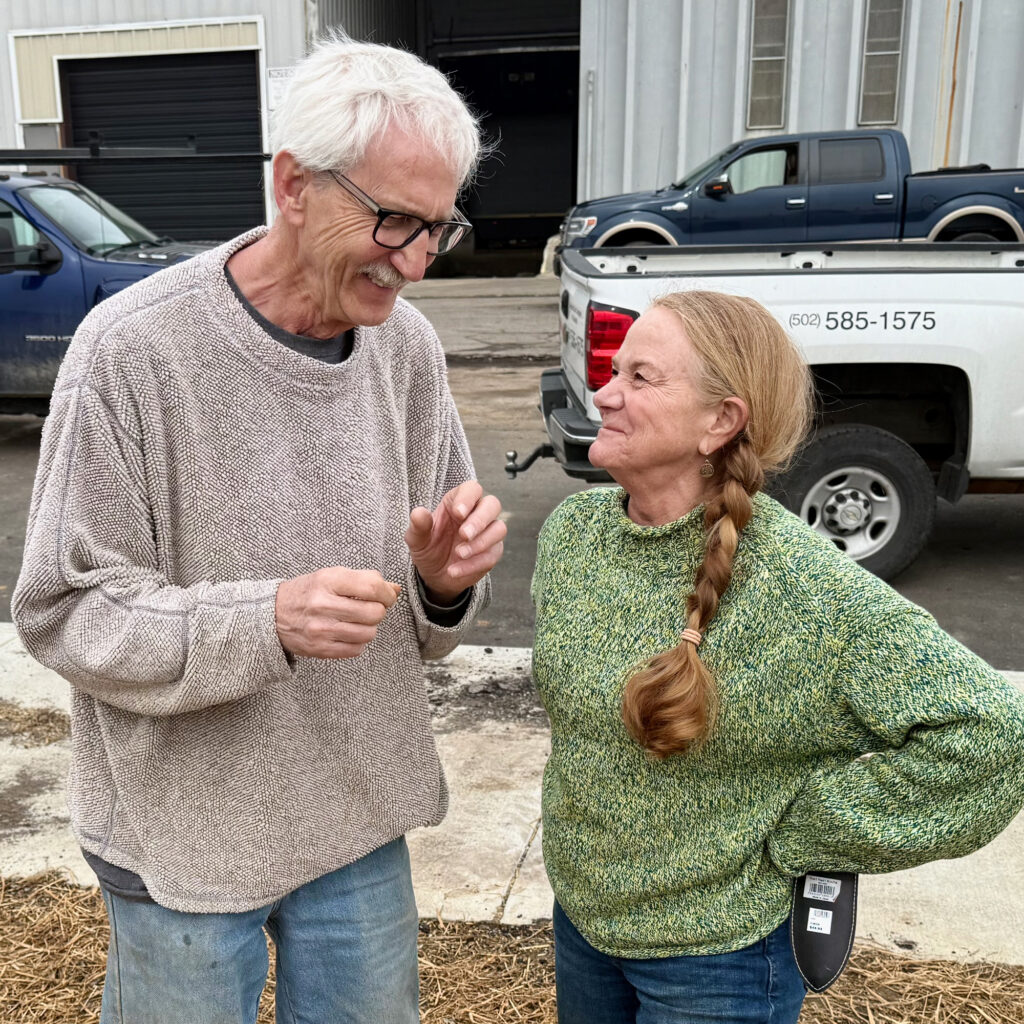
Sullivan, TreesLouisville’s executive director, said the assisted migration program was launched in part because of students at the University of Louisville working with the nonprofit as interns. “They were concerned about climate change,” she said.
Hayman, who retired as a staff photographer from The (Louisville) Courier-Journal newspaper staff 14 years ago, helped launch the program. He has been something of a one-man Civilian Conservation Corps in Louisville for decades, spearheading the planting of a plethora of trees. He said he already had connections with Southern nurseries and had been purchasing some of their trees, so formalizing an assisted migration program was a good next step.
The program is designed as an experiment, but one with a practical goal: Developing a local commercial market in nurseries for trees that are better adapted to a future Louisville. TreesLouisville will track each of the 60 trees they plant this winter in the coming years to see which ones flourish, while also noting their soil and site conditions and the weather. The group plans to collect seeds and experiment with grafting—joining two plants together—for future propagation.
The special trees are going in the ground at various locations, from New Walnut Street Park, where the dozen oaks were planted recently, to Cave Hill Cemetery, which doubles as an arboretum and is the final resting place for Louisville notables such as Col. Harland Sanders, founder of Kentucky Fried Chicken, and boxing legend Muhammad Ali. Olmsted Parks Conservancy, which helps Louisville steward a network of 17 parks and six parkways designed by noted landscape architect Frederick Law Olmsted Sr., is also planting some of the Southern-sourced trees.
The selected trees are species doing well now in either Georgia or Oklahoma, Hayman said.
“So if they are doing well there now, they will do well here in a hundred years, temperature-wise,” Hayman said.
“The Georgia nurseries are hotter and more humid than we are,” he said. “The Oklahoma nursery is hotter, with more extreme temperature swings,” such as 80 degrees in one day, he said. “That really fakes out a tree,” he noted, but these species are used to handling it and should be able to live “in the most difficult sites you can imagine.”
In addition to the Southern oaks, other tree species that are part of the TreesLouisville program include a Caddo sugar maple native to the hot, dry canyons around Caddo County, Oklahoma, a variety of Southern black gums and a water hickory that evolved to tolerate the hot, humid conditions of the lower Mississippi River Valley.
Hayman said he’s pleased to see the assisted migration program take off, along with the progress Louisville has made since it recognized it had a major urban heat and tree problem. But he said he’s impatient for more: “I’m 79 years old. I’d like it to speed up.”
About This Story
Perhaps you noticed: This story, like all the news we publish, is free to read. That’s because Inside Climate News is a 501c3 nonprofit organization. We do not charge a subscription fee, lock our news behind a paywall, or clutter our website with ads. We make our news on climate and the environment freely available to you and anyone who wants it.
That’s not all. We also share our news for free with scores of other media organizations around the country. Many of them can’t afford to do environmental journalism of their own. We’ve built bureaus from coast to coast to report local stories, collaborate with local newsrooms and co-publish articles so that this vital work is shared as widely as possible.
Two of us launched ICN in 2007. Six years later we earned a Pulitzer Prize for National Reporting, and now we run the oldest and largest dedicated climate newsroom in the nation. We tell the story in all its complexity. We hold polluters accountable. We expose environmental injustice. We debunk misinformation. We scrutinize solutions and inspire action.
Donations from readers like you fund every aspect of what we do. If you don’t already, will you support our ongoing work, our reporting on the biggest crisis facing our planet, and help us reach even more readers in more places?
Please take a moment to make a tax-deductible donation. Every one of them makes a difference.
Thank you,

Reporter, Southeast
James Bruggers covers the U.S. Southeast, part of Inside Climate News’ National Environment Reporting Network. He previously covered energy and the environment for Louisville’s Courier Journal, where he worked as a correspondent for USA Today and was a member of the USA Today Network environment team. Before moving to Kentucky in 1999, Bruggers worked as a journalist in Montana, Alaska, Washington and California. Bruggers’ work has won numerous recognitions, including best beat reporting, Society of Environmental Journalists, and the National Press Foundation’s Thomas Stokes Award for energy reporting. He served on the board of directors of the SEJ for 13 years, including two years as president. He lives in Louisville with his wife, Christine Bruggers.
Great Job By James Bruggers & the Team @ Inside Climate News for sharing this story.