

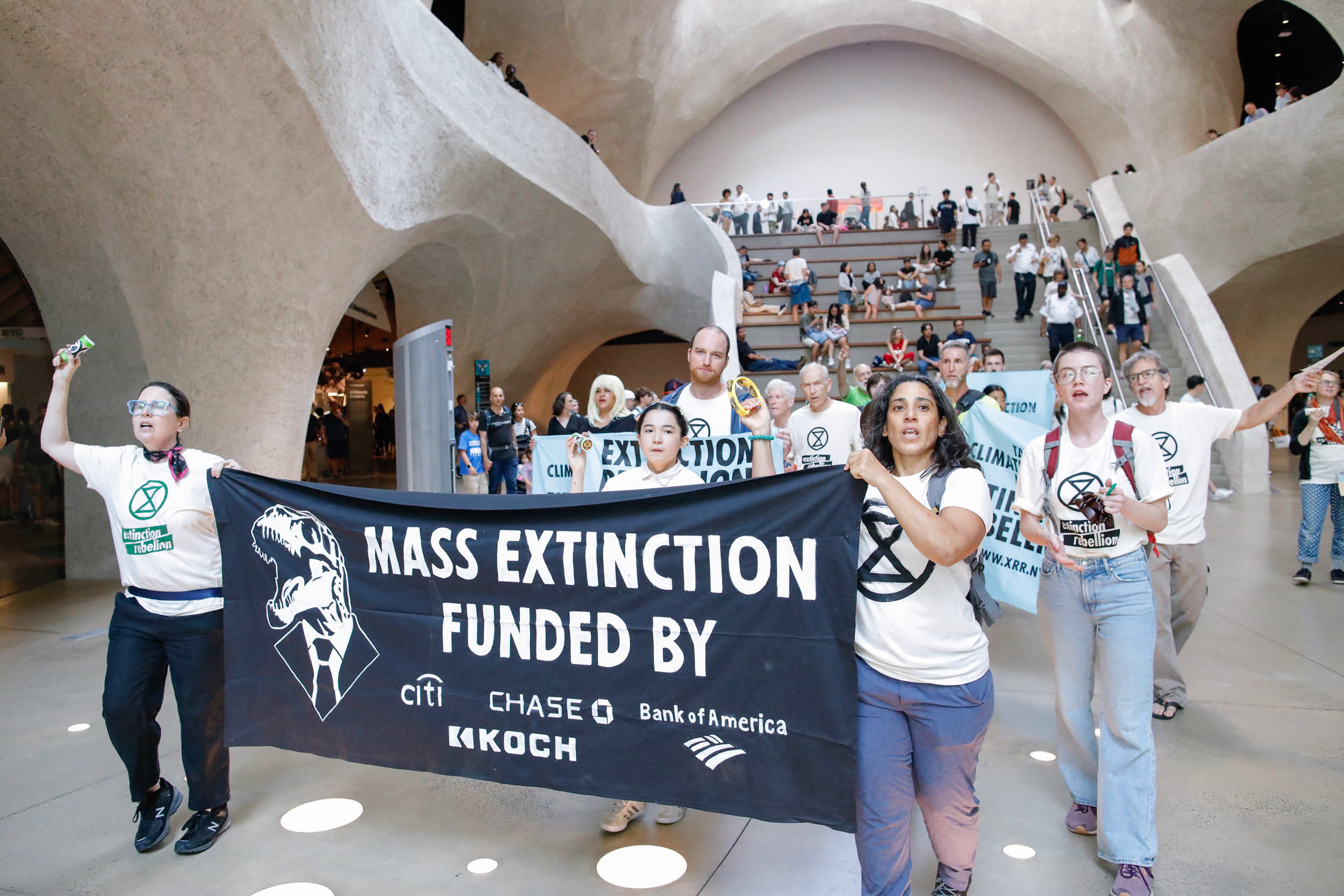
NEW YORK CITY—The group in the Brooklyn studio seemed harmless. There was a graduate student, a Yiddish teacher, a hairdresser. Fifteen people had gathered on a Wednesday night for a training offered by Extinction Rebellion NYC and Climate Defiance, two climate activist groups that engage in nonviolent civil disobedience and theatrical protest.
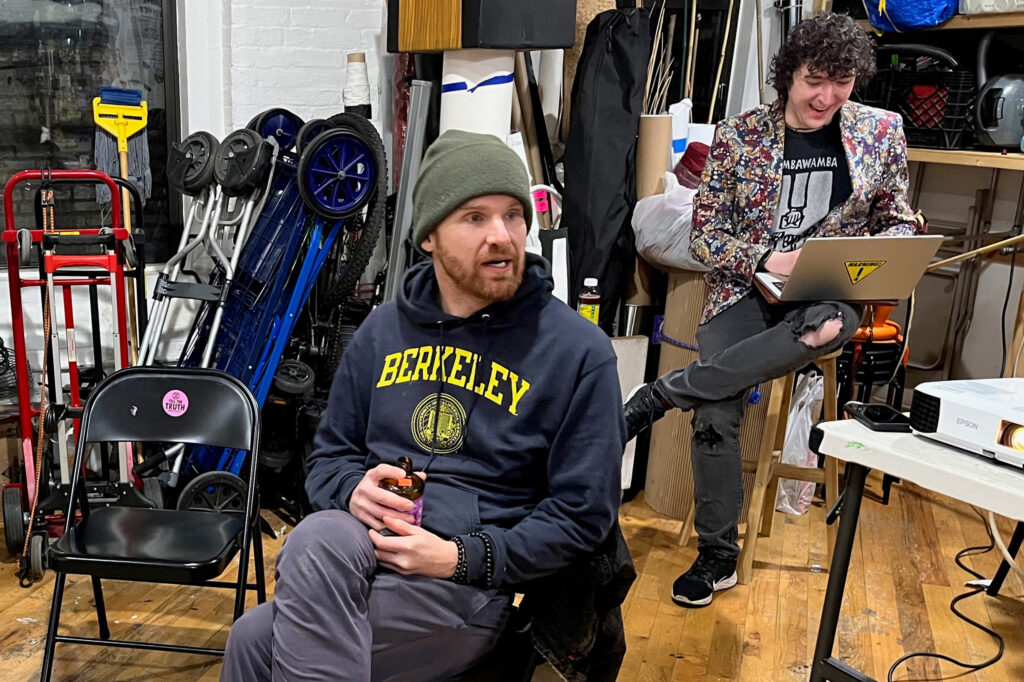
They sat in metal folding chairs eating pizza, surrounded by banners and art supplies, discussing how to gain a crowd’s attention without prompting immediate boos.
Yet their actions have apparently drawn the attention of federal counterterror investigators. Last month, an FBI agent arrived at the door of a former member, who was not at the Brooklyn meeting, saying she had questions about Extinction Rebellion.
Environmental activists have long drawn scrutiny from the FBI. But the recent visit appeared to place this group on the leading edge of the Trump administration’s use of law enforcement against what many civil liberties advocates say are constitutionally protected acts of protest and free speech.
After last year’s killing of conservative activist Charlie Kirk, President Donald Trump issued a national security memorandum titled “Countering Domestic Terrorism and Organized Political Violence.” The memo asserted that the killing and other attacks, such as the attempted assassination of Trump and the slaying of a health care executive in 2024, were “a culmination of sophisticated, organized campaigns” designed to intimidate and influence public policy.
It linked these acts with “anti-Americanism, anti-capitalism, and anti-Christianity,” among other views, and directed the FBI’s Joint Terrorism Task Forces to “coordinate and supervise a comprehensive national strategy to investigate, prosecute, and disrupt entities and individuals engaged in acts of political violence and intimidation designed to suppress lawful political activity or obstruct the rule of law.”
Many civil liberties advocates viewed the memorandum as an overly broad assault on political opposition, and it came as the Department of Homeland Security deployed increasingly aggressive tactics against people observing and protesting immigration raids.
Now, the FBI visit may be a sign the Department of Justice is broadening the administration’s scope, said Dana Fisher, director of the Center for Environment, Community and Equity at American University.
The name of the agent the activist said visited his home matches that of one who was part of the New York Joint Terrorism Task Force as recently as 2023.
“What we’re seeing right now is growing autocracy in our country,” Fisher said.
Days before the New York activist received the FBI visit, Harmeet Dhillon, assistant attorney general for the Justice Department’s civil rights division, posted to X that her office would investigate whether Climate Defiance had broken federal law. The group had recently disrupted a public event held by a congressman at a Long Island synagogue. Last year, several activists in the Boston area, most of whom are members of an Extinction Rebellion chapter there, received visits from people who said they were FBI agents.
The Justice Department referred questions for this article to the FBI, which said, “In keeping with Department of Justice policy, the FBI can neither confirm nor deny conducting specific investigations.”

Nate Smith, who led the Brooklyn training and is one of Extinction Rebellion NYC’s core organizers, said the involvement of a federal counterterrorism agent has shaken some members.
“It has created what it intended to, which is fear,” said Smith, who is also active with Climate Defiance. Some members have been losing sleep, he said, and are haunted by the recent killings of observers Alex Pretti and Renée Good by federal immigration officers in Minneapolis in January.
“We don’t know what these people are capable of,” Smith said.
“They Could Ruin My Life”
The training started with a grounding exercise. One activist led the circle through a series of stretches and deep breaths. People introduced themselves and said why they were there—to find community, to learn how to use their voice.
Extinction Rebellion NYC rents the small studio in an old industrial building in Brooklyn to use for events and making banners. The room’s vaulted brick ceilings and clutter of signs, posters and printing equipment give it the feel of an artist’s workspace.
Sitting in the back of the room, wearing a U.C. Berkeley hoodie and forest green beanie, Smith walked the group through some of what he saw as his more successful events, including the disruption of a Broadway play and a Columbia University panel that featured an oil executive. They watched video and broke down European activists’ infamous splattering of soup on a Vincent van Gogh painting, noting what worked and what didn’t. (While the frame was apparently damaged, the painting itself was protected by glass.)
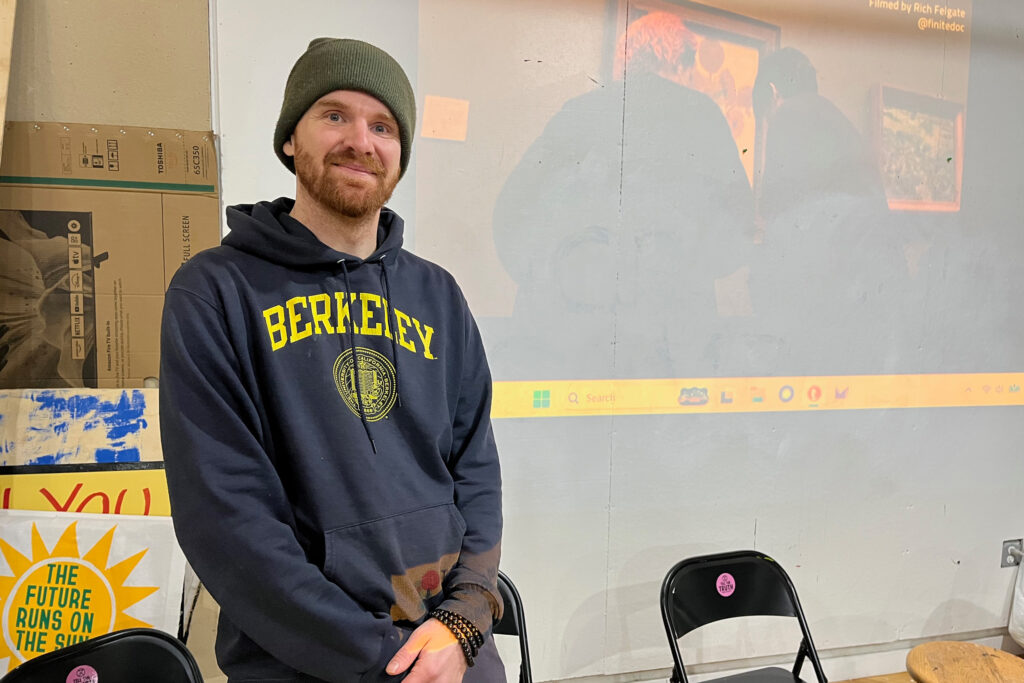
Over the last year, Smith has been pushing the groups to focus on the Trump administration more directly, he said, to highlight its systematic dismantling of climate and environmental policies.
In July, Smith was one of several activists who interrupted a public event at a synagogue in the Hamptons featuring Lee Zeldin, the EPA administrator. News had just leaked that the agency was about to announce its plan to repeal the endangerment finding, which underpinned federal limits on greenhouse gas emissions. At the synagogue, the activists stood up one by one, criticizing that move, saying Zeldin was destroying communities and calling him a monster. One attendee attacked Smith with a chair before he was escorted out.
Most of the time, Smith said, Extinction Rebellion and Climate Defiance do not break any laws. Other times they intentionally commit misdemeanors to get arrested, blocking traffic or staging sit-ins at banks.
Even then, the groups are avowedly nonviolent and take steps to avoid damaging property, like using washable paint. Extinction Rebellion NYC’s chief demand is that government “tell the truth” and declare a climate emergency.
Extinction Rebellion NYC is autonomous from other chapters around the country and the world. It has a couple of dozen core members, according to Smith and another organizer, Henry Pratt, with a group of 100 or so who might show up to any action.
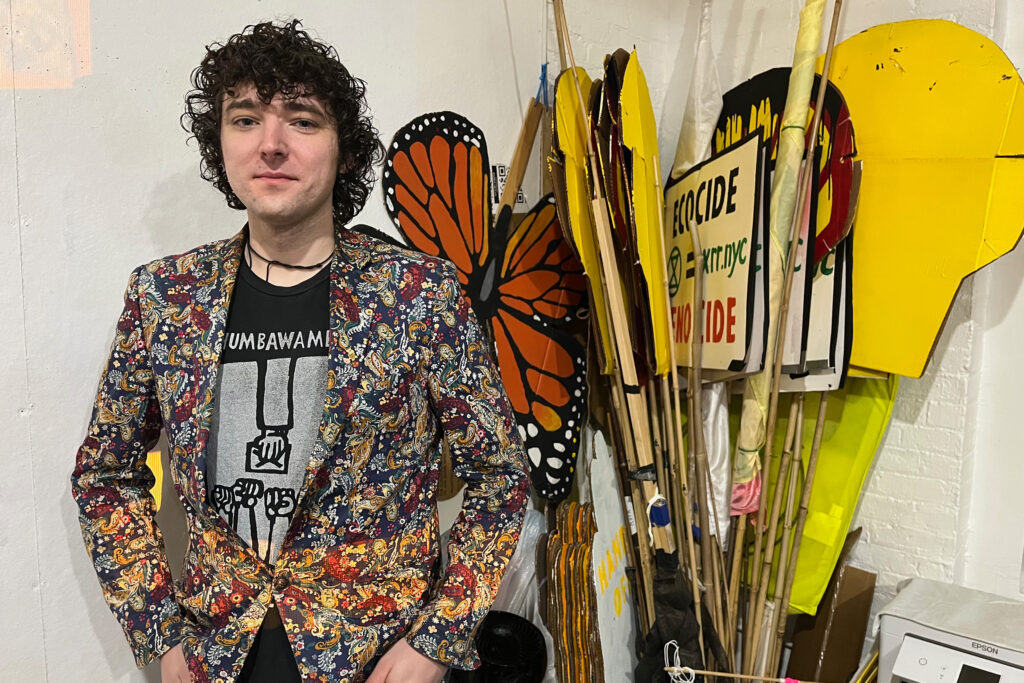
It was January when a former member, who is no longer active with the group and lives in upstate New York, got a phone call from a woman identifying herself as an FBI agent. The man, who asked not to be identified to avoid getting doxed, thought she was a scammer. She said she was outside his home, he said, but gave an address where he no longer lived.
A couple of weeks later the man was having breakfast when the woman arrived at his current address with another man. She showed her badge, identified herself as an FBI agent and said he wasn’t in trouble but that she wanted to talk about Extinction Rebellion.
The man said he couldn’t help them and immediately called a lawyer, Ron Kuby, who has represented Extinction Rebellion members.
“This appears to be in its very early stages, whatever this is,” said Kuby, who found an online video featuring the agent that identified her as working on counterterrorism. Investigators probing activist groups will often start with former members, Kuby said, “because those people are more likely to talk to you.”
The man who received the visit said he was stunned. Within a few days, Extinction Rebellion NYC leaders had spoken with Kuby, who stressed how serious the situation was. If it led to an indictment, the process could prove extremely expensive, Kuby said, even though his clients hadn’t violated federal laws.
“That really was scary,” the man said. “I was like, ‘Oh my god, this is really, really serious. They could ruin my life.’”
It turned out that last year several activists in the Boston area had similar experiences. Nathan Phillips, an ecology professor at Boston University, received a call at work one day from his wife, who was home, saying someone identifying themself as an FBI agent had showed up at their door. Phillips’ wife told the agent he was at work. The agent never followed up.
Phillips called the local FBI field office, he said, but was hung up on after he tried to confirm whether an agent had visited his house. He submitted a request for his records under the Freedom of Information Act, and received a response saying the files were exempt from disclosure because “there is a pending or prospective law enforcement proceeding relevant to these responsive records.”
In addition to his climate activism, Phillips had also protested against the detention by federal immigration agents of a Tufts University student.
“To this day I don’t know why they came to my house looking for me,” Phillips said.
While Phillips had largely not been involved with Extinction Rebellion, several Boston chapter members also were visited by law enforcement around the same time, Phillips and other activists said.
This story is funded by readers like you.
Our nonprofit newsroom provides award-winning climate coverage free of charge and advertising. We rely on donations from readers like you to keep going. Please donate now to support our work.
Donald “Monty” Neill said one of the two people who arrived at his door last year identified himself as an FBI agent and showed a folder, which Neill said he thinks had a badge in it, though he wasn’t wearing his glasses at the time so couldn’t be sure.
“I said, ‘Well, I don’t talk to the FBI,’ and I closed the door,” Neill said.
Fisher, the American University professor, who studies activism, said groups like Extinction Rebellion are “the lowest-hanging fruit to be targeted next” by the Trump administration, because their civil disobedience tactics are broadly unpopular.
“The autocrat’s handbook is all about repression of our civil liberties and our rights,” Fisher said. “So they’re going to try to see if they can do that and they will take that precedent to other organizations.”
Targeting Ideology
Trump administration officials, including FBI Director Kash Patel, have made no secret of their intention to target their political enemies. The national security memorandum from September, and a second one that targeted the anti-fascist movement known as antifa, put these intentions into policy.
“Basically what they did was take a very, very broad sort of interpretation of what domestic terrorism is, much broader than what the statute allows,” said Rachel Levinson-Waldman, director of liberty and national security at the Brennan Center for Justice, a nonpartisan organization focused on democracy and justice.
Federal statute defines some underlying crimes as domestic terrorism under certain conditions. The crimes must involve acts that are dangerous to human life and appear intended to intimidate or coerce civilians or influence government policy through intimidation or coercion, Levinson-Waldman said.
Yet while Trump’s order mentioned violence and coercion, Levinson-Waldman said, it strayed from the law by focusing on political views the administration opposes.
“They make pretty clear that it is ideology itself that is going to be targeted,” Levinson-Waldman said, adding that administration officials have used the term domestic terrorist “almost casually” to refer to opponents.
White House spokesperson Abigail Jackson said in a statement that the memorandum “is focused on investigating, disrupting, dismantling, and prosecuting individuals and entities engaged in organized political violence and domestic terrorism.” She added, “Left-wing organizations have fueled violent riots, organized attacks against law enforcement officers, coordinated illegal doxing campaigns, arranged drop points for weapons and riot materials, and more. The Trump Administration will get to the bottom of this vast network inciting violence in American communities, and the President’s executive actions to address left-wing violence will put an end to any illegal activities.”
Activists with Extinction Rebellion said they have not committed any crimes beyond their public acts of civil disobedience. But even a failed investigation can prove ruinous for people and small activist groups simply because legal representation is costly.
“An organization like ours can be crippled by something like this,” Smith said.
Sitting in a Brooklyn café before the recent training, Smith said a domestic terrorism label “means your rights don’t matter.” After the killings by immigration agents, he said, “I don’t know what’s possible right now.”
Smith said he sees a corrupt government at work, advancing corporate interests over the public, and thinks the targeting of Extinction Rebellion is not random but is tied to the administration’s broader assault on climate policies.
“I’m freaked out,” Smith said.
Yet Smith and Pratt, the other Extinction Rebellion NYC organizer, also said that while their group was reexamining its tactics and security measures, it was not backing down.
After the FBI visit, they shared the news on a channel with more than 700 members on the secure messaging platform Signal, Pratt said. “We were expecting, like, a mass exodus in the chat,” he said. “Instead it was like, ‘green hearts,’ ‘Keep on!’”
Fisher, the American University professor, said previous efforts by the FBI to deter activism during the civil rights movement or against environmental groups have generally backfired.
“The goal of the visits is to intimidate, and for word to get around to folks who are doing activism that they should watch out,” Fisher said. “But if we look back to historical precedent of previous social movements, intimidation and repression tend to actually mobilize more people to participate.”
In the Brooklyn studio, some of the activists seemed to shrug off the FBI presence. Over the course of the training, Smith mentioned the FBI a few times. Yet he referred to it not as a threat but motivation.
“They’re scared,” Smith said of the administration.
In the face of a climate crisis posing an existential threat, Smith said, the activists’ job was to keep the pressure on and, if possible, go viral while trying.
About This Story
Perhaps you noticed: This story, like all the news we publish, is free to read. That’s because Inside Climate News is a 501c3 nonprofit organization. We do not charge a subscription fee, lock our news behind a paywall, or clutter our website with ads. We make our news on climate and the environment freely available to you and anyone who wants it.
That’s not all. We also share our news for free with scores of other media organizations around the country. Many of them can’t afford to do environmental journalism of their own. We’ve built bureaus from coast to coast to report local stories, collaborate with local newsrooms and co-publish articles so that this vital work is shared as widely as possible.
Two of us launched ICN in 2007. Six years later we earned a Pulitzer Prize for National Reporting, and now we run the oldest and largest dedicated climate newsroom in the nation. We tell the story in all its complexity. We hold polluters accountable. We expose environmental injustice. We debunk misinformation. We scrutinize solutions and inspire action.
Donations from readers like you fund every aspect of what we do. If you don’t already, will you support our ongoing work, our reporting on the biggest crisis facing our planet, and help us reach even more readers in more places?
Please take a moment to make a tax-deductible donation. Every one of them makes a difference.
Thank you,

Reporter, New York City
Great Job By Nicholas Kusnetz & the Team @ Inside Climate News for sharing this story.