Home News Page 12

Israel, U.S. stiff-arm U.N. during emergency Security Council meeting | Fortune

Israel, U.S. stiff-arm U.N. during emergency Security Council meeting | Fortune

The United States and Israel clashed with Iran at an emergency meeting of the U.N. Security Council on Saturday where the U.N. chief and many countries urged a halt to their attacks and a return to negotiations to prevent the conflict from spreading further into the region and beyond.

Secretary-General António Guterres told the council that everything must be done to prevent an escalation. “The alternative,” he warned, “is a potential wider conflict with grave consequences for civilians and regional stability.”

Guterres said the U.S. and Israeli airstrikes violated international law, including the U.N. Charter. He also condemned Iran’s retaliatory attacks for violating the sovereignty and territorial integrity of Bahrain, Iraq, Jordan, Kuwait, Qatar, Saudi Arabia and the United Arab Emirates.

The U.S. ambassador to the United Nations, Mike Waltz, insisted the U.S. military action was lawful.

“Iran cannot have a nuclear weapon,” he told the council. “That principle is not a matter of politics. It’s a matter of global security. And to that end, the United States is taking lawful actions.”

Israel’s U.N. Ambassador Danny Danon defended the airstrikes as necessary to stop an existential threat.

“We are stopping extremism before it becomes unstoppable,” he said. “We will ensure that no radical regime armed with nuclear weapons and ballistic missiles can threaten our people or the entire world.”

Amir Saeid Iravani, Iran’s ambassador to the U.N., told the council that the airstrikes have killed and injured hundreds of Iranian civilians, which he called a war crime and a crime against humanity.

He blasted the U.N. and the Security Council, its most powerful body, for not heeding Tehran’s warnings about the “warmongering statements” by the U.S. in recent weeks and urged the council to act now.

“The issue before the council is straightforward: whether any member state may, including a permanent member of this council, through the use of force, coercion or aggression, determine the political future or system of another state or impose control over its affairs,” Iravani said.

During his speech, the Iranian diplomat did not mention or comment on President Donald Trump’s statement that Supreme Leader Ayatollah Ali Khamenei was killed in the strikes, although Iranian state media later confirmed his death. The assassination of the second leader of the Islamic Republic, who had no designated successor, raised the prospects of a protracted conflict given Iranian threats of retaliation.

Iranian and US ambassadors have tense back-and-forth

In a rare exchange, the U.S. and Iranian ambassadors traded warnings and direct rebuffs toward the end of the emergency session as military aggression between their countries risked spilling into a regional war.

After Waltz responded to Iranian claims that the U.S. had violated international law, Iravani asked to speak again to issue a warning: “I advise to the representative of the United States to be polite. It will be better for yourself and the country you represent.”

Waltz responded immediately, saying, “This representative sits here, in this body, representing a regime that has killed tens of thousands of its own people, and imprisoned many more, simply for wanting freedom from your entire tyranny.”

Other Security Council members speak up

Russia’s ambassador condemned the U.S.-Israeli airstrikes, while China’s ambassador was more measured in his criticism.

“We demand that the United States and Israel immediately cease their aggressive actions,” Russian U.N. Ambassador Vassily Nebenzia said. “We insist on the immediate resumption of political and diplomatic settlement efforts … based on international law, mutual respect and a balance of interests.”

China’s U.N. Ambassador Fu Cong said China was very concerned by “the sudden escalation of regional tensions” and supported Russia’s call for a return to diplomatic negotiations.

The permanent observer of the 22-nation Arab League, Maged Abdelaziz, suggested Israel was being hypocritical in justifying its military attack by saying it was intended to prevent Iran from acquiring nuclear weapons. Abdelaziz, a former Egyptian ambassador to the U.N., noted that Israel has refused to subject its own nuclear facilities to inspection by the U.N. nuclear watchdog.

The emergency meeting was called by five council members: Bahrain, which is the Arab representative on the council, France, Russia, China and Colombia,.

In a joint statement, the leaders of Britain and France — both veto-wielding members of the council — along with Germany’s chancellor called for a resumption of U.S.-Iranian talks on Tehran’s nuclear program. The three countries, part of the 2015 nuclear deal with Iran, have led efforts to reach a negotiated solution. Trump pulled the U.S. out of the deal in 2018.

The three European leaders strongly condemned Iranian airstrikes in the region — not the U.S.-Israeli airstrikes — and urged Iran’s leaders to seek a negotiated solution, saying: “Ultimately, the Iranian people must be allowed to determine their future.”

The Security Council meeting is taking place on the last day of the United Kingdom’s presidency and a day before the United States takes over the rotating presidency for the month of March.

___

Amiri reported from Atlanta.

Great Job Edith M. Lederer, Farnoush Amiri, The Associated Press & the Team @ Fortune | FORTUNE for sharing this story.

Woke Up Like This! Remy Ma’s No-Makeup Post Has Fans Double-Tapping (PHOTOS)

Woke Up Like This! Remy Ma’s No-Makeup Post Has Fans Double-Tapping (PHOTOS)

Y’all! Remy Ma just reminded the timeline that whether it’s glam squad-ready or fresh out the house, she’s still THAT girl. The Bronx rapper had fans double-tapping heavy after dropping a carousel that subtly showed two very different vibes — and both ate.

RELATED: Who’s That Sis? Fans Demand Answers After Mystery Man Voice Pops Up In Remy Ma’s Video (WATCH)

No Makeup, No Problem — Remy Slays

On Friday, Remy Ma blessed the gram with a photo dump that took fans from natural beauty to full red-carpet slay in one smooth swipe. In the first few flicks, she rocked a fresh face with a sleek, side-parted dark bob, hoop earrings, and a cozy brown hoodie — giving effortless, everyday glow. But as you scroll through the carousel, Remy transitions into a fierce, face-beat-by-the-gawds look we’re used to seeing on the carpet. And while the glam was flawless, we can’t even lie — bare-faced Remy? Absolutely stunning.

The post quickly grabbed attention, with fans praising her versatility and confidence. From soft and natural to bold and camera-ready, Remy proved she doesn’t need filters or heavy edits to make a statement. One thing about it — she’s going to give beauty, with or without the glam.

Remy Leaves Fans In Awe

Fans quickly flooded Remy Ma’s Instagram comment section, and the energy was off the charts. You know how it goes — they couldn’t help but shower her with praise, calling her timeless and even trying to get her skincare routine. A few others were in disbelief, wondering how she’s aging backwards, and of course, the emojis came through — because we all know she ate that post.

@fatjoe said,

This Instagram user @ohhhh_jahjah shared, “My sister look tf good

And, Instagram user @sicasowavey added, “Serving in every aspect Gemini Gang Naturally Beautiful

Meanwhile, Instagram user @everlasteneblossom commented, “ Bob ate

While Instagram user @priscillashawntee wrote, “Over here aging backwards

Lastly, Instagram user @rogueb_iz_nish added, “There’s just SOMETHING about REMY!

Is She Hiding A Mystery Man?

Is Remy Ma trying to look cute for somebody special? Valentine’s Day may have passed weeks ago, but the ‘Conceited’ rapper was already setting the vibe. A few weeks ago, she hopped on a livestream dressed in red, clearly feeling those love-day vibes. While fans couldn’t get enough of her beauty, others switched into detective mode, trying to figure out who the deep-voiced man in her videos was. Remy kept glancing off to the side, and fans were working overtime to crack the case. Now, everyone’s buzzing, and fans are hoping she’ll spill the tea on who that mystery man was.

RELATED: Snatched & Serving! Remy Ma Shuts Down Timelines After Flaunting Curves In Fiery Bikini & Icy Temps (PHOTOS + VIDEO)

What Do You Think Roomies?

Great Job Desjah & the Team @ The Shade Room for sharing this story.

TMI Episcopal falls short in TAPPS 6A State Championship to Parish Episcopal

TMI Episcopal falls short in TAPPS 6A State Championship to Parish Episcopal

ROBINSON, Texas – Parish Episcopal claimed the TAPPS Class 6A boys basketball state championship with a 62-48 victory over San Antonio TMI Episcopal on Saturday at Robinson High School.

The Parish Episcopal Panthers (21-7) secured their second state title in three years after finishing as runners-up in 2025, relying on strong perimeter defense and a balanced attack led by Hudson Lucas, who scored a game-high 23 points.

TMI Episcopal (21-9) battled throughout, with guard Jaden Flemons contributing 19 points and forward Elijah Williams adding 10 points and nine rebounds.

Among those watching from the stands was five-time NBA champion Tim Duncan, whose son plays for TMI Episcopal, as the Panthers concluded their season with a silver-medal finish.

Read more reporting and watch highlights and full games on the Big Game Coverage page.


Great Job Mary Rominger & the Team @ KSAT San Antonio for sharing this story.

Did you get this mailer calling you an “inconsistent voter” and suggesting an “audit”? What it says to me, an independent

Did you get this mailer calling you an “inconsistent voter” and suggesting an “audit”? What it says to me, an independent


Did you get this mailer calling you an “inconsistent voter” and suggesting an “audit”? What it says to me, an independent


top of page

bottom of page

Great Job LIV & the Team @ League of Independent Voters of Texas for sharing this story.

Donald Trump, Warmonger-in-Chief

Donald Trump, Warmonger-in-Chief

The United States is attacking Iran because Donald Trump was determined to drag us into war no matter what — and despite repeatedly insisting he would do the exact opposite.


Trump’s entire approach this term has been to do the exact opposite of what he promised people he would do. Perhaps nowhere have such lies been more blatant than in his attacking Iran. (President Trump via Truth Social / Anadolu via Getty Images)

So they finally did it. Of all the dumb, pointless wars the United States has waged in the Middle East, the one it launched today against Iran may go down as the dumbest and most pointless. This is a war that didn’t need to happen; even the man waging it doesn’t seem to know why he launched it.

Of course it was Trump who launched this war. Trump, the “peacemaker.” Trump, the “Dealmaker-in-Chief.” Trump, whose political ascent was built on attacking George W. Bush’s destructive war on Iraq; who warned incessantly his political opponent would start a war with Iran.

Trump’s entire MO this term has been to do the exact opposite of what he promised people he would do, whether trampling free speech and escalating internet censorship, or gutting Medicaid and Social Security and making people’s lives more expensive. Now he can add embroiling the United States in yet another bloody Middle East war to that list, the latest middle finger to the voters who may not have liked everything the president said or stood for, but earnestly thought he would at least keep this one promise.

Let’s be very clear about this: the United States is in this war because Trump was determined to drag the country into it no matter what. Mere hours before Trump launched it, the foreign minister of Oman, which was mediating the last-ditch talks on a nuclear deal that took place yesterday, revealed the enormous concessions the Iranians had made in negotiations: not just agreeing to not stockpile uranium, making it impossible to build a bomb, but diluting the uranium it currently holds and agreeing to full verification by International Atomic Energy Agency inspectors. These concessions would have gone well beyond what Barack Obama had extracted in his Iran deal, and they came paired with an explicit vow that Iran would never have a nuclear weapon — something that its leaders have constantly said over the decades, and repeatedly so over the past week.

Didn’t matter. Trump spent the week lying that the Iranians were refusing to make that promise, and in one of his last public statements before launching the war, lamented how they had supposedly failed to move far enough in negotiations. Trump had a deal if he wanted it, and one he could have spent the rest of his life bragging was better than Obama’s. But he didn’t want it.

There is no universe where this war serves the interests of the United States. The lives of thousands of US troops are now at risk, while a number of US bases in neighboring Gulf states have already been attacked in retaliation by Iranian drones and missiles, as the war has dramatically escalated and swept up neighboring states in less than half a day. There are signs that Iran plans to make good on its threat to close the Strait of Hormuz, through which 20 percent of the world’s oil passes, and which at best would spike consumer costs and worsen the US affordability crisis Trump is already ignoring, and at worst would trigger a global recession.

And for what? The encircled, isolated, and faraway Iran poses no serious threat to Americans, who live oceans away and are protected by a military that is funded roughly forty times the sum that Iran recently spent on its own armed forces. In fact, now that the war is finally happening, war hawks are quite happy to admit that Iran is militarily way outmatched by the United States. This is precisely why the United States and Israel have gotten away with unprovoked attack after unprovoked attack on the country over the past decade, and faced only theatrical retaliation that, until last year, was carefully calibrated and telegraphed to let the regime save face while avoiding a war it did not want to fight.

Iran has no way of seriously attacking the US mainland, no matter how many times Trump and his lackeys lie that it does, nor does it have any of the weapons of mass destruction (WMDs) that, just like with George W. Bush’s fraudulent war in Iraq, are now being lazily invoked to justify this war. In fact, Iran is just the latest in a series of relatively weak, WMD-less states that have come into Washington’s regime-change crosshairs in the twenty-first century, which include Afghanistan, Iraq, Libya, and, more recently, Venezuela and Cuba — all while the armed-to-the-teeth North Koreans remain safe from US attack and Trump writes love letters to its leader. Like these other countries, Iran is not being attacked because it is a threat to the United States; it’s being attacked precisely because it isn’t one.

This is why Trump and every other neocon baying for this war have cycled through one rationale after another to justify war with the country this year. Remember in January, when Trump told us that the Iranian government needed to be toppled to protect the brave Iranian civilians being killed by their government? Now, the logic is flipped: the US military must kill these same Iranian civilians in order to topple their government.

And why does the Iranian regime need to be toppled? Last year, it was its nuclear enrichment program, which Trump claimed he had destroyed the first time he started a war with the country last June. Last month, it was Iran’s nonnuclear weapons, its stockpile of ballistic missiles. For the past week, Trump went back to banging the drum about nuclear enrichment, until this morning, when he decided that he was actually trying to bring democracy to Iranians — a task he swiftly got to by bombing an elementary school and killing nearly a hundred little girls.

The reason doesn’t matter, and Trump and the rest of the warmonger gang can barely even bother pretending it does. Reportedly, in a high-level national security meeting two weeks ago, Trump asked his CIA director and chairman of the Joint Chiefs of Staff for their take on the broader US strategy in Iran, apparently forgetting that it is the president who sets the strategy and the military brass that simply put it into motion. Trump, in other words, has no idea what he is actually trying to achieve here, as we can already see from his shifting rationales, schizophrenic approach to negotiations, and that he’s already talking about “off-ramps.”

So whose interest does this serve? The obvious answer is a war-hungry Israeli leadership increasingly under the sway of a deranged, neo-Biblical fantasy of using the United States to burn the Middle East to the ground and annex whatever’s left. As CNN reported, the war has been launched on the eve of the Jewish holiday of Purim, which revolves around a Biblical story of a threat from modern-day Iran, which Israeli prime minister Benjamin Netanyahu made heavy reference to in his statement on today’s attacks.

Israeli officials told Reuters that not only has Israel been involved in planning for this war for months, but that this highly symbolic date of the war had been picked weeks ago (a line since mysteriously scrubbed from the report with no explanation). If true, it suggests that not only has the past week of US diplomacy been a sham, but that this really is an Israeli war, outsourced to Americans to fight and die for. Benjamin Netanyahu has been trying to get the United States into this war for more than thirty years, including repeatedly when the feeble, ailing Joe Biden was in power. Yet it was only once Trump took office that he got his wish, proving to be an even bigger doormat for the Israelis to wipe their shoes on.

With reports of the deaths of Ayatollah Khamenei and other senior Iranian officials, Trump will likely try to claim a quick victory here — maybe even use it as a way to extricate himself from the war he started. That might be easier said than done. Every other US-created power vacuum in the Middle East has devolved into civil war and lawless anarchy, and even the CIA predicted that what would follow Khamenei would be an even harder-line regime run by members of the Islamic Revolutionary Guard Corps.

Another possibility, total Iranian government collapse, could make for Libya-style lawless chaos on an even bigger scale, where the country becomes a breeding ground and safe haven for militants. In either case, Trump and all of Washington would face the choice of either involving the United States further and risking quagmire to ensure a transition that favors US interests, or simply withdrawing and letting what happens happen, which could mean future threats to US bases and Israel — potentially drawing the United States back in anyway. Trump launched this war based on the success of his abduction of Nicolás Maduro, but this is a very different operation against a very different country.

We don’t know what is coming next, and neither does Trump, as much as he hopes he can make a quick and clean exit from the events he has set in motion. We can say one thing for sure, though. Trump is far from the scourge of the neocons, as his most ardent fans had hoped and believed. Trump is the neocon-in-chief.


Great Job Branko Marcetic & the Team @ Jacobin Source link for sharing this story.

The trap Anthropic built for itself | TechCrunch

The trap Anthropic built for itself | TechCrunch

Friday afternoon, just as this interview was getting underway, a news alert flashed across my computer screen: the Trump administration was severing ties with Anthropic, the San Francisco AI company founded in 2021 by Dario Amodei. Defense Secretary Pete Hegseth had invoked a national security law to blacklist the company from doing business with the Pentagon after Amodei refused to allow Anthropic’s tech to be used for mass surveillance of U.S. citizens or for autonomous armed drones that could select and kill targets without human input.

It was a jaw-dropping sequence. Anthropic stands to lose a contract worth up to $200 million and will be barred from working with other defense contractors after President Trump posted on Truth Social directing every federal agency to “immediately cease all use of Anthropic technology.” (Anthropic has since said it will challenge the Pentagon in court.)

Max Tegmark has spent the better part of a decade warning that the race to build ever-more-powerful AI systems is outpacing the world’s ability to govern them. The MIT physicist founded the Future of Life Institute in 2014 and helped organize an open letter — ultimately signed by more than 33,000 people, including Elon Musk — calling for a pause in advanced AI development.

His view of the Anthropic crisis is unsparing: the company, like its rivals, has sown the seeds of its own predicament. Tegmark’s argument doesn’t begin with the Pentagon but with a decision made years earlier — a choice, shared across the industry, to resist binding regulation. Anthropic, OpenAI, Google DeepMind and others have long promised to govern themselves responsibly. Anthropic this week even dropped the central tenet of its own safety pledge — its promise not to release increasingly powerful AI systems until the company was confident they wouldn’t cause harm.

Now, in the absence of rules, there’s not a lot to protect these players, says Tegmark. Here’s more from that interview, edited for length and clarity. You can hear the full conversation this coming week on TechCrunch’s StrictlyVC Download podcast.

When you saw this news just now about Anthropic, what was your first reaction?

The road to hell is paved with good intentions. It’s so interesting to think back a decade ago, when people were so excited about how we were going to make artificial intelligence to cure cancer, to grow the prosperity in America and make America strong. And here we are now where the U.S. government is pissed off at this company for not wanting AI to be used for domestic mass surveillance of Americans, and also not wanting to have killer robots that can autonomously — without any human input at all — decide who gets killed.

Techcrunch event

San Francisco, CA
|
October 13-15, 2026

Anthropic has staked its entire identity on being a safety-first AI company, and yet it was collaborating with defense and intelligence agencies [dating back to at least 2024]. Do you think that’s at all contradictory?

It is contradictory. If I can give a little cynical take on this — yes, Anthropic has been very good at marketing themselves as all about safety. But if you actually look at the facts rather than the claims, what you see is that Anthropic, OpenAI, Google DeepMind and xAI have all talked a lot about how they care about safety. None of them has come out supporting binding safety regulation the way we have in other industries. And all four of these companies have now broken their own promises. First we had Google — this big slogan, ‘Don’t be evil.’ Then they dropped that. Then they dropped another longer commitment that basically said they promised not to do harm with AI. They dropped that so they could sell AI for surveillance and weapons. OpenAI just dropped the word safety from their mission statement. xAI shut down their whole safety team. And now Anthropic, earlier in the week, dropped their most important safety commitment — the promise not to release powerful AI systems until they were sure they weren’t going to cause harm.

How did companies that made such prominent safety commitments end up in this position?

All of these companies, especially OpenAI and Google DeepMind but to some extent also Anthropic, have persistently lobbied against regulation of AI, saying, ‘Just trust us, we’re going to regulate ourselves.’ And they’ve successfully lobbied. So we right now have less regulation on AI systems in America than on sandwiches. You know, if you want to open a sandwich shop and the health inspector finds 15 rats in the kitchen, he won’t let you sell any sandwiches until you fix it. But if you say, ‘Don’t worry, I’m not going to sell sandwiches, I’m going to sell AI girlfriends for 11-year-olds, and they’ve been linked to suicides in the past, and then I’m going to release something called superintelligence which might overthrow the U.S. government, but I have a good feeling about mine’ — the inspector has to say, ‘Fine, go ahead, just don’t sell sandwiches.’

There’s food safety regulation and no AI regulation.

And this, I feel, all of these companies really share the blame for. Because if they had taken all these promises that they made back in the day for how they were going to be so safe and goody-goody, and gotten together, and then gone to the government and said, ‘Please take our voluntary commitments and turn them into U.S. law that binds even our most sloppy competitors’ — this would have happened instead. We’re in a complete regulatory vacuum. And we know what happens when there’s a complete corporate amnesty: you get thalidomide, you get tobacco companies pushing cigarettes on kids, you get asbestos causing lung cancer. So it’s sort of ironic that their own resistance to having laws saying what’s okay and not okay to do with AI is now coming back and biting them.

There is no law right now against building AI to kill Americans, so the government can just suddenly ask for it. If the companies themselves had earlier come out and said, ‘We want this law,’ they wouldn’t be in this pickle. They really shot themselves in the foot.

The companies’ counter-argument is always the race with China — if American companies don’t do this, Beijing will. Does that argument hold?

Let’s analyze that. The most common talking point from the lobbyists for the AI companies — they’re now better funded and more numerous than the lobbyists from the fossil fuel industry, the pharma industry and the military-industrial complex combined — is that whenever anyone proposes any kind of regulation, they say, ‘But China.’ So let’s look at that. China is in the process of banning AI girlfriends outright. Not just age limits — they’re looking at banning all anthropomorphic AI. Why? Not because they want to please America but because they feel this is screwing up Chinese youth and making China weak. Obviously, it’s making American youth weak, too.

And when people say we have to race to build superintelligence so we can win against China — when we don’t actually know how to control superintelligence, so that the default outcome is that humanity loses control of Earth to alien machines — guess what? The Chinese Communist Party really likes control. Who in their right mind thinks that Xi Jinping is going to tolerate some Chinese AI company building something that overthrows the Chinese government? No way. It’s clearly really bad for the American government too if it gets overthrown in a coup by the first American company to build superintelligence. This is a national security threat.

That’s compelling framing — superintelligence as a national security threat, not an asset. Do you see that view gaining traction in Washington?

I think if people in the national security community listen to Dario Amodei describe his vision — he’s given a famous speech where he says we’ll soon have a country of geniuses in a data center — they might start thinking: wait, did Dario just use the word ‘country’? Maybe I should put that country of geniuses in a data center on the same threat list I’m keeping tabs on, because that sounds threatening to the U.S. government. And I think fairly soon, enough people in the U.S. national security community are going to realize that uncontrollable superintelligence is a threat, not a tool. This is totally analogous to the Cold War. There was a race for dominance — economic and military — against the Soviet Union. We Americans won that one without ever engaging in the second race, which was to see who could put the most nuclear craters in the other superpower. People realized that was just suicide. No one wins. The same logic applies here.

What does all of this mean for the pace of AI development more broadly? How close do you think we are to the systems you’re describing?

Six years ago, almost every expert in AI I knew predicted we were decades away from having AI that could master language and knowledge at human level — maybe 2040, maybe 2050. They were all wrong, because we already have that now. We’ve seen AI progress quite rapidly from high school level to college level to PhD level to university professor level in some areas. Last year, AI won the gold medal at the International Mathematics Olympiad, which is about as difficult as human tasks get. I wrote a paper together with Yoshua Bengio, Dan Hendrycks, and other top AI researchers just a few months ago giving a rigorous definition of AGI. According to this, GPT-4 was 27% of the way there. GPT-5 was 57% of the way there. So we’re not there yet, but going from 27% to 57% that quickly suggests it might not be that long.

When I lectured to my students yesterday at MIT, I told them that even if it takes four years, that means when they graduate, they might not be able to get any jobs anymore. It’s certainly not too soon to start preparing for it.

Anthropic is now blacklisted. I’m curious to see what happens next — will the other AI giants stand with them and say, we won’t do this either? Or does someone like xAI raise their hand and say, Anthropic didn’t want that contract, we’ll take it? [Editor’s note: Hours after the interview, OpenAI announced its own deal with the Pentagon.]

Last night, Sam Altman came out and said he stands with Anthropic and has the same red lines. I admire him for the courage of saying that. Google, as of when we started this interview, had said nothing. If they just stay quiet, I think that’s incredibly embarrassing for them as a company, and a lot of their staff will feel the same. We haven’t heard anything from xAI yet either. So it’ll be interesting to see. Basically, there’s this moment where everybody has to show their true colors.

Is there a version of this where the outcome is actually good?

Yes, and this is why I’m actually optimistic in a strange way. There’s such an obvious alternative here. If we just start treating AI companies like any other companies — drop the corporate amnesty — they would clearly have to do something like a clinical trial before they released something this powerful, and demonstrate to independent experts that they know how to control it. Then we get a golden age with all the good stuff from AI, without the existential angst. That’s not the path we’re on right now. But it could be.


Great Job Connie Loizos & the Team @ TechCrunch for sharing this story.

Trump announces ‘major combat operations’ in Iran | Houston Public Media

Trump announces ‘major combat operations’ in Iran | Houston Public Media

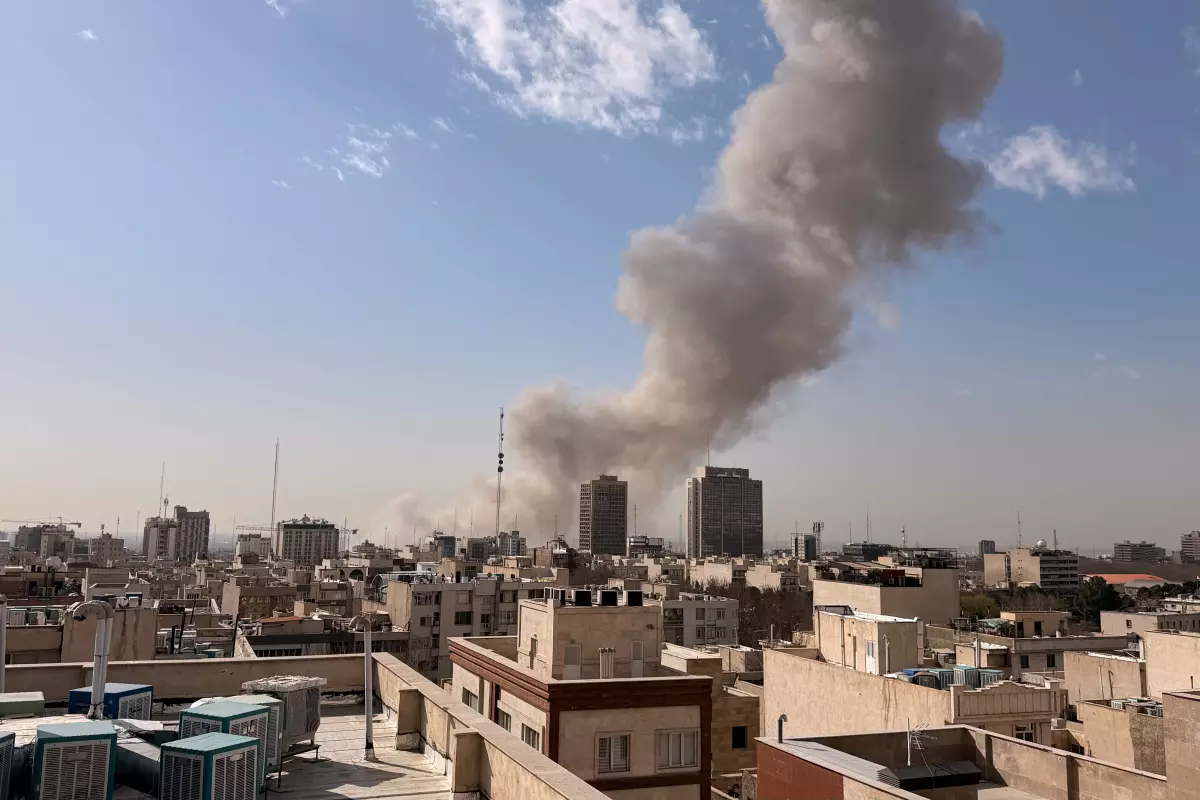
Smoke rises on the skyline after an explosion in Tehran, Iran, Saturday. (AP)

TEL AVIV — The U.S. and Israel have launched strikes against Iran with the goal of toppling the regime, President Trump and Israeli Prime Minister Benjamin Netanyahu said Saturday.

Iran retaliated by launching missiles at Israel and a U.S. naval base in Bahrain. An Iranian official said all Israeli and U.S. interests in the region were now considered legitimate targets.

The joint U.S.-Israeli attack on Iran comes after weeks of escalating tensions and a major U.S. military buildup in the region, as the U.S. and Iran tried to negotiate a deal to limit Iran’s nuclear program. Trump said those efforts had failed.

“Bombs will be dropping everywhere,” President Trump said, addressing Iranians in a video posted to his Truth Social account. “When we are finished, take over your government. It will be yours to take. This will be, probably, your only chance for generations.”

The Israeli military said in a statement its fighter jets were striking “dozens of military targets” in Iran with “full synchronization and coordination” between the Israeli and U.S. militaries following months of joint planning.

Prime Minister Benjamin Netanyahu said the goal of the joint U.S.-Israeli attack is to “remove the existential threat posed by the terrorist regime in Iran.”

“Our joint action will create the conditions for the brave Iranian people to take their destiny into their own hands,” Netanyahu said in a video.

A person briefed on the operation told NPR it was expected to last a few days, with Israel’s military focusing on targeting Iran’s missile program.

“We are going to destroy their missiles and raze their missile industry to the ground,” Trump said.

Israel has closed its airspace to all passenger flights, and civil defense protocols have been activated. Regional military forces remain on high alert.

A 48-hour state of emergency has been declared nationwide. Air raid sirens have been sounding across Israel, with authorities warning civilians to enter bomb shelters.

Trails of smoke streaked the sky above Tel Aviv as Israeli interception systems fired at incoming missiles. A hospital in central Israel began moving operations to an underground fortified compound.

“Our objective is to defend the American people by eliminating imminent threats from the Iranian regime, a vicious group of very hard, terrible people. It’s menacing activities directly endanger the United States, our troops, our bases overseas and our allies throughout the world,” Trump said.

Trump said the U.S. had “sought repeatedly to make a deal” but Iran “rejected every opportunity to renounce their nuclear ambitions.”

Trump told the Iranian Revolutionary Guard Corps to “lay down your arms… or you will face certain death.”

Iranian government media reported rocket fire in parts of the capital, Tehran. State television has broadcast footage showing smoke rising after a blast in the city. The extent of the damage and potential casualties has not yet been confirmed.

The strike follows weeks of speculation about potential military action against Iran, particularly amid a significant U.S. military buildup in the Middle East.

Great Job & the Team @ Houston Public Media for sharing this story.

Trump was once wary of ordering regime change in Iran. Here’s what made him change his mind

Trump was once wary of ordering regime change in Iran. Here’s what made him change his mind

WEST PALM BEACH, Fla. – With Saturday’s military operation against Iran, President Donald Trump demonstrated a dramatic evolution in risk tolerance, adjusting in just a matter of months how far he was willing to go in using American military might to confront Tehran’s clerical rule.

Guardrails were tossed aside, as Trump and Israeli Prime Minister Benjamin Netanyahu ordered up a battle plan that included targeted strikes on Iran’s leadership, including the 86-year-old Supreme Leader Ayatollah Ali Khamenei whose death Trump triumphantly announced in a social media post hours after launching the military operation.

For Trump, it was a far cry from where he stood just eight months ago. At Israel’s urging during its 12-day war with Iran last June, he agreed to deployB-2 bombers to pummel three key Iranian nuclear sites — but drew a bright red line when Israelis presented his administration with a plan for killing Khamenei.

The president peppered the supreme leader with thinly veiled threats back in June that he could have killed him if he wanted to. But he rejected the Israeli plan out of concern that it would destabilize the region.

That caution was set aside on Saturday with Trump announcing Khamenei had been killed, while the Israeli military announced it had taken out Iran’s defense minister and the commander of its Revolutionary Guard. Iran had not confirmed the Supreme Leader’s death as of Saturday evening.

Khamenei “was unable to avoid our Intelligence and Highly Sophisticated Tracking Systems and, working closely with Israel, there was not a thing he, or the other leaders that have been killed along with him, could do,” Trump said. “This is the single greatest chance for the Iranian people to take back their Country.”

Trump loses patience

Trump had pursued talks with Iran for months. Administration officials told reporters that they offered Iran many ways to have a peaceful nuclear program that could be used for civilian purposes, including an offer of free nuclear fuel in perpetuity.

But the officials, who were not authorized to comment publicly and spoke on condition of anonymity, said it was clear to them that Iran wanted enriched uranium for a nuclear weapon. One of them said that Iran has met their offers with “games, tricks, stall tactics.”

The order to launch strikes came just two days after Trump dispatched his special envoys, Steve Witkoff and Jared Kushner, for another round of talks with Iranian officials. Middle East and European allies were urging the U.S. administration to give negotiations more time as Trump signaled he was running out of patience.

“The consequences are likely to be as far-reaching as they are uncertain: Within the system that has held power for nearly five decades, between the government and a dissatisfied populace, and between Iran and its adversaries,” said Ali Vaez, Iran project director at the International Crisis Group. “And although the regime is weakened, a sense that this showdown is an all-or-nothing struggle for its very survival could lead it to respond with every tool still at its disposal.”

Revised risk calculation

Saturday’s strikes came after a series of past provocative actions against Iran that resulted in limited blowback, which seemed to inform Trump’s risk calculation, said Aaron David Miller, who served as an adviser on Middle East issues to Democratic and Republican administrations over two decades.

Trump in 2018 pulled out of the Iran nuclear deal negotiated by Democratic President Barack Obama’s administration. In 2020, Trump ordered a drone strike killing top Iranian Gen. Qassem Soleimani.

At the time, the killing of Soleimani, the head of Iran’s elite Quds Force, was arguably the most provocative U.S. military action in the Middle East since President George W. Bush launched the 2003 Iraq War to topple Saddam Hussein.

And then Trump this past June ordered the strikes on Iran’s nuclear facilities, which he claimed had “obliterated” their program.

“He did all of these things without cost or consequence to him,” said Miller, who is now a senior fellow at the Carnegie Endowment for International Peace. “He’s been risk-ready. That’s the nature of his personality.”

Trump administration officials had publicly urged Tehran to give up its nuclear weapons and ballistic missile programs and end its backing of regional armed proxies. But administration officials said that Tehran would not engage on the missile and proxy concerns.

Iran’s rigidity, at a moment when its economy is in shambles weighed by decades of sanctions and its military battered by last year’s war, astounded Trump.

Even before the latest round of talks ended on Thursday, there were signs Trump was leaning toward military action.

On Tuesday, Trump in his State of the Union speech claimed that Iran has been building ballistic missiles that could reach the U.S. homeland — a justification that he repeated again on Saturday as he announced the bombardment of Iran was underway.

Iran hasn’t acknowledged it is building or seeking to build intercontinental ballistic missiles. The U.S. Defense Intelligence Agency, however, said in an unclassified report last year that Iran could develop a militarily viable intercontinental ballistic missile by 2035 “should Tehran decide to pursue the capability.”

Secretary of State Marco Rubio told reporters on Wednesday that Iran’s refusal to speak to its ballistic missile program was a “big problem.” Rubio declined to address the DIA finding that Iran was still years away from developing a missile that could reach the United States.

And Vice President JD Vance, a former U.S. Marine who served in Iraq and has been skeptical of U.S. interventions, on Thursday told The Washington Post that Trump hadn’t decided whether to strike Iran. But he offered assurances that military action would not result in the United States becoming involved in a drawn-out conflict.

“The idea that we’re going to be in a Middle Eastern war for years with no end in sight — there is no chance that will happen,” Vance said.

By Friday, Trump was venting anew about Iran’s approach.

I’m not happy with the fact that they’re not willing to give us what we have to have,” Trump said. “I’m not thrilled with that. We’ll see what happens.”

Senior U.S. lawmakers were told early Saturday that the strikes were coming. Trump monitored the operation from his Mar-a-Lago resort in Palm Beach, Florida, with members of his national security team.

Trump may have been emboldened by his Venezuela experience

Trump’s success with the U.S. military operation earlier his year to capture Venezuelan leader Nicolás Maduro and whisk him and his wife to New York City to face federal drug conspiracy charges also may have emboldened the president, said Jonathan Schanzer, a former Treasury Department official who is now executive director of the Foundation for Defense of Democracies, a hawkish Washington think tank.

Trump had threatened military action last month, but held off, as Iran carried out a deadly crackdown on protests. The demonstrations were spurred by economic grievances but morphed into a nationwide, anti-government push against the ruling clerics.

As human rights groups reported that thousands were killed in the Iranian crackdown, Trump told protesters that help was on its way, but it did not immediately come and the protests petered out.

Schanzer said that Trump’s decision not to follow through last month gave his team more time to assemble the now massive presence of fighter jets and warships in the region — as he had done in the Caribbean ahead of the Venezuela operation.

It was leverage, Trump hoped, that would get Khamenei to blink. But the Supreme Leader would not capitulate.

“The way this unfolded was inevitable, because there was no way that the Ayatollah was going to show flexibility,” Schanzer said.

___

Madhani reported from Washington.

Copyright 2026 The Associated Press. All rights reserved. This material may not be published, broadcast, rewritten or redistributed without permission.

Great Job Aamer Madhani And Josh Boak, Associated Press & the Team @ KSAT San Antonio for sharing this story.

PBD Panelist says right-leaning comedian Dave Smith calling Trump a “traitor” over waging a war with Iran is equivalent to “the N-word for your leader”

PBD Panelist says right-leaning comedian Dave Smith calling Trump a “traitor” over waging a war with Iran is equivalent to “the N-word for your leader”

Citation

From the February 28, 2026, edition of PBD Podcast, livestreamed on YouTube

VINCENT OSHANA (PANELIST): Can I say something, Pat? Yeah. Like, I saw Dave Smith today. He called the president a traitor. A traitor.

TOM ELLSWORTH (PANELIST): It’s disappointing.  I mean, I see what Dave is doing here. He’s bringing up an old tweet.

But this is not a time, you know, for that.  If you wan to say I disagree with this, he’s a warmonger. I disagree with this. This is illegal. Then you can join Ro Khanna. You can join Thomas Massey with that opinion.

But to say traitor, traitor is a is a high order. That’s like the N-word for your leader. You were you’re basically using the N-word on your leader.  Traitor, traitor is against your own sovereign country.  And Dave, I just don’t think that’s the right word.  I think that’s wrong.

You’re a thoughtful guy, but I completely disagree with this.  I think you need to roll that back.
 

Great Job Media Matters for America & the Team @ Media Matters for America Source link for sharing this story.

With Love: Living consciously in nature – Greenpeace Australia Pacific

With Love: Living consciously in nature – Greenpeace Australia Pacific

I fell flat on my backside one afternoon this January and, weirdly, it made me think of you. Okay, I know that takes a bit of unpacking—so let me go back and start at the beginning.

For the last six years, our family has joined with half a dozen others to spend a week or so up at Wangat Lodge, located on a 50-acre subtropical rainforest property around three hours north of Sydney. The accommodation is pretty basic, with no wifi coverage—so time in Wangat really revolves around the bush. You live by the rhythm of the sun and the rain, with the days punctuated by swimming in the river and walking through the forest. 

An intrinsic part of Wangat is Dan, the owner and custodian of the place, and the guide on our walks. He talks about time, place, and care with great enthusiasm, but always tenderly and never with sanctimony. “There is no such thing as ‘the same walk’”, is one of Dan’s refrains, because the way he sees it “every day, there is change in the world around you” of plants, animals, water and weather. Dan speaks of Wangat with such evident love, but not covetousness; it is a lightness which includes gentle consciousness that his own obligations arise only because of the historic dispossession of others. He inspires because of how he is. 

One of the highlights this year was a river walk with Dan, during which we paddled or waded through most of the route, with only occasional scrambles up the bank. Sometimes the only sensible option is to swim. Among the life around us, we notice large numbers of tadpoles in the water, which is clean enough to drink. Our own tadpoles, the kids in the group, delight in the expedition. I overhear one of the youngest children declaring that she’s having ‘one of the best days ever’. Dan looks content. Part of his mission is to reintroduce children to nature, so that the soles of their feet may learn from the uneven ground, and their muscles from the cool of the water.

These moments are for thankfulness in the life that lives. 

It is at the very end of the walk when I overbalance and fall on my arse—and am reminded of the eternal truth that rocks are hard. As I gingerly get up, my youngest daughter looks at me, caught between amusement and concern, and asks me if I’m okay. 

I have to think before answering, because yes, physically I’m fine. But I feel too, an underlying sense of discomfort; it is that omnipresent pressure of existential awareness about the scale of suffering and ecological damage now at large in the world, made so much more immediately acute after Bondi; the dissonance that such horrors can somehow exist simultaneously with this small group being alive and happy in this place, on this earth-kissed afternoon. 

How is it okay, to be “okay”? What is it to live with conscience in Wangat? Those of us who still have access to time, space, safety and high levels of volition on this planet carry this duality all the time, as our gift and obligation. It is not an easy thing to make sense of; but for me, it speaks to the question of ‘why Greenpeace’? Because the moral and strategic mission-focus of campaigning provides a principled basis for how each of us can bridge that interminable gulf. 

The essence of campaigning is to make the world’s state of crisis legible and actionable, by isolating systemic threats to which we can rise and respond credibly, with resources allocated to activity in accordance with strategy. To be part of Greenpeace, whether as an activist, volunteer supporter or staff member, is to find a home for your worries for the world in confidence and faith that together we have the power to do something about it. Together we meet the confusion of the moment with the light of shared purpose and the confidence of direction. 

So, it was as I was getting back up again from my tumble and considering my daughter’s question that I thought of you—with gratitude, and with love–-because we cross this bridge all the time, together, everyday; to face the present and the future.

‘Yes, my love’, I say to my daughter, smiling as I get to my feet, “I’m okay”. And I close my eyes and think of a world in which the fires are out, and everywhere, all tadpoles have the conditions of flourishing to be able to grow peacefully into frogs. 

Thank you for being a part of Greenpeace. 

With love,

David

Great Job David Ritter & the Team @ Article – Greenpeace Australia Pacific for sharing this story.

Secret Link