

Home News Page 2

Supreme Court Agrees to Hear Fossil Fuel Companies’ Appeal in Boulder Climate Case but Asks for Briefing on Threshold Jurisdiction Questions – Climate Law Blog

Supreme Court Agrees to Hear Fossil Fuel Companies’ Appeal in Boulder Climate Case but Asks for Briefing on Threshold Jurisdiction Questions – Climate Law Blog

“Supreme Court” by Mark Fischer, CC BY-SA 2.0

Yesterday the U.S. Supreme Court granted three fossil fuel companies’ petition for a writ of certiorari seeking review of the Colorado Supreme Court’s opinion allowing the County Commissioners of Boulder County and the City of Boulder (together, Boulder) to proceed with their state-law claims that the companies are liable for climate change-related injuries suffered by Boulder. Boulder’s suit, filed in 2018, seeks damages and other relief and asserts causes of action for public nuisance, private nuisance, trespass, and unjust enrichment. Boulder alleges that the companies “knowingly caused and contributed to the alteration of the climate by producing, promoting, refining, marketing and selling fossil fuels at levels that have caused and continue to cause climate change, while concealing and/or misrepresenting the dangers associated with fossil fuels’ intended use.” Boulder alleges that as a result of the companies’ actions, Boulder has incurred and will continue to incur substantial costs to protect the City and County’s property and residents from the impacts of climate change, including more frequent and more serious heat waves, wildfires, droughts, and floods.

The case’s history is complex. For the first five years after Boulder filed its case in April 2018, the parties litigated the issue of whether the fossil fuel companies could remove the case to federal court. In September 2019, the federal district court for the District of Colorado remanded the case to state court. The companies’ appeal of the remand order then traveled to the Tenth Circuit, to the U.S. Supreme Court, back to the Tenth Circuit, and finally back to the Supreme Court, which in April 2023 denied the companies’ petition for writ of certiorari seeking review of the Tenth Circuit’s affirmance of the district court’s order remanding the case to state court. However, because the district court and the Tenth Circuit denied the defendants’ requests to stay the district court’s September 2019 remand order, the case also proceeded in the meantime in state court. In June 2024, the Colorado trial court denied a motion to dismiss Boulder’s common law claims. In May 2025, the Colorado Supreme Court concluded that the claims were not preempted by federal law and that the trial court did not err in declining to dismiss the claims.

In their petition for writ of certiorari, the companies—Suncor Energy (U.S.A.) Inc., Suncor Energy Sales Inc., and Exxon Mobil Corporation—asked the Supreme Court to consider the question of “[w]hether federal law precludes state-law claims seeking relief for injuries allegedly caused by the effects of interstate and international greenhouse-gas emissions on the global climate.” In its order granting certiorari, the Court asked the parties to brief both this question and also the additional issue of whether the Court has statutory and Article III jurisdiction to hear the case.

The remainder of this blog post discusses how the Suncor v. Boulder case will proceed, provides an overview of the jurisdictional issues the parties have been asked to brief, and highlights the potential impact on the case of the U.S. Environmental Protection Agency’s (EPA’s) recent rescission of the endangerment finding for greenhouse gases under the Clean Air Act. The post concludes with thoughts on potential near-term impacts on the more than 30 pending cases in which state, Tribal, and local government plaintiffs pursue climate change-focused claims against energy companies, as well as other cases that involve similar preemption issues.

Timeline for Briefing and Argument

Briefing will occur over the spring and summer, and oral argument is expected to be scheduled for the first week of the Court’s October 2026 term.

When this case was previously before the Supreme Court in April 2023 on the companies’ unsuccessful petition for writ of certiorari regarding whether the Tenth Circuit had erred in affirming the remand of the case to Colorado state court, Justice Alito did not participate in the consideration of the petition. The 2023 order did not provide the reason for his recusal.

In Monday’s order granting certiorari, there was no note indicating that any justice had not participated. If that does not change, all nine justices would be participating in the consideration of this case. There is no indication of why Justice Alito appears to have changed his position on recusal in this case.

Does the Supreme Court Have Jurisdiction to Hear the Case?

The Court has directed the parties to brief the issues of whether it has statutory and Article III jurisdiction to hear the case. Under 28 U.S. § 1257(a), the Court’s statutory jurisdiction to review state court decisions extends to “[f]inal judgments or decrees rendered by the highest court of a State in which a decision could be had.”

Boulder argued in its opposition to the companies’ certiorari petition that the Court does not have statutory jurisdiction because the Colorado Supreme Court’s decision is not a “final judgment” since it does not “terminate the litigation between the parties on the merits of the case.”

The fossil fuel companies very briefly touched on this issue in their petition, asserting that the Colorado Supreme Court’s decision fell into one of the four categories of cases that the Supreme Court identified in Cox Broadcasting Corp. v. Cohn, 420 U.S. 469 (1975), as cases in which a state high court’s decision on a federal issue is treated as a “final judgment” for purposes of 28 U.S.C. § 1257. The fossil fuel companies contended that this case fell within the fourth category of cases described in Cox because the Colorado Supreme Court had “finally decided” the federal question (i.e., preemption); that the Supreme Court’s review of the question would be prevented if the companies prevail on the merits on nonfederal grounds; that reversal of the Colorado Supreme Court’s decision would terminate the litigation; and that declining review “would seriously erode significant federal policies.”

In the amicus brief it filed in support of the companies’ petition, the United States also addressed the statutory jurisdictional issue. Although the U.S.’s brief noted the companies’ argument based on Cox, the U.S. primarily contended that under the Court’s 2020 decision in Atlantic Richfield Co. v. Christian, 590 U.S. 1 (2020), the Colorado Supreme Court’s decision was a “final judgment” because the court was exercising its “original jurisdiction” in a “self-contained proceeding,” as opposed to considering an interlocutory appeal from the denial of a motion to dismiss.

In its opposition, Boulder countered both the Cox and the Atlantic Richfield arguments for statutory jurisdiction. Boulder argued that this case does not meet any of the requirements to qualify for the fourth category of exceptions to the final judgment rule in Cox. Boulder argued (1) that the companies raised “a host of other federal defenses on which they could yet prevail,” which could lead to piecemeal appellate review; (2) that reversal of the Colorado Supreme Court would not preclude Boulder’s claims based on deception or for harms resulting from in-state conduct; and (3) that requiring the companies to wait until a final judgment to seek Supreme Court review of the preemption question would not erode any federal policy. Boulder alternatively argued that the fourth Cox exception should be overruled. Regarding Atlantic Richfield, Boulder argued that the procedural context in that case, which involved the Montana Supreme Court, was factually distinct from the procedural context in this case.

Boulder’s opposition noted that the statutory jurisdiction issues had also been presented to the Court when fossil fuel industry defendants unsuccessfully filed a petition for writ of certiorari seeking review of the Hawai‘i Supreme Court’s October 2023 decision allowing the City and County of Honolulu to proceed with state-law climate change-based claims. In its amicus brief in the Honolulu case, the U.S. took the position that the defendants did not meet their burden of showing that the case fit the fourth Cox category. Because the Supreme Court denied certiorari, it did not opine on this issue.

In addition, Boulder raised what Boulder characterized as the “complicated question” of whether the Supreme Court has Article III jurisdiction, arguing that there would only be standing if either (1) Boulder would have had standing to originally bring the suit in federal court or (2) the Colorado Supreme Court’s refusal to dismiss the case inflicted an Article III injury on the fossil fuel companies. Regarding whether Boulder would have had standing, Boulder’s opposition brief noted that the Supreme Court was deadlocked in American Electric Power Co., Inc. v. Connecticut, 564 U.S. 410, 420 (2011), on whether federal courts had jurisdiction over a suit for public nuisance arising from climate-change injuries.

In the fossil fuel companies’ reply brief, the companies allocated just 2½ pages to responding to all of Boulder’s the jurisdictional arguments. The companies characterized Boulder’s Article III arguments as “creative but insubstantial,” disputed Boulder’s efforts to distinguish the case from Atlantic Richfield, and argued that Boulder’s arguments against the application of the Cox fourth category lacked merit.

The parties—and potentially amicus parties as well—will flesh out these jurisdictional arguments in the merits briefing.

What About the Rescission of the Endangerment Finding?

The parties also will further develop their arguments on whether federal law preempts state-law claims for relief for injuries allegedly caused by the climate effects of interstate and international greenhouse gas emissions. One new issue that the merits briefs will confront is the impact of EPA’s finalization of the rescission of the 2009 endangerment finding for greenhouse gas emissions from motor vehicles permitting regulation under the Clean Air Act.

In its brief opposing certiorari, Boulder said that when EPA proposed rescinding the endangerment finding in August 2025, the agency “recognized that this could significantly affect the preemption arguments raised in this case.” Boulder also cited a Wall Street Journal editorial that noted warnings by “[s]ome energy companies” that “withdrawing the endangerment finding could make them vulnerable to lawsuits by states and localities alleging that their emissions cause a public nuisance by contributing to climate change.”

EPA addressed the preemption issue in its final rule, stating that the Clean Air Act “continues to preempt state common-law claims and statutes that seek to regulate out-of-state emissions.” This assertion will certainly be contested in the merits briefing, even as litigation over the legality of EPA’s repeal advances through the courts.

Impacts on the Climate Litigation Landscape

Federal preemption is also one of the primary issues in many of the other pending climate cases brought by state, Tribal, and local governments against fossil fuel industry defendants. For example, the Maryland Supreme Court heard oral arguments, including argument on federal preemption issues, in October 2025 on appeals by Baltimore, Annapolis, and Anne Arundel County of the trial courts’ dismissals of their cases. The question of federal preemption is also at the forefront of the United States’ ongoing lawsuit seeking to block the State of Hawaii’s climate suit against fossil fuel industry defendants. The U.S.’s recently dismissed case seeking to block Michigan from filing such a suit also asserted preemption claims. In addition, lawsuits challenging climate Superfund laws in Vermont and New York involve claims of federal preemption. The New York law has been challenged by the United States, by the U.S. Chamber of Commerce and other business groups, and by 22 states along with fossil fuel trade associations and a mining company. The Vermont law has been challenged by the United States and by the U.S. Chamber of Commerce and American Petroleum Institute.

The courts hearing all these cases may be reticent to delve into preemption questions until the Supreme Court issues a decision in the Suncor v. Boulder case, and fossil fuel companies will likely be interested in stalling the cases in which they are defendants. Courts could of their own volition seek to delay cases. In many of the cases against fossil fuel companies, the defendants may request that cases be put on hold and/or that discovery be stayed, an outcome that plaintiffs generally would not want.

The procedural routes for staying cases or discovery will vary from state to state, but courts generally are afforded discretion to control their dockets. Proceedings in these cases could be suspended for a year or more.

Some of the pending cases, however, are focused on issues that are distinct from the preemption question, and courts might not find it necessary to delay them. For example, New York City’s appeal of the dismissal of its greenwashing action against fossil fuel companies is focused on whether the trial court erred in finding that the City failed to state claims under its consumer protection law and whether such claims were timely. Puerto Rican municipalities could proceed with briefing in their appeal of the dismissal of their federal and Puerto Rico law claims, which a federal district court dismissed as time-barred or on personal jurisdiction and service of process grounds. The Puerto Rican municipalities’ opening brief in the First Circuit is currently due April 13. And Michigan’s recently filed antitrust case against fossil fuel industry defendants may raise such distinct issues that a court would not be receptive to delay.

The Sabin Center will continue to track potential delays and other activity in these cases in the Climate Litigation Database.

Photo: “Supreme Court” by Mark FischerCC BY-SA 2.0


Supreme Court Agrees to Hear Fossil Fuel Companies’ Appeal in Boulder Climate Case but Asks for Briefing on Threshold Jurisdiction Questions – Climate Law Blog

Great Job Margaret Barry & the Team @ Climate Law Blog for sharing this story.

Read NPR’s annotated fact check of President Trump’s State of the Union

Read NPR’s annotated fact check of President Trump’s State of the Union

Updated February 24, 2026 at 9:56 PM CST

Stay up to date with our Politics newsletter, sent weekly.


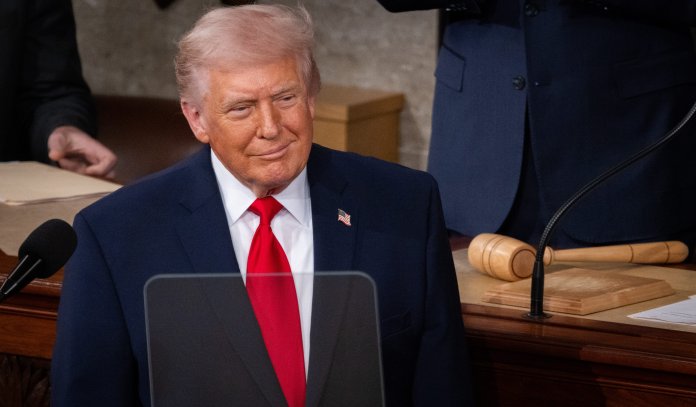
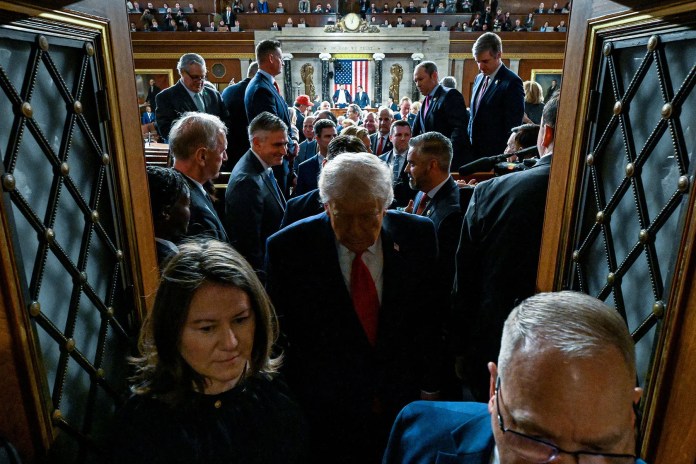
President Trump is set to deliver the first official State of the Union address of his second term on Tuesday night. The speech, which is set to start at 9 p.m. ET, gives Trump the opportunity to tout accomplishments and outline his agenda for his administration’s second year.

It comes at at time when Americans are divided on whether Trump’s first year has been a success. A new NPR/PBS News/Marist poll shows that six in 10 believe the country is worse off than last year and that a majority think the state of the union is not strong.

Reporters from across NPR’s newsroom will fact check his speech and offer context — on topics like immigration, the economy, tariffs and trade and foreign policy.

Follow along here as the speech — which he teased is likely to be long — unfolds tonight. (Newest fact checks show up first below.)


Was Iryna Zarutska killed by an immigrant?

TRUMP: “She had escaped a brutal war only to be slain by a hardened criminal set free to kill in America — came in through open borders. Mrs. Zarutska, tonight, I promise you we will ensure justice for your magnificent daughter, Iryna.”

Iryna Zarutska was fatally stabbed on August 22, 2025 while riding the light rail line in Charlotte, North Carolina. Zarutska, who was 23, was stabbed by 34-year-old DeCarlos Brown Jr., who has a reported history of mental health issues.

In tonight’s address, Trump claimed Brown was an immigrant released into America thanks to an open border policy. There is no evidence of this. Local media has reported that Brown was born and raised in Charlotte and had spent time in and out of North Carolina jails.

Jasmine Garsd Immigration Correspondent


 “I ended eight wars”

TRUMP: “In my first 10 months, I ended eight wars.” 

President Trump has had diplomatic successes, but his repeated claim that he’s ended eight wars is an exaggeration.

Perhaps his biggest success to date was brokering a ceasefire in the Israel and Hamas war in Gaza last October. However, Israel has continued to carry out airstrikes, killing hundreds of Palestinians since the truce was announced. Israel alleges many ceasefire violations by Palestinian militias.

Trump’s list also includes Israel and Iran. Israel and the U.S. exchanged airstrikes with Iran for 12 days last June before Trump declared a truce. However, none of the longstanding issues were resolved, and Trump is again threatening to attack Iran.

Greg Myre, national security correspondent


Iran’s nuclear program “obliterated”

TRUMP: “That’s why, in a breakthrough operation last June, the United States military obliterated Iran’s nuclear weapons program with an attack on Iranian soil known as Operation Midnight Hammer. For decades, it had been the policy of the United States never to allow Iran to obtain a nuclear weapon.”

Trump again repeated his oft-stated claim that the U.S. “obliterated” Iran’s nuclear program during one day of bombing in Iran last June. There’s a broad consensus that combined U.S. and Israeli strikes inflicted major damage on Iran’s nuclear program. However, Iran has not allowed international inspectors to examine their nuclear facilities, making a precise assessment impossible.

In addition, Trump has not explained why he’s considering a new round of attacks on Iran’s nuclear program if it was ‘obliterated’ just months ago.

Greg Myre, national security correspondent


Foreign investment 

TRUMP: “In 12 months, I secured commitments for more than $18 trillion pouring in from all over the globe.”

Trump referenced this figure, but a White House website of total investment at both home and abroad sits at under $10 trillion. And other analyses have found that number inflated as well.

Saige Miller, Washington Desk Producer


Oil and natural gas production

TRUMP: “American oil production is up by more than 600,000 barrels a day … American natural gas production is at an all time high because I kept my promise to drill, baby, drill.”

The U.S. set an annual crude oil production record last year, rising about 400,000 barrels a day from 2024, according to the Energy Information Administration. That was not a new trend initiated by Trump — crude output rose for four years in a row. However, it’s expected to drop by about 100,000 barrels a day in 2026, thanks in large part to low oil prices. Globally, the world is currently oversupplied with oil.

It is true that natural gas production is up; the EIA forecasts record natural gas production in 2026 and 2027. Natural gas prices were low in 2024 but jumped sharply last year, due in part to massive exports of liquefied natural gas from the U.S. to other countries, mostly in Europe and Asia.

Oil companies have not been on a drilling spree, as Trump’s “drill, baby, drill” phrasing would suggest. According to Baker Hughes, a firm that monitors the energy industry, the number of active drilling rigs in the U.S. this week is down about 7% from this time a year ago. Low oil prices and skeptical investors have kept companies cautious. However, technological improvements have helped make U.S. oil production more efficient, squeezing more oil and natural gas out of existing wells, which has helped keep production high anyway.

Camila Domonoske, Cars and Energy Correspondent


Voter fraud is already incredibly rare

TRUMP: “I am asking you to approve the SAVE AMERICA Act to stop illegal aliens and others who are unpermitted persons from voting in our sacred American elections. The cheating is rampant in our elections. It’s rampant.

Trump has been claiming that noncitizens are voting en masse in American elections for more than a decade.

But it’s illegal for noncitizens to vote in federal races, and they have never been found to vote in anything but microscopic numbers. In the rare cases they do vote, research has found it’s often due to misunderstandings about the rules, as opposed to an attempt to influence election results, as Trump often claims.

Still, since Trump took office for his second term, his government has put more resources than ever before toward trying to find these voters. They’ve found very little.

“Even states that are looking everywhere to try to amplify the numbers of noncitizens … when they actually look, they find a surprisingly, shockingly small number,” said David Becker, an election expert who runs a nonprofit that has been tracking noncitizen voting audits across the country.

In Michigan, an audit after the 2024 election found 16 alleged noncitizen votes out of the state’s roughly 5.7 million cast. In Iowa, it was 35 votes out of 1.67 million cast.

Experts often note that for immigrants without legal status, it doesn’t make sense to risk prison, deportation and family separation to cast one ballot — especially because the inherent paper trail of voting makes it very easy to get caught.

Trump correctly noted that not every state requires voters to show photo ID at the time they cast a ballot. But he oversimplified the dozen or so states that don’t have such a requirement in implying that anyone can easily vote without being verified by officials first.

Federal law already requires identity verification for all voters at registration, by mandating they provide a valid driver’s license number or the last four digits of their Social Security number. People who don’t register in person are also required to provide ID the first time they vote, regardless of the state they live in.

The SAVE America Act that Trump referenced tonight isn’t expected to garner the requisite 60 votes in the Senate needed to overcome a legislative filibuster, but you can still read a breakdown of what’s in the proposed Republican election overhaul here.

Miles Parks, Voting Correspondent


Congressional stock trading ban faces tough odds for passage

TRUMP: “As we ensure that all Americans can profit from a rising stock market, let’s also ensure that members of Congress cannot corruptly profit from using insider information. They stood up for that? I can’t believe it. I can’t believe it. Did Nancy Pelosi stand up if she’s here? Doubt it. Pass the ‘Stop Insider Trading Act’ without delay. I wasn’t sure if anybody even on this side was going to applaud for that. I was – I’m very impressed.”

Congress has unsuccessfully pursued a stock trading ban for their members for years. Members of both sides of the aisle have put forth proposals that have drawn broad, bipartisan support. However, those efforts have fallen short of becoming law.

Those failures have spanned several House speakers, including former Speakers Nancy Pelosi and Kevin McCarthy. Pelosi’s husband, Paul, has drawn attention as a venture capitalist who has been active in trading.

This time around, the GOP-led Stop Insider Trading Act has little chance of passage, currently without much bipartisan support.

Claudia Grisales, Congressional Correspondent


 DHS and terrorism prevention

TRUMP: “As we speak, Democrats in this Chamber have cut off all funding for the Department of Homeland Security — it’s all cut off. All cut off. They have instituted another Democrat shutdown, the first one costing us two points on GDP. Two points we lost on GDP, which probably made them quite happy, actually. Now they have closed the agency responsible for protecting Americans from terrorists and murderers.”

Since Trump took office for his second term in January 2025, there have been mounting concerns among former federal employees and field experts about a diminished capacity to counter violent extremism. Many seasoned counterterrorism officials left government service, and budget cuts have fundamentally shifted the core infrastructure that had been devoted to community-based prevention programs, data-gathering and analysis. In the case of one of these programs, the Center for Prevention Programs and Partnerships, the administration replaced an outgoing head with a 22-year-old without experience in law enforcement or counterterrorism. Outside of DHS, other agencies that have traditionally played a role in countering violent extremism, such as the FBI, have seen manpower diverted to immigration enforcement.

Odette Yousef, Domestic Extremism Correspondent


 Payments to insurance companies

TRUMP: “That’s why I introduced the “Great Health Care Plan.” I want to stop all payments to big insurance companies and instead, give that money directly to the people so they can buy their own health care, which will be better health care at a much lower cost.”

At this point, Trump’s “Great Health Care Plan” isn’t a comprehensive health policy, but an articulation of policy priorities that Trump has asked Congress to develop into legislation. He supports loosening rules around mandatory benefits required by the Affordable Care Act and promoting health savings accounts, which allow people to set aside pre-tax funds to pay for certain health-related expenses. Under current law, HSA funds can’t be used for health insurance costs like premiums.

Even the “catastrophic” or skinny plans preferred by Trump are private insurance plans, and the money paid for them goes to big insurance companies. The only way to stop payments to health insurance companies would be to bolster public health insurance options like Medicaid and Medicare.

Selena Simmons-Duffin, Health Policy Correspondent


Did murderers, ex-convicts and mental institution patients emigrate to the U.S. under Biden?

TRUMP: “They poured in by the millions and millions from prisons, from mental institutions. There were murderers, 11,888 murders. They came into our country.”

There is no evidence of this.

A historic number of people came across the U.S. border during the Biden administration, however many were vetted. Programs like parole and the CBP One app required entry screenings and interviews.

There has also been extensive research showing that immigrants, both documented and undocumented, are less likely to commit crimes than citizens. What’s more, although the number of people in immigration detention is at a historic high (near 70,000 as of earlier this month), around 74% have no criminal conviction.

Jasmine Garsd, Immigration Correspondent


Tariffs and manufacturing

TRUMP: “Moving forward, factories, jobs, investment and trillions and trillions of dollars will continue pouring into the United States of America because we finally have a president who puts America first.”

President Trump argues that high tariffs will spark a renaissance in U.S. manufacturing. But it hasn’t happened yet. Factories have been in a slump for most of the last year, shedding 108,000 jobs in 2025, according to the Bureau of Labor Statistics.

No doubt Trump’s taxes on foreign imports have allowed some U.S. factories to raise their prices. But the vast majority of factory managers, many of whom rely on foreign components, say tariffs have been a drag on their business. “Morale is very low across manufacturing in general,” one unnamed factory manager told the Institute for Supply Management in December.

Scott Horsley, Chief Economics Correspondent


Venezuelan oil “received” in the U.S.

TRUMP: “We just received from our new friend and partner, Venezuela, more than 80 million barrels of oil.

Since the U.S. captured Venezuelan leader Nicolás Maduro last month, the U.S. government has been helping sell some of Venezuela’s oil. The U.S. has worked with two Swiss oil trading companies, Vitol and Trafigura. (Both Vitol and Trafigura have pleaded guilty to bribery and settled cases with the Department of Justice during the Biden administration.)

Secretary of Energy Chris Wright says that U.S.-facilitated oil sales total more than $1 billion. However the Venezuelan government has said it has only received $300 million. In a Senate hearing last month, Secretary of State Marco Rubio said $200 million is in a bank account in Qatar. It’s unclear where the rest of the money is and if and when it will get to the Venezuelan people.

The U.S. is the biggest producer of oil in the world and the world is currently oversupplied with oil.

Julia Simon, Climate Solutions Correspondent


Prescription drug prices

TRUMP: “I’m also ending the wildly inflated cost of prescription drugs like it’s never happened before. Other presidents tried to do it, but they never could. They tried. Most didn’t try, actually. But they tried. They said they’d try. They couldn’t do it. They didn’t even come close. They were all talk and no action, but I got it done under my just-enacted most-favored nation agreements, Americans who have for decades paid by far the highest prices of any nation anywhere in the world for prescription drugs, will now pay the lowest price anywhere in the world for drugs anywhere – the lowest price. ”

This claim is not true. Americans still pay several times more money for prescription drugs than people in peer countries. The Trump administration has taken aim at drug prices in various ways, but how helpful those efforts will ultimately be — and for how many people — is not yet clear.

His biggest move so far has been to use tariffs as leverage to negotiate deals with more than a dozen drugmakers, and then launch a direct-to-consumer website called TrumpRx where people can buy brand-named drugs at a discount. There are only about 40 drugs currently available on the site, and those same companies Trump struck deals with raised prices on hundreds of other drugs they sell. For most people, using insurance and paying a copay for their medications will be cheaper than TrumpRx, according to an analysis by KFF.

What many peer countries do to keep the prices of prescription drugs down is to regulate those prices. President Trump and congressional Republicans have generally rejected that approach, branding it as “government price setting.”

Selena Simmons-Duffin & Sydney Lupkin, health correspondents


Data centers and electricity rates

TRUMP: “Many Americans are also concerned that energy demand from AI data centers could unfairly drive up their electric utility bills. Tonight, I’m pleased to announce that I have negotiated the new ratepayer protection pledge. You know what that is. We’re telling the major tech companies that they have the obligation to provide for their own power needs; they can build their own power plants as part of their factory.”

Electricity prices rose 6.3% in the last 12 months – more than double the overall rate of inflation. That’s partly due to the high cost of natural gas, which is a major fuel for power plants. It’s also due to increased demand, some of which comes from power-hungry data centers. Rising electricity prices were a big theme in last year’s gubernatorial elections in New Jersey and Virginia.

Scott Horsley, Chief Economics Correspondent


Declining murder rates 

TRUMP: “Last year, the murder rate saw its single largest decline in recorded history. This is the biggest decline, think of it, in recorded history, the lowest number in over 125 years.”

Murders have been on a steep decline following a pandemic-era surge.

The homicide rate in 35 studied cities dropped 21% in 2025, compared with 2024, according to data from the Council on Criminal Justice.

The FBI hasn’t released 2025 homicide data for all jurisdictions nationwide yet. However, the Council on Criminal Justice states “there is a strong possibility” that the murder rate will be roughly 4 per 100,000 residents. That, according to the council, would be the lowest rate ever recorded, going back to 1900. It would also mark the largest single-year percentage drop in homicides on record.

Murders and violent crime were already declining under the Biden administration. In 2024, President Joe Biden’s final year in office, violent crime dropped to a 20-year low.

Saige Miller, Washington Desk Producer


Standing by tariffs after rebuke by SCOTUS

TRUMP: “As time goes by, I believe the tariffs, paid for by foreign countries, will, like in the past, substantially replace the modern day system of income tax, taking a great financial burden off the people that I love.”

The federal government has been collecting about $30 billion every month in tariffs, which is far more than it made from import taxes before Trump returned to the White House last year.

The Supreme Court struck down about half of Trump’s tariffs last week, ruling that the president had exceeded his authority. Some of those levies are being replaced with alternative import taxes.

The Constitution gives Congress the power to levy tariffs — though lawmakers have delegated limited tariff powers to the executive branch.

Economists say the vast majority of tariff bills are being paid by businesses in the U.S. that import products. In some cases, those costs are being passed along to consumers in the form of higher prices.

Tariff revenue, while substantial, has fallen short of what the administration projected. This is partly because some imports have been granted tariff exemptions, and partly because importers have shifted production to countries facing lower tariff rates. Imports from China, for example, made up 12% of total imports in 2024. By last fall that had dropped to about 8%.

Scott Horsley, Chief Economics Correspondent


Tax cuts

TRUMP: “Last year I urged this Congress to begin the mission by passing the largest tax cuts in American history, and our Republican majorities delivered so beautifully.”

Congressional Republicans voted last summer to extend portions of the 2017 tax cut which otherwise would have expired last year. An analysis by the Tax Foundation found the package — the One Big Beautiful Bill Act — is the sixth largest tax cut in U.S. history, not the largest. The bill also adds new tax breaks on tips, overtime pay and Social Security benefits. The result will be somewhat higher take-home pay for many workers in 2026. The bill also cut government spending on safety-net programs such as Medicaid and food stamps.

The non-partisan Congressional Budget Office says the bulk of the tax savings will go to the wealthy. Middle-income households will see a smaller benefit, between $500 and $1000 a year. For families making less than $55,000 the loss of government benefits will likely outweigh any tax savings, leaving them worse off. The tax cut is also expected to encourage more business investment, which could boost future economic growth.

Scott Horsley, Chief Economics Correspondent


Gasoline prices

TRUMP: “Gasoline, which reached a peak of over $6 a gallon in some states under my predecessor — it was, quite honestly, a disaster — is now below $2.30 a gallon in most states, and in some places, $1.99 a gallon. And when I visited the great state of Iowa just a few weeks ago, I even saw $1.85 a gallon for gasoline.

According to GasBuddy, only the cheapest 10% of stations in the country are seeing prices of $2.31 per gallon or cheaper. And while gasoline was $1.85 a gallon in Iowa in early January, prices have since risen. As for $1.99 gasoline, “only 8 out of roughly 150,000 gas stations nationwide are selling gasoline below $2 per gallon,” GasBuddy’s Patrick de Haan wrote on Tuesday.

While the specific prices named by President Trump are exceptional rather than representative, gasoline is certainly cheaper now than it was before his inauguration. The national average gasoline price is currently at $2.92 a gallon, according to AAA, or about 22 cents cheaper than this time a year ago.

Those prices are driven by global markets, and a worldwide oversupply of oil is the dominant force keeping prices in check. Presidents do not set gasoline prices. However, politics can be a factor in global markets, and Trump has put pressure on the oil cartel OPEC to keep oil prices down.

Camila Domonoske, Cars and Energy Correspondent


Job growth

TRUMP: “More Americans are working today than at any time in the history of our country. Think about that — any time in the history of our country, more working today, and 100% of all jobs created under my administration have been in the private sector. “

Job growth slowed sharply in the last year. U.S. employers added just 181,000 jobs in all of 2025, compared to more than 1.4 million in 2024. Hiring picked up in January of this year, but the job gains last month were concentrated in health care — an industry that is typically insulated from the ups and downs of the broader economy. Unemployment has remained low — just 4.3% in January — but that’s up from 4% a year ago when Trump returned to the White House.

Scott Horsley, Chief Economics Correspondent


Do we have the strongest and most secure border so far?

TRUMP: “After four years in which millions and millions of illegal aliens poured across our borders totally unvetted and unchecked, we now have the strongest and most secure border in American history, by far.”

This is partly true.

It is not true that there have been zero crossings; for example, there were 237,538 in 2025, according to data from U.S. Customs and Border Protection. But Border Patrol encounters with migrants crossing into the United States from Mexico have fallen to their lowest level in more than 50 years, according to a Pew Research Center analysis of statistics from the federal government.

While it is true that there were a historic number of crossings during the Biden administration, it is untrue that the border was wide open for people to cross unvetted: in the final year of his administration, President Biden significantly tightened controls.

Jasmine Garsd, Immigration Correspondent


Stock market 

TRUMP: “The stock market has set 53 all-time record highs since the election. Think of that – one year – boosting pensions, 401(k)s and retirement accounts for the millions and millions of Americans, they’re all gaining. Everybody’s up, way up.”

The stock market has enjoyed big gains over the last year, with the Dow Jones Industrial Average topping 50,000 for the first time earlier this month. In 2025, the S&P 500 index jumped 18%, after a 24% gain in 2024. The stock market rally has given a boost to many people’s retirement savings. It’s important to remember, however, that stock ownership is very concentrated. The richest 10% of families own 87% of all stock market wealth, while half of all Americans own little or no stock.

Scott Horsley, Chief Economics Correspondent


 Inflated claims about inflation

TRUMP: “The Biden administration and its allies in Congress gave us the worst inflation in the history of our country, but in 12 months, my administration has driven core inflation down to the lowest level in more than five years, and in the last three months of 2025 it was down to 1.7%.”

Inflation has cooled in recent months. But the cost of living is still climbing faster than most people would like. A few items have gotten cheaper in the last year, such as gasoline and eggs. But housing, groceries, electricity and natural gas have all gotten more expensive.

Inflation reached a four-decade high of 9.1% in 2022, after Russia’s invasion of Ukraine sent prices soaring around the world. By the time President Joe Biden left office, inflation had fallen to 3%. It dropped as low as 2.3% last April, before rebounding to 3% in September.

Trump’s tariffs have raised the price of some imported goods, but the effects on the overall cost of living have been limited. Annual inflation dipped to 2.4% in January. (A separate measure of inflation, which is closely watched by the Federal Reserve, shows that prices are still climbing at roughly the same rate that they were a year ago.)

Scott Horsley, Chief Economics Correspondent


A “turnaround for the ages”

TRUMP: “When I last spoke at this chamber 12 months ago, I had just inherited a nation in crisis with a stagnant economy, inflation at record levels…”

The U.S. economy was in solid shape before President Trump returned to the White House for his second term. In fact, in October 2024, The Economist had labeled the U.S. economy “the envy of the world,” because it had bounced back from the pandemic recession in stronger shape than most of its peers. To be sure, many Americans were frustrated with the high cost of living, and that dissatisfaction contributed to Trump’s victory the following month. However, costs have continued to climb over the last year, and that dissatisfaction is now weighing on Trump’s own approval rating. Nearly six-in-ten Americans say the country is worse off now than it was a year ago, according to the latest NPR/PBS News/Marist poll.

Scott Horsley, Chief Economics Correspondent


Copyright 2026 NPR

Great Job NPR Staff & the Team @ Texas Public Radio for sharing this story.

A White House Invite, a Punchline—and a Choice for the Men of Team USA

A White House Invite, a Punchline—and a Choice for the Men of Team USA

After a joking White House invitation cast women’s victories as an afterthought, Team USA’s men face a defining opportunity to show whether championship culture includes equal respect and real solidarity.

Hilary Knight of Team USA celebrates after the medal ceremony for Women’s Ice Hockey after the Women’s Gold Medal match between the United States and Canada on Feb. 19, 2026, in Milan. (Andreas Rentz / Getty Images)

Both the U.S. women’s and men’s ice hockey teams won gold at the 2026 Milan-Cortina Winter Olympics. Yet, within hours of defeating Canada, only the U.S. men’s hockey team received a congratulatory call from President Donald Trump and an invitation to the White House.

What should have been a routine celebration of athletic excellence instead became a revealing cultural moment. 

After extending the invitation, the president joked, “I must tell you, we’re going to have to bring the women’s team,” adding that he would “probably be impeached” if they were not invited. Laughter followed.

Both teams had delivered extraordinary victories against a fierce rival. Both performances electrified fans and showcased the highest level of international competition. Yet the reactions surrounding those wins exposed something familiar: Women’s achievements are still too often treated as secondary, inconvenient or acknowledged only as an obligation.

Some have dismissed the comment as harmless—just a joke, just locker room talk, boys being boys. But humor has long been one of the ways inequalities sustains itself. Framed as harmless, softened by laughter and repeated often enough, it teaches audiences what is acceptable and what feels risky to challenge.

When authority figures frame inclusion as an obligation rather than a given, the message travels quickly. Laughter signals what feels safe. Silence signals what feels dangerous to question.

Team environments depend on unity and belonging. Speaking up can feel like breaking ranks, while remaining quiet feels safer. Yet silence, even when unintended, communicates acceptance. Over time, these moments accumulate, reinforcing who is perceived as central and who remains an addition.

When women’s inclusion becomes a punchline, the triumph no longer belongs equally to everyone it represents.

The contrast is especially striking given the broader reality of these Olympics. Women alone won six of the United States’ 12 gold medals and helped secure two more wins in mixed-gender events (men won the other four), and won 21 of the country’s 33 total medals. This continues a decades-long pattern in which women drive American Olympic success while still fighting for equal visibility and respect.

Women’s performances are not supplementary to American achievement—they are foundational to it.

This tension is not new. Women athletes have long had to advocate not only for resources, but for recognition— pushing for equal pay, fair media coverage and investment that reflects their contributions. Progress in women’s sports has rarely arrived automatically; it has come through persistence and collective insistence on being seen as fully legitimate competitors.

Disparities in recognition do more than diminish women’s accomplishments—they reshape the meaning of celebration itself. The men earned their victory unequivocally, yet the surrounding controversy risks attaching an unnecessary shadow to what should have been uncomplicated national pride. When women’s inclusion becomes a punchline, the triumph no longer belongs equally to everyone it represents.

The U.S. women’s hockey team ultimately declined the White House invitation, a decision reflecting principle as much as disappointment. Recognition offered alongside dismissal rarely feels like recognition at all.

When women win and are treated as an afterthought, the message reaches classrooms, workplaces and communities alike: You may help carry the nation, but you will not be centered in its story.

What happens next matters.

The most meaningful response from the men’s team would be solidarity: a public acknowledgment that women athletes deserve equal respect, that jokes minimizing their inclusion were harmful and that teammates across gender lines stand together. A sincere apology. Such a response would not diminish their victory; it would elevate it.

Solidarity in moments like these matters, because gender equality in sports has too often been framed as a women’s issue alone. Progress accelerates when those who benefit from existing structures choose to challenge them. Allyship does not erase achievement; it expands its meaning.

Such actions do not come without risk. Speaking publicly in opposition, especially to a sitting president, invites swift backlash. Athletes who step into controversy often face immediate and personal criticism.

U.S. Olympic skier Hunter Hess experienced this after expressing “mixed emotions” about representing the United States; President Trump responded by calling him “a real loser.” The pressure to remain silent is real, particularly in environments that reward cohesion and discourage dissent.

But moments like this offer athletes a rare opportunity to shape culture beyond competition. And people are watching.

Young girls—as well as young boys and children everywhere—are learning what respect looks like in real time. They are learning whether success excuses dismissal or whether excellence includes standing up for others. They are learning how men treat women when recognition and power are on the line.

Sports have never existed apart from culture. Athletics has long helped shape national conversations about fairness, visibility and belonging. Moments like this become lessons that extend far beyond the rink.

When women win and are treated as an afterthought, the message reaches classrooms, workplaces and communities alike: You may help carry the nation, but you will not be centered in its story.

Inclusion without respect is not equality.

The victories over Canada should have been remembered solely for athletic brilliance: four teams competing, two American triumphs, one shared sense of pride. Instead, they revealed how persistent the work of equality remains.

The men’s team now faces an opportunity few champions receive: to ensure their victory stands not only for competitive excellence, but for integrity. A moment of solidarity could transform controversy into progress and ensure this championship is remembered not only for winning, but for leadership.

Women’s sports are not a punchline. They are part of the victory and they always have been. It’s time we treated them that way.

Great Job Jodi Bondi Norgaard & the Team @ Ms. Magazine for sharing this story.

Apple’s First Touchscreen MacBook Pro Could Arrive Earlier Than Expected

Apple’s First Touchscreen MacBook Pro Could Arrive Earlier Than Expected

Apple is reportedly preparing to launch several new devices next month, including the iPhone 17e, refreshed MacBook Pro models powered by M5 Max and M5 Ultra chips, and a budget MacBook featuring the A18 Pro chipset. Alongside these updates, the company is said to be planning a major design and hardware overhaul for the MacBook Pro lineup, originally expected in early 2027. However, recent reports suggest Apple could move up the timeline, bringing the redesigned MacBook Pro with an OLED touchscreen to late 2026. The new model may also introduce select iPhone-inspired features to the laptop lineup.

Apple OLED Touchscreen MacBook Pro Timeline

According to a Bloomberg report citing sources familiar with the matter, Apple is planning to launch a new MacBook Pro with an OLED touchscreen as early as fall this year. If true, this would mark the company’s first laptop to feature an OLED touchscreen panel. However, Apple has not officially confirmed any plans regarding such a device.

Dynamic Island May Replace Notch

The upcoming MacBook Pro is also rumoured to feature the Dynamic Island, replacing the traditional notch at the top of the display. Apple first introduced the Dynamic Island with the iPhone 14 Pro series in September 2022. On the laptop, it is expected to house the webcam while also enabling media controls, live activities, and potentially third-party app integrations, similar to its functionality on iPhones.

Design And User Experience Details

Despite the display upgrade, the OLED MacBook Pro is said to retain a design similar to the current generation, including a backlit keyboard and trackpad. Reports suggest the device will not shift to a “touch-first” interface; instead, users can choose to interact via touch or continue using the traditional point-and-click approach, offering flexibility rather than a full transition to touchscreen computing.

Earlier 2027 Plans And M6 Chip

Previously, the OLED touchscreen MacBook Pro was expected to debut in early 2027, powered by Apple’s yet-to-be-announced M6 processor. The redesigned models, reportedly codenamed K114 and K116, are said to arrive in 14-inch and 16-inch variants with thinner and lighter frames. Earlier rumours had also pointed to a hole-punch cutout instead of Dynamic Island, though the latest report suggests Apple may opt for the more interactive design element.

ALSO SEE: Samsung Galaxy Unpacked 2026 Launch Today: Galaxy S26 Series Expected, Where To Watch

Great Job Priya Singh & the Team @ Mashable India tech for sharing this story.

Fact-checking Trump’s 2026 State of the Union address

Fact-checking Trump’s 2026 State of the Union address

President Donald Trump delivered the longest State of the Union address in history Tuesday night, touting his administration’s economic policies and immigration enforcement, while condemning Democrats and the previous administration.

Trump also made a series of exaggerated, misleading and false claims throughout the course of the evening on topics ranging from the economy to crime to elections.

Here’s what the president got right — and wrong — in his address.

Did Trump lift millions off food stamps?

“We have lifted 2.4 million Americans — a record — off of food stamps,” Trump said.

Verdict

This needs context.

Analysis

Nearly 42 million Americans rely on the Supplemental Nutrition Assistance Program, informally known as food stamps.

Around 2.4 million people are expected to lose eligibility for the program because of new work requirements passed in Trump’s One Big Beautiful Bill, according to the Center on Budget Policy and Priorities, a nonpartisan think tank.

But the timeline for making sure that people meet those requirements varies by state, so some of the cuts haven’t happened yet. And there is no proposed federal program to supplement the loss of food assistance.

Under the new work requirements, adults ages 55 to 64 and parents whose youngest children are at least 14 years old must document 80 hours per month of work, education or volunteering to maintain SNAP benefits. Without such documentation, they are eligible for food stamps for only three months within a three-year period. The law also gets rid of exemptions for veterans and people experiencing homelessness.

Did the ‘Warrior Dividend’ money come from tariffs?

“Every service member recently received a Warrior Dividend of $1,776. They put it on my desk. We got the money from tariffs and other things. A lot of money we have,” Trump said.

Verdict

The claim that “Warrior Dividend” payments came from tariffs is false.

Analysis

According to a Pentagon release in December, the money to pay 1.28 million active-duty service members and 174,000 reserve members $1,776 each came from a supplemental housing fund that Congress appropriated as part of Trump’s massive domestic spending bill last summer.

The funds were delivered to recipients “as a nontaxable supplement to their regular monthly housing allowance,” the internal Pentagon News Service reported in December.

As part of the announcement, Jules W. Hurst III, the acting comptroller for the Defense Department, said at the time, “We are grateful to President Trump, Chairman [Roger] Wicker, Chairman [Mike] Rogers and the other members of Congress who have made this Warrior Dividend possible through the One Big Beautiful Bill Act.”

Trump says there’s almost ‘no crime anymore’ in D.C.

“[W]e have almost no crime anymore in Washington, D.C. How did that happen? In fact, crime in Washington is now at the lowest level ever recorded, and murders in D.C. this January were down close to 100% from a year ago,” Trump said.

Verdict

This is exaggerated.

Analysis

Crime in Washington has fallen in all but one category in 2026 so far, according to data published by the Metropolitan Police Department. (Assault with a dangerous weapon is the only category that has increased in 2026.) That data also showed declines in 2025 from 2024 in all violent crime and property crime categories.

But it is not accurate to say there is “almost no crime” in Washington.

Since Jan. 1, there have been nine homicides, 126 assaults with a dangerous weapon and 322 motor vehicle thefts in the city. Year-to-date, homicides are down 67%.

Trump claims other presidents failed to lower drug prices

“I am also ending the wildly inflated cost of prescription drugs. Other presidents tried to do it, but they never could. They didn’t even come close,” Trump said.

Verdict

This is false.

Analysis

In 2022, President Joe Biden signed the Inflation Reduction Act, capping insulin at $35 a month for people on Medicare, placing a $2,000 annual cap on out-of-pocket drug costs for people on Medicare and, for the first time, allowing Medicare to negotiate the prices of some of its most expensive medications. On Jan. 1, the first negotiated prices took effect, including for the blockbuster blood thinner Eliquis and the cancer drug Imbruvica. After the law capped insulin costs for Medicare patients, drugmakers also extended $35 monthly caps to privately insured patients.

By contrast, Trump has stuck voluntary deals with at least 16 drugmakers in exchange for tariff relief. He launched the self-pay platform TrumpRx, which so far offers cash prices on 43 medications. Most of those deals, however, don’t change what people with private insurance or Medicare pay at the pharmacy counter. Medicaid patients already tend to pay little or nothing for prescriptions. And many of the drugs listed on TrumpRx have generic versions that cost less than the advertised prices.

Was inflation at record levels when Trump assumed office?

“The Biden administration and its allies in Congress gave us the worst inflation in history of our country. But in 12 months, my administration has driven core inflation down to the lowest level in more than five years, and in the last three months of 2025 it was down to 1.7%,” Trump said.

Verdict

This is false.

Analysis

Inflation is not typically measured in just three-month periods. The consumer-price index, the most cited inflation metric, includes food and energy. While energy prices have been dropping, food prices have been on the rise over the last year.

On an annual basis, inflation when Trump took office was 2.9%, which is not a record high level.

Inflation fell as low as 2.3% in April before it spiked again after his sweeping worldwide tariffs were introduced.

Recent record inflation was experienced in 2022 when it hit 8.9%. The highest inflation ever experienced happened in the 1980s, when it reached as high as around 14%.

Trump said more Americans are working now than ever before

“More Americans are working today than at any time in the history of our country.” Trump said.

Verdict

This is true.

Analysis

The statement is correct, though the labor market’s rate of growth has slowed sharply since Trump took office, and 2025 was the worst year for job creation since 2020. Excluding recessions, 2025 was actually the worst year for job creation since 2003.

A total of 584,000 jobs were created last year, according to the Bureau of Labor Statistics. That’s down significantly from more than 2 million in both 2024 and 2023. In 2022, as the economy bounced back from the pandemic, more than 4.5 million jobs were created. The pace of job creation is also slower than it was in each of the first three years of Trump’s first term.

President Donald Trump delivered his State of the Union address on Tuesday, touting his administration’s policies on immigration and trade.

Did Trump secure $18 trillion in investments in U.S.?

“I secured commitments for more than $18 trillion, pouring in from all over the globe,” Trump said.

Verdict

This is false.

Analysis

While a number of companies, such as tech firms, semiconductor companies and pharmaceutical manufacturers, have made public commitments to invest in the U.S., many of those commitments are either only slight increases from previous announcements or in line with previous plans. In addition, the commitments and investments the White House touted on its own website total $9.7 trillion.

A review of the White House list also found the $9.7 trillion figure to be misleading. More than $2.5 trillion of that is not investments, Bloomberg Economics found in November. About $3.5 trillion of that comes from opaque sovereign pledges, and another $3.5 trillion is corporate investments. Of those corporate investments, $2.9 trillion is planned for data centers.

“More than $250 billion of the White House pledges were announced or planned before Trump retook office in January,” Bloomberg Economics researchers also found.

Many of the commitments are also over the long term and are likely to be subject to change. For example, it recently took drugmaker Fujifilm Biotechnologies five years to open one factory in North Carolina.

Did Trump eliminate taxes on tips, overtime and Social Security?

“We held strong, and with the Great Big Beautiful Bill, we gave you no tax on tips, no tax on overtime and no tax on Social Security for our great seniors,” Trump said.

Verdict

This needs context.

Analysis

It’s true that Trump cut taxes for seniors and hourly workers with the bill he signed into law last year, but he didn’t eliminate all the taxes he mentioned here. Some workers can now deduct overtime and tips, though there are income caps and maximum deduction limits. While some seniors may pay less in tax thanks to a new deduction, Social Security income is still taxed.

Trump says the murder rate is the lowest it’s been in 125 years

“Last year, the murder rate saw its single largest decline in recorded history. This is the biggest decline, think of it, in recorded history, the lowest number in over 125 years,” Trump said.

Verdict

This is true.

Analysis

This is true, according to an analysis of crime data published last month by the Council on Criminal Justice, an independent, nonpartisan group.

The group’s January analysis predicted that “when nationwide data for jurisdictions of all sizes is reported by the FBI later this year, there is a strong possibility” that the homicide level “would be the lowest rate ever recorded in law enforcement or public health data going back to 1900, and would mark the largest single-year percentage drop in the homicide rate on record.”

However, it’s important to note that crime did not suddenly begin falling when Trump returned to office in January 2025; it has been declining gradually for years. Several years of national data show that crime has consistently been falling in cities and towns across the U.S.

Trump says the ‘One Big Beautiful Bill’ was the largest tax cut in history

“Last year, I urged this Congress to begin the mission by passing the largest tax cut in American history, and our Republican majority delivered so beautifully,” Trump said.

Verdict

This is false.

Analysis

Trump is referring in this statement to his “One Big Beautiful Bill,” which he signed into law in July. The law cut taxes for many people and businesses while also significantly cutting an array of federal programs.

Trump’s claim that the law represents the largest tax cut in American history, however, is false. While the cuts are significant, they are the sixth largest in American history, according to a November analysis published by the nonpartisan Tax Foundation.

Trump says 70,000 new construction jobs have been added

“We have added 70,000 new construction jobs in just a very short period of time,” Trump said.

Verdict

This is exaggerated.

Analysis

From January 2025 to January 2026, 44,000 construction jobs were added, according to the Bureau of Labor Statistics, far fewer than the 70,000 Trump touted.

Did Biden allow millions of migrants, including murderers, into the U.S.?

“They poured in by the millions and millions — from prisons, from mental institutions. There were murders — 11,888 murders. They came into our country. You allowed that to happen,” Trump said, in reference to Biden.

Verdict

This needs context.

Analysis

It’s true that 10 million people entered the U.S. illegally under the Biden administration, but there’s no evidence that millions of migrants were coming from prisons and mental institutions, as Trump claims.

As for the claim about 11,888 murders, there are more than 13,000 convicted murderers without legal status who are not in ICE custody, but that figure can’t be blamed exclusively on Biden. It’s not clear when those migrants arrived in the U.S. — they could have entered at any point over the last four decades or even earlier, according to the Department of Homeland Security. The 13,000 number also includes noncitizens in state and federal prisons.

Rep. Ilhan Omar of Minnesota shouted in dissent at President Trump as he urged the House to prohibit sanctuary cities.

Trump claims $19 billion in fraud committed in Minnesota

“When it comes to the corruption that is plundering, it really is plundering, America, there’s been no more stunning example than Minnesota, where members of the Somali community have pillaged an estimated $19 billion dollars from the American taxpayer. We have all the information, and in actuality, the number is much higher than that,” Trump said.

Verdict

This lacks evidence.

Analysis

The figure far exceeds estimates from the Justice Department, which has so far charged 98 people in Minnesota, 85 of whom are Somali, with $1 billion of fraud. The House Oversight Committee has estimated the fraud “could exceed $9 billion” as investigations continue.

Federal prosecutors, who began investigating the fraud allegations during the Biden administration, have also indicated that the total amount of federal taxpayer money that was misused could be as much as about $9 billion. That number stems from a federal prosecutor’s public statement that estimated that half of the $18 billion in federal funds paid out to 14 programs in the state may have been fraudulent.

Trump says egg and beef prices are declining

“The price of eggs is down 60%,” Trump said. “And even beef, which was very high, is starting to come down significantly.”

Verdict

This needs context.

Analysis

Egg prices came down over the last year — dipping around 48% from January 2025 to January 2026, according to data from the Bureau of Labor Statistics.

Meanwhile, beef prices keep hitting all-time highs — with ground beef reaching a fresh record at $6.75 per pound last month, up nearly 22% from the year before, according to the Bureau of Labor Statistics.

Has Trump ended 8 wars?

“I ended eight wars,” Trump said.

Verdict

This is exaggerated.

Analysis

There is no consensus about how many wars or potential wars Trump has ended. And where peace has prevailed, Trump’s impact as a mediator is up for debate.

Trump has claimed credit for ending conflicts between Israel and Iran, Egypt and Ethiopia, Thailand and Cambodia, Serbia and Kosovo, Rwanda and the Democratic Republic of Congo, Armenia and Azerbaijan, and India and Pakistan.

In some cases, fighting has resumed after declarations of peace or ceasefires, including between Thailand and Cambodia and Rwanda and the Democratic Republic of Congo. And in other cases, there was no shooting war in the first place, as with Egypt and Ethiopia, but Trump’s envoys sought to defuse tensions that could trigger a conflict over a dam project.

Trump has claimed that in his first term, a U.S.-brokered economic secured peace between Serbia and Kosovo. The two sides have not been in a shooting war since the 1990s, but deep political tensions persist, despite the deal agreed upon during Trump’s first term.

Some of the countries’ leaders have said Trump helped end the fighting, including between Israel and Iran, Thailand and Cambodia, Armenia and Azerbaijan, and Pakistan and India. Pakistan has described Trump as having played an instrumental role in ending a war with India. But India’s government has denied that the U.S. played a role in negotiating the ceasefire, saying the fighting ended as a result of direct talks between the two countries.

Israel and regional experts have credited Trump with helping end a 12-day war between Israel and Iran after he ordered airstrikes against Iran’s nuclear sites. Trump is now threatening another U.S. air attack on Iran depending on the outcome of diplomatic talks with Iranian officials Thursday.

Even some of Trump’s critics have praised his role in helping broker a ceasefire deal between Israel and Hamas in the Gaza Strip, though the ceasefire remains fragile.

Will the SAVE America Act get rid of mail voting?

“I’m asking you to approve the SAVE America Act,” Trump said. “It’s very simple. All voters must show voter ID. All voters must show proof of citizenship. No more crooked mail-in ballots, except for illness, disability, military or travel.”

Verdict

Trump’s comments about mail-in ballots are false.

Analysis

The SAVE America Act, which was approved by the House but has not passed the Senate, proposes adding significant new proof of citizenship and voter ID requirements, but it wouldn’t eliminate mail voting.

Trump claims cheating in elections is ‘rampant’

“Cheating is rampant in our elections. It’s rampant,” Trump said.

Verdict

This is false.

Analysis

There is no evidence of widespread fraud in American elections. The conservative Heritage Foundation has collected only dozens of cases of fraud in key swing states amid tens of millions of ballots cast over decades.

Aria Bendix , Dan De Luce, Kayla Steinberg, Julia Ainsley, Berkeley Lovelace Jr. , Steve Kopack and Christina Wilkie contributed.

Virginia Gov. Abigail Spanberger delivered the Democratic rebuttal to President Trump’s State of the Union address, slamming the White House over cost of living concerns.

Great Job Jane C. Timm and Adam Edelman | NBC News & the Team @ NBC 5 Dallas-Fort Worth for sharing this story.

Russia’s Eliminationist Rhetoric Against Ukraine: A Collection

Russia’s Eliminationist Rhetoric Against Ukraine: A Collection

  • Russia fights for a “world order” in which there is “no place for frostbitten Nazis, historical lies and genocide [against the Russian people].” (March 17, 2022)
  • Negotiations with Ukraine aim to “fix the neutral status of Ukraine, its demilitarization, the rejection of the use of Nazi ideological laws that were adopted in this country. Well, and a number of positions that the Russian Federation considers to be most important.” (March 26, 2022)
  • Deep Ukrainianism” is a fictional concept “fueled by anti-Russian poison and an all-consuming lie about its identity, is one big fake. This phenomenon has never happened in history. And it doesn’t exist now.” (April 5, 2022)
  • Ukraine will “suffer its own fate” after having “mentally transformed into the Third Reich, having written down the names of Jews and Nazi henchmen into history books. This is its path, of such Ukraine.” (April 5, 2022)
  • Russia’s “most important goal” is to “change the bloody and full of false myths consciousness of a part of today’s Ukrainians.” (April 5, 2022)
  • “History will put everything in its place and show which side the truth is on. Who became the custodian of true Christian values, protecting them from atheists, bandits, and nationalists.” (April 27, 2022)
  • “Zelensky has no other way to stay in office. If, of course, the position itself remains.” (May 3, 2022)
  • “I am often asked why my Telegram posts are so harsh. The answer is I hate them. They are bastards and geeks. They want death for us, Russia. And as long as I’m alive, I will do everything to make them disappear.” (June 7, 2022)
  • “I saw a message that Ukraine, under Lend-Lease, wants to receive SPG-9 from its overseas owners with payment for delivery in 2 years. Otherwise, next winter it will simply freeze. Just a question. And who said that in two years Ukraine will even exist on the world map?” (June 15, 2022)
  • Putin’s special military operation aims to “protect the citizens of Donbass and to denazify and demilitarize Ukraine. Everything is clear here, and they will be achieved.” (July 9, 2022)
  • “As a result of Western involvement, “Ukraine may lose the remnants of state sovereignty and disappear from the world map” and “Ukrainian criminals will definitely be tried for the atrocities committed against the people of Ukraine and Russia (July 21, 2022)
  • “The Ukrainian state in its current configuration with the Nazi political regime will pose a constant, direct and clear threat to Russia. Therefore, in addition to protecting our people and protecting the borders of the country, the goal of our future actions, in my opinion, should be the complete dismantling of the political regime of Ukraine.” (Oct. 10, 2022)
  • “Here, various cockroaches that have bred in the Kiev insectarium constantly threaten to ‘return the Crimea.’ Well, the goals are clear: to cheer up the tame insects around and show the owner of the insectarium that they are still very capable of running cockroaches for a piece of food. Almost like a cockroach – favorite Janissaries in the play of the famous Kyivian Mikhail Bulgakov ‘Running.’ Therefore, I want to remind them of indisputable facts:
    • “Kiev is the capital of Ancient Russia.
    • “Kyiv is a large Little Russian city within the Russian Empire.
    • “Kyiv is the republican capital of the USSR.
    • “And finally, Kyiv is just a Russian city where people always thought and spoke Russian. To make everything very clear what and how to return…” (Nov. 20, 2022)
  • Pseudo-Ukrainian rabid mongrels with Russian surnames, choking on their toxic saliva, declare that their enemy is located within the borders of Russia, from the West to Vladivostok. Rabies has no cure.” (Dec. 11, 2022)
  • “The termination of life, or death, of the former state will be accompanied by insane laughter, indecent antics and vile clown antics of the Nazi gang, completely crazy from the abundance of blood and drugs. And the deathly silence of Western doctors, looking with cold contempt at the agony of their own tortured patient…” (Feb. 3, 2023)
  • “It is so important to achieve all the goals of a special military operation. Push the borders of threats to our country as far as possible, even if these are the borders of Poland. Destroy neo-Nazism to the ground. In order not to waste time later on catching the remnants of Bandera gangs in the Little Russian forests. So that the world will find long-awaited peace.” (Feb. 24, 2023)
  • “Hungarian Prime Minister Viktor Orban said that Ukraine is financially a non-existent country. As soon as funding from the US and Europe ends, the war will end. Well done, boldly and accurately for a European politician. One can only add that as soon as Western funding ends, Ukraine itself will end. She doesn’t need anyone.” (April 14, 2023)
  • “The Kyiv dog continues to bark. Saliva flows down the hairy muzzle so that the owners see his fighting qualities… Do not underestimate even delusional performances. It is also a hysterical manifesto of the Kiev regime in order to consolidate the Nazi elite, maintain the morale of the troops and receive new support from their sponsors. And the answer to it can only be this:
    • Massive destruction of personnel and military equipment used by the Nazi regime during the counteroffensive, with the infliction of the maximum military defeat of the Armed Forces of Ukraine.
    • The complete defeat of the enemy and the final overthrow of the Nazi regime in Kiev with its complete demilitarization throughout the Ukraine.
    • The implementation of acts of retribution against key figures of the Nazi regime, regardless of their location and without statute of limitations.” (April 29, 2023)
  • “Our main task is … to inflict a devastating defeat on all enemies – the Ukronazis, the United States, their minions in NATO, including vile Poland, and other Western nits. We must finally return our lands.” (May 1, 2023)
  • “After today’s terrorist attack, there are no options left except for the physical elimination of Zelensky and his cabal. It is not even needed to sign the act of unconditional surrender. Hitler, as you know, did not sign it either.” (May 3, 2023)
  • “Now is the time to say how Ukraine will disappear, as well as what is the risk of renewed conflict in Europe and in the world. This will depend on which path the process of disintegration of this dying state will follow as a result of a lost military conflict. There are two of them. Or the path of relatively slow erosion of Ukrainian statehood with the gradual loss of the remaining elements of state sovereignty. Or the path of its instant collapse with the simultaneous annihilation of all signs of statehood.” (May 25, 2023)
  • “We do not need Ukraine in NATO. In any case, as long as at least a stump of this state is preserved in its current form. Consequently, for Nazi Ukraine, the conflict will be permanent. And the new political regime in Kiev (if it exists at all) will definitely not be asked for in NATO.” (June 16, 2023)
  • “The Ukrainian junta keeps saying that the condition for negotiations is access to some of their 1991 borders. These are the borders of the regions of Russia and once the provinces of the Russian Empire, and not the mythical Ukraine. Ukraine is the Land of Sannikov, founded by Lenin. It didn’t last long and disappeared from the map. There is no such land. Whatever they think in the West and in the occupied Russian city of Kyiv.” (July 2, 2023)
  • “The special military operation will continue with the same goals. One of them: refusal of the Kiev Nazi group from membership in NATO, which we insisted on from the very beginning (which is impossible). This means that this group will have to be eliminated (which is possible and necessary).” (July 11, 2023)
  • We must not stop until the current inherently terrorist Ukrainian state is completely dismantled. It must be destroyed completely. Or rather, so that not even ashes remain from it. So that this abomination can never, under any circumstances, be reborn… This is the only way — the complete disposal of the state machine of a hostile country and absolute guarantees of loyalty for the future.” (Aug. 19, 2023)
  • “Judging by simple arithmetic, this ‘country’ [of Ukraine] had a mythical past, a sad present and no future… The decay vector is clearly visible. With so many people abandoning their state, the Kyiv regime and its ‘Ukraine’ will soon have nothing to support themselves, let alone fight. Therefore, the most noticeable number in Ukrainian reports will be the number 404. Computer error code: people fled, country not found.” (Aug. 31, 2023)
  • “Today is the Day of reunification of new regions with Russia. A year ago, at referendums, their residents made a fateful decision – to be with their Fatherland. This choice became a symbol not only of the restoration of historical justice, but also of the unity of the Russian people, their colossal will and dedication. The special military operation will continue until the Nazi Kyiv regime is completely destroyed and the original Russian territories are liberated from the enemy. Victory will be ours. And there will be more new regions within Russia.” (Sept. 30, 2023)
  • “We must admit that Odessa, Nikolaev, Kyiv, and practically everything else is not Ukraine at all. After this, there are only three steps before admitting the obvious:
    • Zelensky, who does not go to the polls, is NOT the president, but a usurper.
    • The Ukrainian language is NOT a language, but a surzhik [Ukrainian-Russian pidgin language].
    • Ukraine is NOT a country, but artificially collected territories.” (Nov. 12, 2023)
  • “That’s all. The masks have finally been dropped. The Rada canceled the presidential elections. After all, while there is a war going on until the last Ukrainian, there are no elections, there are Zelensky ones… Hence the hysteria of the cocaine clown with the aim of refusing to elect a president of the still existing country 404. However, every cloud has a silver lining. After all, the bottom line is that such a ‘Ukraine’ will not have a  ‘president,’ nor will such a ‘president’ have a ‘Ukraine.’” (Nov. 23, 2023)
  • “What about negotiations in 2024? Everything is quite obvious.
    • 1. The special operation will continue, its goal will remain the disarmament of Ukrainian troops and the rejection of the current Ukrainian state from the ideology of neo-Nazism.
    • 2. The removal of the ruling Bandera regime is clearly not declared, but the most important and inevitable goal that must and will be achieved.
    • 3. Odessa, Dnepropetrovsk, Kharkov, Nikolaev, Kyiv are Russian cities, like many other temporarily occupied ones. All of them are still marked in yellow-blue on paper maps and on electronic tablets.
    • And so – yes. ‘Negotiations’ are, of course, possible. Russia has never rejected them, unlike the crazy Ukrainian authorities. Such ‘negotiations’ are not limited by time. They can continue until the complete defeat and capitulation of the Bandera troops of the North Atlantic Alliance.” (Dec. 28, 2023)
  • “Why Ukraine is dangerous for its residents: The Existence of Ukraine [is] deadly dangerous for the Ukrainians. And I am referring not only to the current state, the Bandera political regime. I’m talking about any Ukraine. Why? Why? The presence of an independent state in the historical Russian territories will now be a constant reason for the resumption of hostilities. It’s late. Whoever stood at the steering of the cancerous neoplasm under the name of Ukraine, this will not add legitimacy to his rule and the legal viability of the country itself. And, therefore, the probability of a new contraction will remain uncertainly long… that is why the existence of Ukraine [is] fatal for Ukrainians.” (Jan. 17, 2024)
  • “The senior Ukrainian drug addict made an unpretentious propaganda move caused by a failure at the front. Having mercilessly blown the double dose, he signed a decree on territorial claims to Russia on the lands historically populated by Ukrainians. There is nothing to comment, because the Ukrainians are Russians, and Malorossia is part of Russia.” (Jan. 22, 2024)
  • “This is not just an operation to return [to] our official territories and punish the Nazis. It is possible and necessary to go to the land of the existing Ukraine. To Odessa, to Kharkiv, to Dnepropetrovsk, to Nikolaev. To Kiev and beyond. There should be no restrictions in the sense of some recognized borders of the Ukrainian reich.” (Aug. 8, 2024)
  • “This story will not go unpunished for Ukraine. The country will be destroyed, like Sodom and Gomorrah, and the demons will inevitably fall. Moreover, retribution will cover them not in the distant future – after the transition to another world. On the contrary, the punishment will be earthly, cruel, painful and will happen soon. For it is said: “Then Jesus struck them and killed them and hung them on five trees; and they hung on the trees until evening” (Josh. 10:26). And the True Orthodox Church in the former Ukrainian lands will shine in its former glory.” (Aug. 23, 2024)
  • “Western corpse-eaters can continue to pour endless funds into their Kyiv bastards and reap their sad harvest. But the fact remains: the economic foundation of Ukrainian statehood has been undermined. The resource base illegally obtained by Bandera’s creatures at the end of the 20th century has returned to their native country. There is nothing left to parasitize on. The abundant Western aid will soon end for quite prosaic reasons. There is very little of our own left. And then there is only rapid decomposition and inevitable collapse…” (Aug. 30, 2024)
  • “Tomorrow will be three years since the beginning of the special military operation. We had to take this step when the point of no return was finally passed in the confrontation with the so-called collective West. And there was only one way to protect our Motherland and its citizens, to push the enemy away from our borders… 80 years ago, our country defeated fascism. Its vile descendants will not escape retribution. And this retribution will not be in a new Nuremberg. It will be on the battlefield. It is shorter and fairer…. We will not allow a worldwide Apocalypse. We must make the revenge of Nazism on the planet impossible. Burn out its roots with a hot iron. Preserve historical memory and leave a worthy legacy for new generations on Earth.” (Feb. 23, 2025)
  • (Discussing the Ukrainian drone attack on a pumping station of the Caspian Pipeline Consortium, referring to Ukraine as an “animal.”) “The bite must prove to the breadwinner that the animal has ceased to be domestic and now poses a danger to the entire barnyard. And even to the owner himself… Now the owner of the aggressive creature will have to check whether the animal suffers from rabies in order to protect his health. As is known, there are two ways to do this. The first is to immediately treat yourself, having received a painful vaccination, six injections from a deadly disease, while simultaneously observing the behavior of the suspicious creature. And the second, most reliable way to prevent the spread of rabies is to quickly euthanize the sick animal for a posthumous study of brain tissue, just in case. Which of them the new US administration will choose, the near future will show.” (Feb. 18, 2025)
  • “During the Bright Easter week, the Kursk region was completely liberated. On the eve of the Great Victory Day, our heroic soldiers continue to crush the enemy in other areas. The Nazi scum must disappear from our land forever!” (April 27, 2025)
  • “The shagreen skin of the Bandera state is shrinking. Disinfection against parasites continues.” (June 8, 2025)
  • “The pinworms from Bankova cannot confirm that the Ukrainian Armed Forces received about 30% of the weapons and military equipment supplied by the Americans. I have already written that these deadly gifts become trophies of various criminals around the world, including international terrorist groups. Finally, this banal truth is beginning to reach the suppliers themselves, who until recently were zealous advocates of helping the parasitic Ukrainian democracy with pork and dwarf tapeworms. And this is only the beginning. If the US continues the audit, they will probably learn many more interesting things. This means that the main intestinal worm with a community of roundworms and other helminths will face an investigation in Congress. In this case, the final outcome for the Kiev parasites will be disastrous. They will inevitably meet their end with the help of antihelminthic therapy.” (June 23, 2025)
  • The so-called Ukraine in the EU is a danger for our country. There are two ways to stop this danger: a) either the EU itself must realize that it does not need the Kiev quasi-state in principle; b) or, which is certainly preferable, if there is simply no one to join the EU…” (June 25, 2025)
  • We’re no longer talking about simply lanced suppuration, but about the gas gangrene of the Bandera regime. Therefore, it will have to self-amputate and cut off the rotting part of its body. Otherwise, the entire deformed KKK organism will inevitably perish. However, if the amputation proves insufficient, the putrefactive decomposition will continue – and then the death of the Kyiv neo-Nazi regime is inevitable. However, that’s where it deserves to be…” (November 19, 2025)

Great Job Clara Apt & the Team @ Just Security for sharing this story.

In State of the Union address, Trump used women to prove his point

In State of the Union address, Trump used women to prove his point

As President Donald Trump’s State of the Union speech sought to boost his economic message amid a turbulent season of high prices and unemployment, he primarily highlighted women and girls as beneficiaries of policy successes in his almost two-hour address.

Nearly every example of his policy wins was accompanied by reference to a woman, either hypothetical or present in the chamber. He named a woman who bought IVF drugs through TrumpRX after struggling with infertility; a mother with children who could qualify for money through his “Trump accounts”; and a mother he said will benefit from an expanded child tax credit and no tax on tips.

“I met Megan Hemhauser, a devoted mom who homeschools her children, beautiful, two children during the day while waiting tables at night as her husband works overtime,” Trump said during his speech. “Megan is here this evening, and she’s happy to tell you that she is so, so much richer … Megan and her husband will take home more than $5,000 extra just for the year, cutting her tax bill in more than half.”

His other shout-outs concentrated on women and girls who had faced violence and tragedy, including: Erika Kirk, widow of conservative activist and Turning Point USA co-founder Charlie Kirk; Milly Cate, a survivor of the Camp Mystic flooding in Texas; and “angel moms,” his term for the mothers of children who were killed by undocumented immigrants.

The medals and honors awarded to guests during the ceremony primarily went to men service members. One exception was a posthumous Purple Heart awarded to Specialist Sarah Beckstrom, the member of the National Guard who was killed in Washington, D.C., last year.

Absent from the president’s speech were the Jeffrey Epstein files, the release of which is currently roiling congressional lawmakers. An NPR investigation found that the Justice Department has withheld some of the documents related to allegations that Trump sexually abused a minor, and also removed files from the public database where accusations against Epstein mention the president. The files appear to include more than 50 pages of FBI interviews and notes concerning accusations against Trump. A spokesperson for the Department of Justice told NPR that the removed files were privileged, duplicates or related to an investigation.

Lawmakers’ guests to Tuesday night’s speech included several people who survived abuse under the purview of Epstein, a convicted sex offender with ties to many powerful people who died while awaiting trial on sex trafficking charges. Rep. Ro Khanna, a California Democrat who was one of the most vocal proponents of releasing more batches of documents concerning the late financier’s sex offenses, brought Haley Robson, who says Epstein trafficked her starting when she was 16. In the chamber, he sat alongside Kentucky Republican Thomas Massie, who partnered with Khanna to force the DOJ to release more files. 

Other Democrats wore pins, including “Release the files” white pins with a redaction line in the middle.

A number of Democratic lawmakers boycotted the event, attending counterprogramming like the “People’s State of the Union” earlier in the day, while a section of Democratic women wore white, in a reference to a voting bill that could make it more difficult for married women and LGBTQ+ people to vote.

During the counter-event, Democratic lawmakers addressed a small crowd near the Lincoln Memorial, framed by the Capitol building. Some brought guests, while others, like Pennsylvania Rep. Summer Lee, spoke about their constituents, including one in her district whose son-in-law was detained by immigrant officers, 

“That is the real state of our union, where families are being torn apart and traumatized,” Lee said. “Where the government would rather protect powerful people in the Epstein files than the women and the girls who were sexually abused.”

Lee also announced she would be introducing articles of impeachment against Attorney General Pam Bondi.

Trump’s approval rating among women has dropped since his last State of the Union address. One recent CNN poll showed a nine-point drop for women respondents since February 2025, while a Quinnipiac poll from this February showed a 30 percent approval rating for the president among women, with 64 percent disapproving.

Great Job Ajohnston & the Team @ The 19th Source link for sharing this story.

Trump vows ‘we will always protect Social Security, Medicare, Medicaid,’ but his signature tax cut shortened their lifespans | Fortune

Trump vows ‘we will always protect Social Security, Medicare, Medicaid,’ but his signature tax cut shortened their lifespans | Fortune

In his State of the Union address, President Donald Trump proudly proclaimed to members of Congress and the public that the United States is “bigger, better, richer and stronger than ever before,” touting the benefits of his signature tax policy in particular, the One Big Beautiful Bill Act (OBBBA). He also claimed that his administration is working to make it easier for Americans to save for retirement. “Under this administration,” he said, “we will always protect Social Security and Medicare … We will always protect Social Security, Medicare, Medicaid.”

But both things cannot be true.

Despite Trump’s ongoing pledges to protect the nation’s vital social safety nets, recent economic projections reveal a starkly different reality. Sweeping legislative changes spearheaded by his administration have drastically shortened the financial lifespans of both Medicare and Social Security, accelerating their paths toward insolvency.

For decades, surplus payroll tax revenue was socked away in trust funds, which were designed to be tapped when revenue was no longer sufficient to cover benefits.

According to a newly updated report from the Congressional Budget Office (CBO), recent policy shifts have erased 12 years of projected solvency from the Hospital Insurance (HI) Trust Fund, which pays for Medicare Part A. The fund is now expected to be entirely exhausted by 2040, rather than 2052, as projected in March 2025. The primary culprit behind this rapid financial deterioration is the OBBBA into law, lowering tax rates and creating a temporary deduction for taxpayers aged 65 and older. While politically popular, these tax cuts significantly starved the trust fund of the revenues it normally receives from taxing Social Security benefits.

The HI Trust Fund serves as the financial backbone for essential health services, including inpatient hospital care, skilled nursing facility stays, home health care, and hospice care. If that fund is exhausted in 2040, Medicare would be legally restricted to paying out only what it collects in revenue, triggering automatic benefit cuts. The CBO estimates these reductions would begin at an 8% cut in 2040 and steadily climb to a 10% cut by 2056.

Meanwhile, Social Security faces a similarly accelerated timeline toward crisis. The CBO estimates that the Social Security trust fund will run out of money even sooner, by fiscal year 2032, which begins in October 2031. If Congress fails to intervene before this insolvency date, benefits would be strictly limited to incoming revenue. The Committee for a Responsible Federal Budget estimates that a typical couple turning 60 today would face a devastating $18,400 annual cut to their retirement benefits when the fund runs dry.

Trump laid into Democrats for voting against OBBBA, which he called “these really important and very necessary massive tax cuts. They wanted large-scale tax increases to hurt the people instead. But we held strong and with the great Big Beautiful Bill we gave you no tax on tips, no tax on overtime, and no tax on Social Security for our great country.”

Reducing tax revenue for these programs, though, is hastening their looming fiscal crisis. Alongside lower projected payroll tax revenues, this policy shift enacted during the Trump administration has starved the safety net of critical future funding.

Cuts to come in the future?

Once the trust funds are exhausted, additional money must be found somewhere or else benefits must be slashed. Another source is discretionary money.

But Bernard Yaros, lead U.S. economist at Oxford Economics, has warned that funding Social Security and Medicare with general revenue could trigger a negative reaction in the bond market, sparking a sustained increase in interest rates, ultimately forcing lawmakers to make painful, drastic cuts to nondiscretionary programs to head off a full-blown fiscal crisis.

Faced with these looming cliffs, lawmakers may be tempted to simply finance the shortfalls with more national debt rather than making tough political choices to hike taxes or reduce benefits. However, economists warn this could spark a severe financial crisis. Veronique de Rugy, a senior research fellow at the Mercatus Center, cautioned in a Creators Syndicate op-ed that financial markets will quickly account for the additional borrowing.

“Inflation may not wait for debt to pile up,” de Rugy warned, noting it could “arrive the moment Congress commits to that debt-ridden path”.

Addressing this looming shortfall will require significant legislative action. To restore the 12 years of lost Medicare solvency alone, lawmakers will be forced to increase taxes, slash health care payments, or implement a politically fraught combination of these approaches—eventually. That flies directly in the face of the politically popular tax cuts that Trump hailed as so significant, on the year of the United States’ 250th birthday.

Great Job Nick Lichtenberg & the Team @ Fortune | FORTUNE for sharing this story.

Wu-Tang Clan’s Oliver “Power” Grant Passes Away

Wu-Tang Clan’s Oliver “Power” Grant Passes Away

Source: SOPA Images / Getty

Oliver “Power” Grant, an instrumental figure in the rise of Wu-Tang Clan from local Staten Island rappers to international Hip-Hop superstars, has passed away.

“Paradise my Brother safe Travels!!,” wrote Method Man on Instagram as a caption to a photo of him and Power.

If you check the liner notes of all your classic Wu-Tang Clan albums, “Power” was listed as an executive producer. The mythology is that Power was childhood friends with RZA’s older brother, Divine. So when the Abbot decided to bring together a group of talented lyricists like Ol’ Dirty Bastard, Raekwon and Ghosftace Killah to bumrush the music industry under the Wu-Tang Clan banner, Grant was on board as an early financial backer.

While Power never craved the spotlight, his behind-the-scenes hustle was paramount. He is the founder of Wu-Wear, the streetwear clothing brand co-signed by the WTC that enjoyed immense success during the Wu’s initial run — at one point it boasted four brick and mortar stores in the United States and pieces could be purchased in Macy’s. In the following years, it remained a reputable (though heavily bootlegged) brand and in 2008, Power switched its name to Wu-Tang Brand. But Wu-Wear would relaunch in 2017, with Live Nation, to serve as Wu-Tang Clan’s official merchandise.

Power also saw success as an actor. He starred as “Rich Bower” in 1999’s Black and White and was first seen on the big screen as “Knowledge” in Hype Williams’ Belly.

At the time of this report, no cause of death has been shared. Rest in powerful peace Oliver “Power” Grant.

This story is developing.

Great Job Alvin aqua Blanco & the Team @ Black America Web for sharing this story.

UIL playoffs hoops heat up, San Antonio-area teams punch ticket to regional finals

UIL playoffs hoops heat up, San Antonio-area teams punch ticket to regional finals

SAN ANTONIO – The 2026 UIL girls’ basketball playoffs are on to the regional finals after a big group of San Antonio-area programs advanced out of the third round.

The Brennan girls’ basketball team defeated Buda Johnson 56-38 in the Class 6A-DI regional semifinals.

In 6A-DI, Judson advanced with a 64-46 victory over Vandegrift.

Wagner continued its historic undefeated season with a win over Corpus Christi. Veterans Memorial 66-33 to move on in the 5A-DI bracket.

In Class 5A-DII, Kerrville Tivy downed Sharyland 54-48.

In the 4A-DI bracket, Davenport overcame Jones 38-26 to continue their state title quest.

Carrizo Springs and Fredericksburg won their regional semifinal games in Class 4A-DII, setting up a regional final clash against each other in the fourth round.

In Class 3A-DII, Jourdanton toppled Aransas Pass 66-41. The Squaws will face Taft in the next round. The Red Raiders defeated Cole in the regional semifinals.

Read more reporting and watch highlights and full games on the Big Game Coverage page.

Copyright 2026 by KSAT – All rights reserved.

Great Job Mary Rominger & the Team @ KSAT San Antonio for sharing this story.

Secret Link