Tim and Cameron talk Trump’s new military ad drop that rails against “wokeness,” Trump’s commencement speech on trophy wives and yachts in Monaco, Chinese military robot dogs, and the rise of hyper-masculine religious movements.
Follow FYPod on TikTok @thefypod
Leave a comment
Watch, listen, and leave a comment.
FYPod is available wherever you get your podcasts and on YouTube. Subscribe to our YouTube channel here.
Great Job Tim Miller & the Team @ The Bulwark Source link for sharing this story.
Michael Steele speaks with David French about what the election of an American Pope means for the U.S (and the world). Plus, how politics is beginning to replace religion, the way to actually engage with hyper political people with differing views, Kristi Noem’s Habeas Corpus comments and the world’s lack of bible literacy.
Leave a comment
Watch, listen and leave a comment. Don’t care for video? Use the controls on the left side of the player to toggle to the audio edition.
Ad-free editions are available exclusively with a Bulwark+ membership. The Michael Steele Podcast is available wherever you get your podcasts and on YouTube. To add this to your player of choice, click here.
Great Job The Bulwark & the Team @ The Bulwark Source link for sharing this story.
Tim Miller talks with Karen Hao, author of ‘Empire of AI’, about the unchecked rise of Sam Altman, the hidden costs of OpenAI’s rapid expansion, and the unsettling consequences of a future increasingly shaped by powerful, unregulated artificial intelligence.
Read Karen Hao’s book ‘Empire of AI’
Leave a comment
As always: Watch, listen, and leave a comment. Bulwark+ Takes is home to short videos, livestreams, and event archives exclusively for Bulwark+ members.
Don’t care for video? Use the controls on the left side of the player to toggle to audio.
Add Bulwark+ Takes feed to your player of choice, here.
Great Job Tim Miller & the Team @ The Bulwark Source link for sharing this story.
Despite our missteps in some of our more recent wars, we were fighting to bring freedom, democracy, and self-governance to others. Now, Trump’s mercantilist agenda is showing us what it looks like to not have an American-led world order. And even after Russia’s largest aerial assault on Ukraine since the war began, he still won’t threaten Putin—only Zelensky. Meanwhile, just looking at the math alone, the reconciliation bill is alarming.
Bill Kristol joins Tim Miller for a Memorial Day pod.
Leave a comment
show notes
The Bulwark Podcast is available wherever you get your podcasts and on YouTube. Follow, leave us a review and wherever you tune in. Add the show to your player of choice, here.
As always: Watch, listen, and leave a comment.
Don’t care for video? Use the controls on the left-hand side of the player to toggle to the audio edition.
Ad-free editions of The Bulwark Podcast are available exclusively for Bulwark+ members.
Great Job Tim Miller & the Team @ The Bulwark Source link for sharing this story.
Amid a flood of industry lobbying in Washington, DC, and Democrats’ capitulation, the Senate is set to pass the GENIUS Act, a sweeping cryptocurrency law that could spread fraud-ridden, destabilizing digital currencies across the banking system. But lawmakers and consumer protection experts warn that the bill has an even more serious problem: it would allow Elon Musk and other Big Tech tycoons to issue their own private currencies.
That means we could soon live in a world where all online transactions will require us to pay for goods in billionaires’ own made-up monopoly money, for which tech giants will be able to charge exorbitant transaction fees.
This scenario isn’t just a pipe dream. It’s a long-running project by tech platforms to control payment networks. In the past few weeks, Meta began laying the groundwork once again to launch its own cryptocurrency.
What’s more, thanks to a bipartisan “compromise” that convinced Democratic holdouts to support the legislation, the latest version of the bill could stop the government’s top financial and tech regulator from overseeing any of these potential tech currencies.
The GENIUS Act, which stands for Guiding and Establishing National Innovation for US Stablecoins, was designed to create light-touch regulations for stablecoins, a more commonly used form of crypto token that is often pegged to the US dollar in an equivalent value (one stablecoin is redeemable to one dollar).
If it becomes law, any banking or even nonbanking enterprise could get a license to deal stablecoins with minimal oversight. This could riddle the entire financial system with volatility and make illicit activity like fraud and terrorism undetectable while providing major new markets to the companies issuing the cryptocurrencies. The El Salvador–based firm Tether is currently the largest trading platform for these currencies and has faced numerous US lawsuits for fraud.
After some crypto-friendly Democrats temporarily backed away from their support for the bill earlier this month, Republicans came to the bargaining table and made what appeared to be some modest concessions to temper Democrats’ concerns about Trump’s corrupt use of crypto for personal gain. But a legal analysis from the Democratic staff on the Banking Committee just blasted this new version of the bill for allowing Big Tech to create its own currencies, among a litany of other problems.
The bill also includes a giant carve-out to ensure Musk’s social media platform X, formerly Twitter, would not be covered by even modest restrictions, thereby “gifting the President’s closest Big Tech ally a competitive advantage in creating his own private currency,” according to the Banking Committee analysis.
Musk might not be the only one scoring these benefits. The Trump administration could also waive the bill’s more stringent requirements for any favored tech company, according to the Senate Banking Committee staff.
On top of these carve-outs, a new legal citation slipped into the bill tacitly strips away the authority of the Consumer Financial Protection Bureau (CFPB), a key financial and tech regulator, to oversee the issuance of stablecoins. The CFPB has been probing Meta and other tech companies’ payment networks and has taken action to regulate those platforms like banks.
Despite these concerns, sixteen Democratic senators just voted in favor of moving the updated bill to a floor vote, which all but guarantees its passage through the Senate. Just two Republicans, Senator Rand Paul (R-KY) and Senator Jerry Moran (R-KS), voted against the measure, disfavoring federal intervention to assist crypto and Big Tech.
According to Democrats on the Senate Banking Committee, their colleagues have now given license to the kind of outright pay to play that Democrats had claimed to oppose in the original version of the GENIUS Act.
The tech giants that stand to benefit from the bill funneled millions of dollars to key swing-seat candidates this past election. Those include vocal crypto allies Ruben Gallego (D-AZ) and Elissa Slotkin (D-MI), who each received $10 million from political action committees funded by cryptocurrency interests. The Protect Progress PAC, the Democratic arm of the crypto lobby’s campaign spending operation, spent $33 million on both primary and general election races in 2024.
The GENIUS Act is ostensibly geared toward assisting cryptocurrency companies whose lobbying groups have pushed hard for the bill. But Brian Shearer, a former senior adviser at the CFPB and a legal expert at Vanderbilt University, argues that the legislation’s implications will be far more wide-ranging across nonbanking industries.
The bill’s language erodes a two-hundred-year-old legal standard that mandates a separation between banks that deal in financial products and commercial enterprises that sell goods. The division was put in place to prevent industrial firms from accumulating too much power in finance, enabling them to restrict competitors or consumers from accessing banking.
In the past, blurring the lines between finance and commerce has caused major problems.
For example, within the financial sector, the 1999 repeal of the Glass-Steagall Act under former president Bill Clinton removed a long-standing barrier between the riskier business of investment banking and the more stolid side of commercial banking, which just deals with managing depositors’ accounts. Financial experts cite the law’s repeal as helping to pave the way for the 2008 financial crash.
While that outcome may sound extreme, the point, Shearer says, is that “even minor disruptions to the fundamentals of financial regulation can have these profound consequences to the whole financial system.” Regulators have warned of a potential financial collapse if crypto is allowed to infiltrate traditional banking markets.
The GENIUS Act also comes at a time when financial regulators, led by the CFPB, have been cracking down on Big Tech for using its market power to force user adoption of its own payment processing services, which come with high transaction fees.
Apple, Google, and Meta each run their own payment networks, and Musk has previously indicated his desire to integrate payment services into X’s social media platform.
Apple Pay has developed the most advanced online payment system, with nearly eight hundred million global users. As part of a Department of Justice antitrust lawsuit, Apple stands accused of forcing users and developers to adopt its payment network.
Former CFPB lawyer Brian Shearer explains that under the GENIUS Act, Apple could launch its own stablecoin “payment card,” which would hold customers’ deposits and give the tech giant even greater access to financial and transaction data on its users.
Meta has laid out perhaps the most elaborate plans for issuing its own currency. In 2019, company CEO Mark Zuckerberg announced the launch of Meta’s own crypto token known as Libra but pulled back because of blowback from global and US regulators. Federal regulators, including Federal Reserve chair Jerome Powell, warned that lax oversight on financial products like Libra could pose a risk to financial markets. For example, there’s no deposit insurance coverage for payments held on tech platforms.
Meta’s announcement of Libra drew scrutiny from the CFPB, which opened an inquiry into Big Tech payment networks. Following the probe, the agency issued rules in 2024 holding tech-based payment services to the same regulatory standards as other financial institutions and applying fraud, privacy, and other consumer-protection laws to stablecoins.
Shortly after the rules were announced, Zuckerberg complained about the CFPB’s actions on The Joe Rogan Experience podcast, and Musk called for the agency to be shut down.
Now the latest version of the GENIUS Act could strip the CFPB’s authority to enforce those rules. Without the CFPB’s involvement, a patchwork of other, less robust financial regulators would be left to monitor these potentially harmful practices.
As the legislation makes its way through the Senate, reports have emerged that Mark Zuckerberg is once again considering a company stablecoin. One reason cited for the move would be to make it easier for Meta to pay content creators overseas without dealing with cumbersome international banking procedures.
If lawmakers pass the GENIUS Act and allow Meta’s plans to move forward, the corporation could essentially become its own financial institution for an existing customer base of nearly four billion global users across its social media platforms.
“Big tech wants to open their own banks, which they can’t do under existing bank regulations,” wrote Shearer on the financial policy site Open Banker. “We know this is a real threat because Meta has already tried it and failed once before.”
Great Job Luke Goldstein & the Team @ Jacobin Source link for sharing this story.
returns to discuss whether conservatism remains valid in the MAGA era.
Leave a comment
Watch, listen or leave a comment. Ad-free editions are exclusively available for Bulwark+ members.
Don’t care for video? Use the controls on the left side of the player to toggle to the audio edition.
The Mona Charen Show is a weekly, one-on-one discussion that goes in depth on political and cultural topics. New shows drop Mondays. Find this show wherever you get your podcasts and on YouTube. Add the show to your player of choice, here.
REFERENCES:
Great Job Mona Charen & the Team @ The Bulwark Source link for sharing this story.
After the 1932 election, when Franklin Delano Roosevelt won, Democrats had big majorities in Congress and were in charge of the White House for the next decade and a half. This is when the New Deal, Social Security, the Fair Labor Standards Act, National Labor Relations Act, regulations on corporations and Wall Street, and more were passed. Then World War II started. In the 1946 midterm elections, Republicans retook control of Congress for the first time since FDR had been elected. By this point, FDR was dead, and the country shifted in a more right-wing direction.
The Republicans elected to Congress in 1946 included people like Richard Nixon and Joe McCarthy. They had seen how organized labor was getting more and more powerful in these preceding years, especially 1945–1946. There was this huge strike wave after World War II with workers fighting back against wartime inflation, wanting to keep some of the gains they had won during the war like security of union membership. These Republicans came in with a mission to stop this growth that the labor movement had been seeing.
At the same time, the fragile wartime alliance between the United States and Soviet Union was breaking down. There had always been strong anti-Soviet, anti-communist sentiment in the United States, and so the Republicans and corporate America were really eager to use this emerging Cold War, anti-Soviet animus against organized labor, and to paint the labor movement in the US as nothing more than a communist conspiracy aiming to destroy the American way of life.
So in 1947, they passed the Taft-Hartley Act, which was a series of amendments to the 1935 National Labor Relations Act that explicitly wanted to rein in the kinds of powerful, militant union tactics like secondary strikes and secondary boycotts; to allow states to pass “right-to-work” laws, which are designed to defund and bankrupt unions; and to weaken the law around who could be in a union via a number of other provisions. Harry Truman vetoed the Taft-Hartley act. But Republicans were able to override his veto, and it was passed anyway.
This was 1947. Ever since then, repealing Taft-Hartley has been the number one political and legislative agenda of the labor movement; it still hasn’t been repealed, despite numerous Democratic administrations and Democratic congresses coming in since 1947.
An important component of the Taft-Hartley Act was a provision that union officers would have to sign an affidavit swearing they were not members of the Communist Party. They didn’t have to sign affidavits saying that they had never been involved in any kind of fascist organization, or that they were not part of any other political party or political movement. It was only the Communist Party. A lot of these CIO unions were led by communists, and they would be perjuring themselves if they signed this. And that was kind of beside the point, because it was more of a matter of principle. Why should anyone have to announce what their political affiliations were as a condition of being a union official?
But the AFL’s leadership had always been conservative and anti-communist. They were jumping all over this saying, “see, this is why it’s such a bad idea to allow communists into the labor movement — it’s just going to lead to the destruction of unions.” And some of the noncommunist CIO leaders, like Philip Murray, the president of the CIO at the time, and especially Walter Reuther, the up-and-coming, just elected president of the UAW, agreed. Taft-Hartley helped to give more justification to the CIO for a purge of communist-led unions. And Taft-Hartley really did kneecap organized labor. You could see union density growing between the late 1930s and the mid-1940s, right up until Taft-Hartley was passed. Ever since then, union density has been in decline.
Great Job Jeff Schuhrke & the Team @ Jacobin Source link for sharing this story.
ON MAY 14, HOMELAND SECURITY SECRETARY Kristi Noem, citing “improved security” and a “stabilizing economy,” rescinded President Joe Biden’s Temporary Protective Status order providing legal residence for more than 10,000 Afghans who came to the United States after the Taliban took over their country. This decision, which will terminate their legal status in less than a month, is a betrayal not only of American values and the Afghans themselves, but also of a generation of American combat veterans. On Memorial Day, it’s important to remember not just the people who died in service of the country, but why they died. As Lincoln said on the battlefield at Gettysburg, “It is rather for us to be here dedicated to the great task remaining before us—that from these honored dead we take increased devotion to that cause for which they gave the last full measure of devotion.”
In less than a month, Afghans, many of whom fought and risked their lives to protect Americans over the course of twenty years, may be deported back to the very government that remains allied with al Qaeda. We asked for their help to hunt down the people who attacked us on September 11th, and at infinite personal risk, they gave it. Then we offered our help, giving them a safe place to live—and now we’re going back on our word.
President Donald Trump, who excited some with empty talk of returning to Bagram Airfield, has reverted to form: He understands nothing of honor, sacrifice, or courage. He speaks often of honoring America’s heroes. But he doesn’t understand duty, the commitment to a mission, a devotion to something larger than the self.
I often wish President Trump would dare to spend a day with some of our Afghan allies. Perhaps then, he would comprehend the gravity of the situation facing these people who bet everything on America. Had he spent a day with me on the National Mall with my good friend, Lt. Gen. Haibatullah Alizai, he could have seen that our Afghan allies are our friends and family. And he might have understood why it’s impossible to honor those who gave their lives for this country if you abuse and betray those who fought alongside them.
Share
I’VE TAKEN A FEW AFGHANS to Arlington National Cemetery before, but nobody truly grasped the weight of America’s betrayal like Gen. Alizai. He not only lost a war but lost his army and his country. Despite America’s abandonment, he, like nearly all Afghans, is grateful for his place here in America.
“I’m the lucky one,” he often reminds me.
We first met in 2014 when I was a young major advising the Afghan National Police’s Directorate of Intelligence, which Alizai’s father ran. Haibatullah was then a rising colonel working behind the scenes with his father’s advisers to hunt al Qaeda in the shadows. We met again in 2020 during America’s fateful final year of the war. We became friends as everything fell apart. As senior leaders fled the country, Haibatullah became the final commanding general of the Afghan National Army. First we tried to keep the Afghans in the fight. Then we tried to slow the collapse. Then we tried to save whoever we could—and we still are. He lives near me now—but his heart is in Afghanistan.
On a beautiful, sunny spring day in D.C., Gen. Alizai and I walked around the National Mall.
“Who would’ve thought a few years ago we would be here today,” he chuckled.
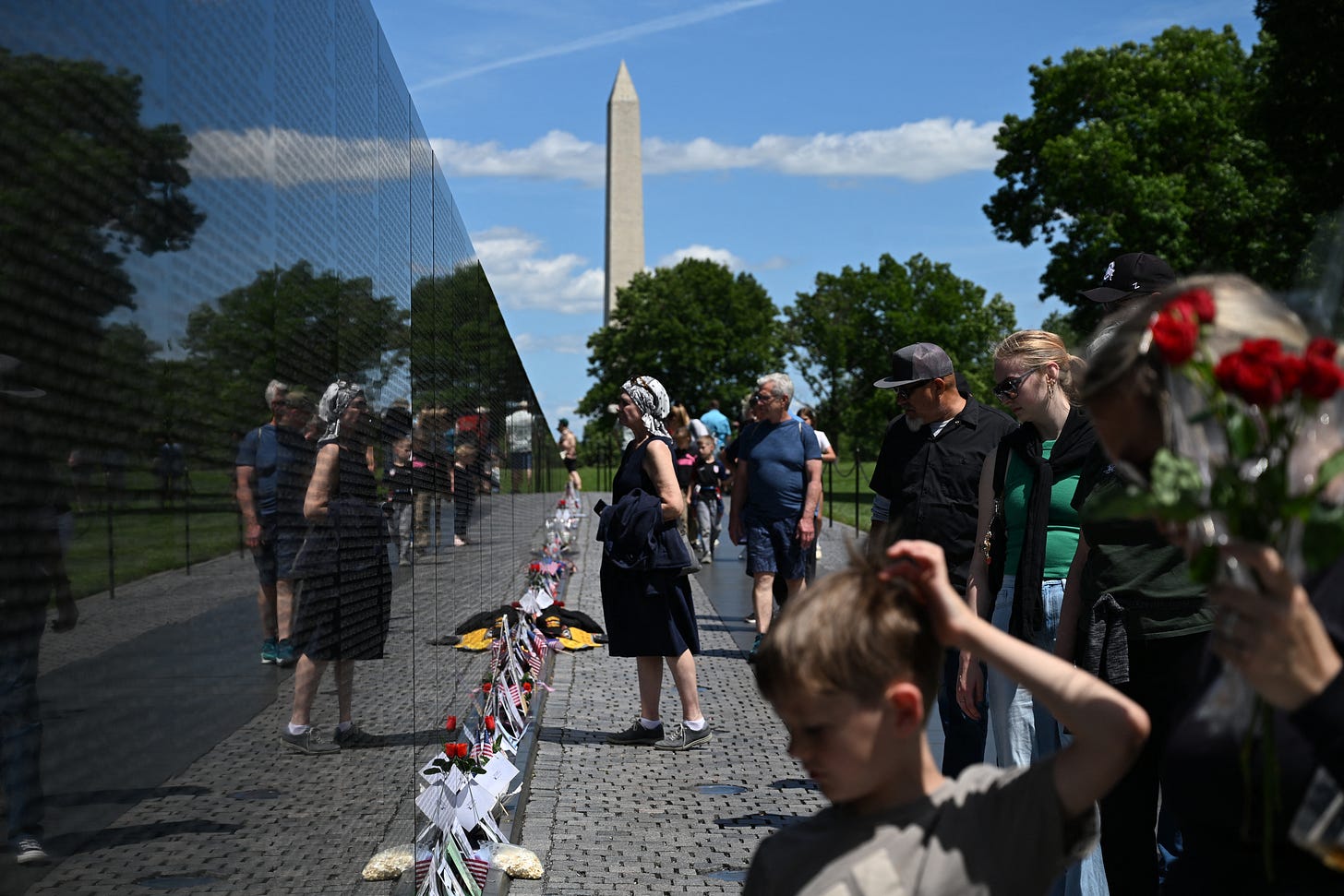
I wanted to bring him to the Vietnam War Memorial. Gen. Alizai is a student of American and military history, so it wasn’t mysterious to him why we would visit that black gash in the ground rather than the more triumphant memorials scattered around the Mall.
As we approached the Vietnam War Memorial, we discussed the parallels between the Vietnam War and the war in Afghanistan.
People pay their respects at the Vietnam Veterans Memorial during Memorial Day weekend in Washington, D.C. on May 25, 2025. (Photo by Alex Wroblewski / AFP via Getty Images)
Many historians now view the Vietnam War as just part of a longer post-colonial conflict that involved not just the United States but France, China, the Soviet Union, and others—but which had at its heart a civil war among the Vietnamese. I fear Americans don’t realize that our war in Afghanistan was also part of a civil war among Afghans—it started after the Soviets left, it never really ended, and there are still brave Afghans fighting against the Taliban now.
Gen. Alizai saw other similarities.
“The South Vietnamese perished in re-education camps,” he said. “The same thing is happening in Afghanistan.”
We, veterans of America’s latest lost war, walked gingerly through America’s memorial to its previous lost war.
“Aren’t you guys getting a memorial?” he asked me.
“I think so.”
“That’s great, bro. I wish we could give my brothers something, anything,” He said, referring to the 70,000 Afghan National Security Force personnel who were killed during twenty years of war.
“Inshallah,” I said.
“Yes, inshallah.”
Share
AS WE LEFT THE MEMORIAL, an elderly, black, wheelchair-using Vietnam veteran introduced himself to us. He was a volunteer, helping tourists find their way around. He immediately spotted my veteran attire and came over to talk to us.
I introduced him to Gen. Alizai. The two quickly connected, as combat veterans tend to do, over war stories.
“General, I’m honored to have met you. Thank you for protecting us for twenty years,” said the Vietnam vet.
“Thank you for your service, too, brother,” Gen. Alizai said. Service to whom? Not to Alizai. Not to Afghanistan. No, service to the country that tried, for a time, to do so much for Alizai and Afghanistan—and for itself—and was now at least giving so many Afghans a safe home.
These two men, who had never met and served in different armies during different wars, still understood the gravity of each other’s sacrifices: the Vietnam War veteran, who fought for a country that still didn’t treat him equally despite his heroic sacrifice, and the Afghan general, who fought with a country that purported to be his ally but abandoned his country.
Despite our country’s betrayal of both men, they remain proud to have fought for and alongside this country.
LATER IN THE DAY, WE VISITED Arlington National Cemetery and immediately headed to the Tomb of the Unknown Soldier. We quickly found a spot to observe the famous changing of the guards. The Old Guard soldiers were crisp, professional, and immaculate—a testament to the honor of being selected for one of the most prestigious posts in the U.S. armed forces.
I asked Alizai what he thought.
“I think all countries should have something similar,” he said.
“Maybe one day Afghanistan can have something similar, my friend?” I asked him.
“Inshallah.”
We walked toward the most sacred plot of land for veterans of the Global War on Terrorism: Section 60, where GWOT veterans are buried. We stopped by my friends, Capt. Jesse Melton III and Senior Airman LeeBernard Chavis, and we—a Jew and a Muslim—paid our respects to Melton and Chavis, two Christians. Our different faiths will never negate the blood, sweat, and tears we all shed.
After we paid our final respects to my friend, Gen. Alizai searched for his friend, Sgt. First Class Michael Goble. Eventually, after nearly twenty minutes of looking, he found his old friend.
“He was a good guy,” Gen. Alizai said wistfully, standing before Goble’s headstone. “We did operations together in northern Afghanistan, and then a few weeks after our final operation, he was killed.”
We both paid our respects to Gen. Alizai’s brother-in-arms. We both prayed and knelt before Goble’s grave.
“Do we have any other people to pay respects to, brother?” General Alizai asked.
“I don’t think so,” I said.
But as we turned the corner, I noticed new tombstones. We went to go look.
When I saw the names, my heart sank. “It’s the three from the Kabul 13.”
Gen. Alizai quickly joined me at the graves of Sgt. Nicole Gee, Staff Sgt. Ryan Cross, and Staff Sgt. Darin Hoover.
“These were the last Americans to be killed in Afghanistan,” I said. “I don’t know what for anymore, General,” I added, choking back tears.
“The Kabul 13 are our heroes, brother,” he said. “Just like all of your friends who died for us. We will not forget them. Whatever happened in Afghanistan, it wasn’t our fault. We all fought with honor.”
Share
NEARLY FOUR YEARS AGO, THE UNITED STATES abandoned a war that began with an attack on our cities, our government, and our way of life. In response, a generation of Americans faced repeated deployments for nearly twenty years. From Africa to the Pacific, GWOT veterans chased radical Islamic terrorists to the ends of the Earth. We proudly answered our nation’s call.
On Memorial Day, we honor those who took an oath to the Constitution, promised to give whatever was asked of them to defend it, and gave everything. We don’t honor them because they were well trained, though often they were. We don’t honor them because they were willing to kill, though they were. We don’t honor them only when they won, though often they did.
We honor them because of the bravery they showed in service of the country and the cause of freedom to which we’re all supposed to be committed.
While victory remained elusive, many veterans took pride in our efforts to rescue tens of thousands of our trusted and vetted Afghan allies. It wasn’t the American government that rescued thousands of Afghan allies from death. It was hardened combat veterans, ably assisted by civilians, who worked tirelessly to change policy or to work around it.
Our efforts and the honor that we rebuilt from the ashes of our retreat will be destroyed should President Trump initiate mass deportation efforts aimed at the very Afghans who protected America for twenty years. Whatever one thinks of America’s war in Afghanistan, our allies have earned their place among us. If it weren’t for them, more American combat veterans would be buried in Arlington, and more Gold Star families would be enduring the unimaginable today.
Share The Bulwark
Great Job Will Selber & the Team @ The Bulwark Source link for sharing this story.
[Editor’s note: What follows are President Ronald Reagan’s remarks at Arlington National Cemetery on the morning of Memorial Day in 1986, after placing a wreath at the Tomb of the Unknown Soldier.]
TODAY IS THE DAY WE PUT ASIDE to remember fallen heroes and to pray that no heroes will ever have to die for us again. It’s a day of thanks for the valor of others, a day to remember the splendor of America and those of her children who rest in this cemetery and others. It’s a day to be with the family and remember.
I was thinking this morning that across the country children and their parents will be going to the town parade and the young ones will sit on the sidewalks and wave their flags as the band goes by. Later, maybe, they’ll have a cookout or a day at the beach. And that’s good, because today is a day to be with the family and to remember.
Arlington, this place of so many memories, is a fitting place for some remembering. So many wonderful men and women rest here, men and women who led colorful, vivid, and passionate lives. There are the greats of the military: Bull Halsey and the Admirals Leahy, father and son; Black Jack Pershing; and the GI’s general, Omar Bradley. Great men all, military men. But there are others here known for other things.
Here in Arlington rests a sharecropper’s son who became a hero to a lonely people. Joe Louis came from nowhere, but he knew how to fight. And he galvanized a nation in the days after Pearl Harbor when he put on the uniform of his country and said, “I know we’ll win because we’re on God’s side.” Audie Murphy is here, Audie Murphy of the wild, wild courage. For what else would you call it when a man bounds to the top of a disabled tank, stops an enemy advance, saves lives, and rallies his men, and all of it single-handedly. When he radioed for artillery support and was asked how close the enemy was to his position, he said, “Wait a minute and I’ll let you speak to them.”
Share
Michael Smith is here, and Dick Scobee, both of the space shuttle Challenger. Their courage wasn’t wild, but thoughtful, the mature and measured courage of career professionals who took prudent risks for great reward—in their case, to advance the sum total of knowledge in the world. They’re only the latest to rest here; they join other great explorers with names like Grissom and Chaffee.
Oliver Wendell Holmes is here, the great jurist and fighter for the right. A poet searching for an image of true majesty could not rest until he seized on “Holmes dissenting in a sordid age.” Young Holmes served in the Civil War. He might have been thinking of the crosses and stars of Arlington when he wrote: “At the grave of a hero we end, not with sorrow at the inevitable loss, but with the contagion of his courage; and with a kind of desperate joy we go back to the fight.”
All of these men were different, but they shared this in common: They loved America very much. There was nothing they wouldn’t do for her. And they loved with the sureness of the young. It’s hard not to think of the young in a place like this, for it’s the young who do the fighting and dying when a peace fails and a war begins. Not far from here is the statue of the three servicemen—the three fighting boys of Vietnam. It, too, has majesty and more. Perhaps you’ve seen it—three rough boys walking together, looking ahead with a steady gaze.
The Three Servicemen Statue, part of the Vietnam Veterans Memorial. (Photo by Ian Abbott, FlickrCC BY-NC-SA 2.0)
There’s something wounded about them, a kind of resigned toughness. But there’s an unexpected tenderness, too. At first you don’t really notice, but then you see it. The three are touching each other, as if they’re supporting each other, helping each other on.
I know that many veterans of Vietnam will gather today, some of them perhaps by the wall. And they’re still helping each other on. They were quite a group, the boys of Vietnam—boys who fought a terrible and vicious war without enough support from home, boys who were dodging bullets while we debated the efficacy of the battle. It was often our poor who fought in that war; it was the unpampered boys of the working class who picked up the rifles and went on the march. They learned not to rely on us; they learned to rely on each other. And they were special in another way: They chose to be faithful. They chose to reject the fashionable skepticism of their time. They chose to believe and answer the call of duty. They had the wild, wild courage of youth. They seized certainty from the heart of an ambivalent age; they stood for something.
And we owe them something, those boys. We owe them first a promise: That just as they did not forget their missing comrades, neither, ever, will we. And there are other promises. We must always remember that peace is a fragile thing that needs constant vigilance. We owe them a promise to look at the world with a steady gaze and, perhaps, a resigned toughness, knowing that we have adversaries in the world and challenges and the only way to meet them and maintain the peace is by staying strong.
That, of course, is the lesson of this century, a lesson learned in the Sudetenland, in Poland, in Hungary, in Czechoslovakia, in Cambodia. If we really care about peace, we must stay strong. If we really care about peace, we must, through our strength, demonstrate our unwillingness to accept an ending of the peace. We must be strong enough to create peace where it does not exist and strong enough to protect it where it does. That’s the lesson of this century and, I think, of this day. And that’s all I wanted to say. The rest of my contribution is to leave this great place to its peace, a peace it has earned.
Thank all of you, and God bless you, and have a day full of memories.
Share
Great Job Ronald Reagan & the Team @ The Bulwark Source link for sharing this story.