returns to discuss whether conservatism remains valid in the MAGA era.
Leave a comment
Watch, listen or leave a comment. Ad-free editions are exclusively available for Bulwark+ members.
Don’t care for video? Use the controls on the left side of the player to toggle to the audio edition.
The Mona Charen Show is a weekly, one-on-one discussion that goes in depth on political and cultural topics. New shows drop Mondays. Find this show wherever you get your podcasts and on YouTube. Add the show to your player of choice, here.
REFERENCES:
Great Job Mona Charen & the Team @ The Bulwark Source link for sharing this story.
After the 1932 election, when Franklin Delano Roosevelt won, Democrats had big majorities in Congress and were in charge of the White House for the next decade and a half. This is when the New Deal, Social Security, the Fair Labor Standards Act, National Labor Relations Act, regulations on corporations and Wall Street, and more were passed. Then World War II started. In the 1946 midterm elections, Republicans retook control of Congress for the first time since FDR had been elected. By this point, FDR was dead, and the country shifted in a more right-wing direction.
The Republicans elected to Congress in 1946 included people like Richard Nixon and Joe McCarthy. They had seen how organized labor was getting more and more powerful in these preceding years, especially 1945–1946. There was this huge strike wave after World War II with workers fighting back against wartime inflation, wanting to keep some of the gains they had won during the war like security of union membership. These Republicans came in with a mission to stop this growth that the labor movement had been seeing.
At the same time, the fragile wartime alliance between the United States and Soviet Union was breaking down. There had always been strong anti-Soviet, anti-communist sentiment in the United States, and so the Republicans and corporate America were really eager to use this emerging Cold War, anti-Soviet animus against organized labor, and to paint the labor movement in the US as nothing more than a communist conspiracy aiming to destroy the American way of life.
So in 1947, they passed the Taft-Hartley Act, which was a series of amendments to the 1935 National Labor Relations Act that explicitly wanted to rein in the kinds of powerful, militant union tactics like secondary strikes and secondary boycotts; to allow states to pass “right-to-work” laws, which are designed to defund and bankrupt unions; and to weaken the law around who could be in a union via a number of other provisions. Harry Truman vetoed the Taft-Hartley act. But Republicans were able to override his veto, and it was passed anyway.
This was 1947. Ever since then, repealing Taft-Hartley has been the number one political and legislative agenda of the labor movement; it still hasn’t been repealed, despite numerous Democratic administrations and Democratic congresses coming in since 1947.
An important component of the Taft-Hartley Act was a provision that union officers would have to sign an affidavit swearing they were not members of the Communist Party. They didn’t have to sign affidavits saying that they had never been involved in any kind of fascist organization, or that they were not part of any other political party or political movement. It was only the Communist Party. A lot of these CIO unions were led by communists, and they would be perjuring themselves if they signed this. And that was kind of beside the point, because it was more of a matter of principle. Why should anyone have to announce what their political affiliations were as a condition of being a union official?
But the AFL’s leadership had always been conservative and anti-communist. They were jumping all over this saying, “see, this is why it’s such a bad idea to allow communists into the labor movement — it’s just going to lead to the destruction of unions.” And some of the noncommunist CIO leaders, like Philip Murray, the president of the CIO at the time, and especially Walter Reuther, the up-and-coming, just elected president of the UAW, agreed. Taft-Hartley helped to give more justification to the CIO for a purge of communist-led unions. And Taft-Hartley really did kneecap organized labor. You could see union density growing between the late 1930s and the mid-1940s, right up until Taft-Hartley was passed. Ever since then, union density has been in decline.
Great Job Jeff Schuhrke & the Team @ Jacobin Source link for sharing this story.
ON MAY 14, HOMELAND SECURITY SECRETARY Kristi Noem, citing “improved security” and a “stabilizing economy,” rescinded President Joe Biden’s Temporary Protective Status order providing legal residence for more than 10,000 Afghans who came to the United States after the Taliban took over their country. This decision, which will terminate their legal status in less than a month, is a betrayal not only of American values and the Afghans themselves, but also of a generation of American combat veterans. On Memorial Day, it’s important to remember not just the people who died in service of the country, but why they died. As Lincoln said on the battlefield at Gettysburg, “It is rather for us to be here dedicated to the great task remaining before us—that from these honored dead we take increased devotion to that cause for which they gave the last full measure of devotion.”
In less than a month, Afghans, many of whom fought and risked their lives to protect Americans over the course of twenty years, may be deported back to the very government that remains allied with al Qaeda. We asked for their help to hunt down the people who attacked us on September 11th, and at infinite personal risk, they gave it. Then we offered our help, giving them a safe place to live—and now we’re going back on our word.
President Donald Trump, who excited some with empty talk of returning to Bagram Airfield, has reverted to form: He understands nothing of honor, sacrifice, or courage. He speaks often of honoring America’s heroes. But he doesn’t understand duty, the commitment to a mission, a devotion to something larger than the self.
I often wish President Trump would dare to spend a day with some of our Afghan allies. Perhaps then, he would comprehend the gravity of the situation facing these people who bet everything on America. Had he spent a day with me on the National Mall with my good friend, Lt. Gen. Haibatullah Alizai, he could have seen that our Afghan allies are our friends and family. And he might have understood why it’s impossible to honor those who gave their lives for this country if you abuse and betray those who fought alongside them.
Share
I’VE TAKEN A FEW AFGHANS to Arlington National Cemetery before, but nobody truly grasped the weight of America’s betrayal like Gen. Alizai. He not only lost a war but lost his army and his country. Despite America’s abandonment, he, like nearly all Afghans, is grateful for his place here in America.
“I’m the lucky one,” he often reminds me.
We first met in 2014 when I was a young major advising the Afghan National Police’s Directorate of Intelligence, which Alizai’s father ran. Haibatullah was then a rising colonel working behind the scenes with his father’s advisers to hunt al Qaeda in the shadows. We met again in 2020 during America’s fateful final year of the war. We became friends as everything fell apart. As senior leaders fled the country, Haibatullah became the final commanding general of the Afghan National Army. First we tried to keep the Afghans in the fight. Then we tried to slow the collapse. Then we tried to save whoever we could—and we still are. He lives near me now—but his heart is in Afghanistan.
On a beautiful, sunny spring day in D.C., Gen. Alizai and I walked around the National Mall.
“Who would’ve thought a few years ago we would be here today,” he chuckled.
I wanted to bring him to the Vietnam War Memorial. Gen. Alizai is a student of American and military history, so it wasn’t mysterious to him why we would visit that black gash in the ground rather than the more triumphant memorials scattered around the Mall.
As we approached the Vietnam War Memorial, we discussed the parallels between the Vietnam War and the war in Afghanistan.
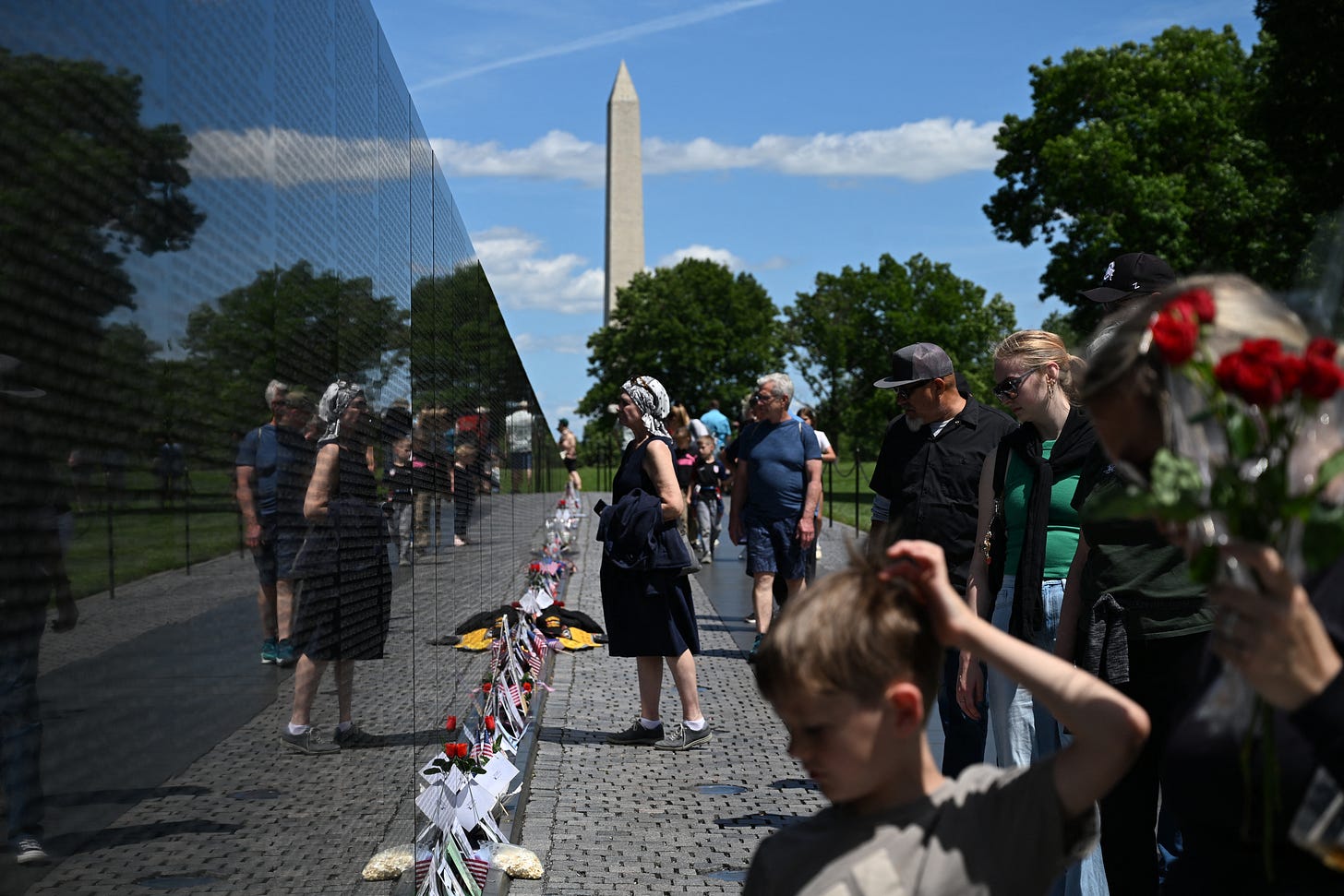
People pay their respects at the Vietnam Veterans Memorial during Memorial Day weekend in Washington, D.C. on May 25, 2025. (Photo by Alex Wroblewski / AFP via Getty Images)
Many historians now view the Vietnam War as just part of a longer post-colonial conflict that involved not just the United States but France, China, the Soviet Union, and others—but which had at its heart a civil war among the Vietnamese. I fear Americans don’t realize that our war in Afghanistan was also part of a civil war among Afghans—it started after the Soviets left, it never really ended, and there are still brave Afghans fighting against the Taliban now.
Gen. Alizai saw other similarities.
“The South Vietnamese perished in re-education camps,” he said. “The same thing is happening in Afghanistan.”
We, veterans of America’s latest lost war, walked gingerly through America’s memorial to its previous lost war.
“Aren’t you guys getting a memorial?” he asked me.
“I think so.”
“That’s great, bro. I wish we could give my brothers something, anything,” He said, referring to the 70,000 Afghan National Security Force personnel who were killed during twenty years of war.
“Inshallah,” I said.
“Yes, inshallah.”
Share
AS WE LEFT THE MEMORIAL, an elderly, black, wheelchair-using Vietnam veteran introduced himself to us. He was a volunteer, helping tourists find their way around. He immediately spotted my veteran attire and came over to talk to us.
I introduced him to Gen. Alizai. The two quickly connected, as combat veterans tend to do, over war stories.
“General, I’m honored to have met you. Thank you for protecting us for twenty years,” said the Vietnam vet.
“Thank you for your service, too, brother,” Gen. Alizai said. Service to whom? Not to Alizai. Not to Afghanistan. No, service to the country that tried, for a time, to do so much for Alizai and Afghanistan—and for itself—and was now at least giving so many Afghans a safe home.
These two men, who had never met and served in different armies during different wars, still understood the gravity of each other’s sacrifices: the Vietnam War veteran, who fought for a country that still didn’t treat him equally despite his heroic sacrifice, and the Afghan general, who fought with a country that purported to be his ally but abandoned his country.
Despite our country’s betrayal of both men, they remain proud to have fought for and alongside this country.
LATER IN THE DAY, WE VISITED Arlington National Cemetery and immediately headed to the Tomb of the Unknown Soldier. We quickly found a spot to observe the famous changing of the guards. The Old Guard soldiers were crisp, professional, and immaculate—a testament to the honor of being selected for one of the most prestigious posts in the U.S. armed forces.
I asked Alizai what he thought.
“I think all countries should have something similar,” he said.
“Maybe one day Afghanistan can have something similar, my friend?” I asked him.
“Inshallah.”
We walked toward the most sacred plot of land for veterans of the Global War on Terrorism: Section 60, where GWOT veterans are buried. We stopped by my friends, Capt. Jesse Melton III and Senior Airman LeeBernard Chavis, and we—a Jew and a Muslim—paid our respects to Melton and Chavis, two Christians. Our different faiths will never negate the blood, sweat, and tears we all shed.
After we paid our final respects to my friend, Gen. Alizai searched for his friend, Sgt. First Class Michael Goble. Eventually, after nearly twenty minutes of looking, he found his old friend.
“He was a good guy,” Gen. Alizai said wistfully, standing before Goble’s headstone. “We did operations together in northern Afghanistan, and then a few weeks after our final operation, he was killed.”
We both paid our respects to Gen. Alizai’s brother-in-arms. We both prayed and knelt before Goble’s grave.
“Do we have any other people to pay respects to, brother?” General Alizai asked.
“I don’t think so,” I said.
But as we turned the corner, I noticed new tombstones. We went to go look.
When I saw the names, my heart sank. “It’s the three from the Kabul 13.”
Gen. Alizai quickly joined me at the graves of Sgt. Nicole Gee, Staff Sgt. Ryan Cross, and Staff Sgt. Darin Hoover.
“These were the last Americans to be killed in Afghanistan,” I said. “I don’t know what for anymore, General,” I added, choking back tears.
“The Kabul 13 are our heroes, brother,” he said. “Just like all of your friends who died for us. We will not forget them. Whatever happened in Afghanistan, it wasn’t our fault. We all fought with honor.”
Share
NEARLY FOUR YEARS AGO, THE UNITED STATES abandoned a war that began with an attack on our cities, our government, and our way of life. In response, a generation of Americans faced repeated deployments for nearly twenty years. From Africa to the Pacific, GWOT veterans chased radical Islamic terrorists to the ends of the Earth. We proudly answered our nation’s call.
On Memorial Day, we honor those who took an oath to the Constitution, promised to give whatever was asked of them to defend it, and gave everything. We don’t honor them because they were well trained, though often they were. We don’t honor them because they were willing to kill, though they were. We don’t honor them only when they won, though often they did.
We honor them because of the bravery they showed in service of the country and the cause of freedom to which we’re all supposed to be committed.
While victory remained elusive, many veterans took pride in our efforts to rescue tens of thousands of our trusted and vetted Afghan allies. It wasn’t the American government that rescued thousands of Afghan allies from death. It was hardened combat veterans, ably assisted by civilians, who worked tirelessly to change policy or to work around it.
Our efforts and the honor that we rebuilt from the ashes of our retreat will be destroyed should President Trump initiate mass deportation efforts aimed at the very Afghans who protected America for twenty years. Whatever one thinks of America’s war in Afghanistan, our allies have earned their place among us. If it weren’t for them, more American combat veterans would be buried in Arlington, and more Gold Star families would be enduring the unimaginable today.
Share The Bulwark
Great Job Will Selber & the Team @ The Bulwark Source link for sharing this story.
[Editor’s note: What follows are President Ronald Reagan’s remarks at Arlington National Cemetery on the morning of Memorial Day in 1986, after placing a wreath at the Tomb of the Unknown Soldier.]
TODAY IS THE DAY WE PUT ASIDE to remember fallen heroes and to pray that no heroes will ever have to die for us again. It’s a day of thanks for the valor of others, a day to remember the splendor of America and those of her children who rest in this cemetery and others. It’s a day to be with the family and remember.
I was thinking this morning that across the country children and their parents will be going to the town parade and the young ones will sit on the sidewalks and wave their flags as the band goes by. Later, maybe, they’ll have a cookout or a day at the beach. And that’s good, because today is a day to be with the family and to remember.
Arlington, this place of so many memories, is a fitting place for some remembering. So many wonderful men and women rest here, men and women who led colorful, vivid, and passionate lives. There are the greats of the military: Bull Halsey and the Admirals Leahy, father and son; Black Jack Pershing; and the GI’s general, Omar Bradley. Great men all, military men. But there are others here known for other things.
Here in Arlington rests a sharecropper’s son who became a hero to a lonely people. Joe Louis came from nowhere, but he knew how to fight. And he galvanized a nation in the days after Pearl Harbor when he put on the uniform of his country and said, “I know we’ll win because we’re on God’s side.” Audie Murphy is here, Audie Murphy of the wild, wild courage. For what else would you call it when a man bounds to the top of a disabled tank, stops an enemy advance, saves lives, and rallies his men, and all of it single-handedly. When he radioed for artillery support and was asked how close the enemy was to his position, he said, “Wait a minute and I’ll let you speak to them.”
Share
Michael Smith is here, and Dick Scobee, both of the space shuttle Challenger. Their courage wasn’t wild, but thoughtful, the mature and measured courage of career professionals who took prudent risks for great reward—in their case, to advance the sum total of knowledge in the world. They’re only the latest to rest here; they join other great explorers with names like Grissom and Chaffee.
Oliver Wendell Holmes is here, the great jurist and fighter for the right. A poet searching for an image of true majesty could not rest until he seized on “Holmes dissenting in a sordid age.” Young Holmes served in the Civil War. He might have been thinking of the crosses and stars of Arlington when he wrote: “At the grave of a hero we end, not with sorrow at the inevitable loss, but with the contagion of his courage; and with a kind of desperate joy we go back to the fight.”
All of these men were different, but they shared this in common: They loved America very much. There was nothing they wouldn’t do for her. And they loved with the sureness of the young. It’s hard not to think of the young in a place like this, for it’s the young who do the fighting and dying when a peace fails and a war begins. Not far from here is the statue of the three servicemen—the three fighting boys of Vietnam. It, too, has majesty and more. Perhaps you’ve seen it—three rough boys walking together, looking ahead with a steady gaze.
The Three Servicemen Statue, part of the Vietnam Veterans Memorial. (Photo by Ian Abbott, FlickrCC BY-NC-SA 2.0)
There’s something wounded about them, a kind of resigned toughness. But there’s an unexpected tenderness, too. At first you don’t really notice, but then you see it. The three are touching each other, as if they’re supporting each other, helping each other on.
I know that many veterans of Vietnam will gather today, some of them perhaps by the wall. And they’re still helping each other on. They were quite a group, the boys of Vietnam—boys who fought a terrible and vicious war without enough support from home, boys who were dodging bullets while we debated the efficacy of the battle. It was often our poor who fought in that war; it was the unpampered boys of the working class who picked up the rifles and went on the march. They learned not to rely on us; they learned to rely on each other. And they were special in another way: They chose to be faithful. They chose to reject the fashionable skepticism of their time. They chose to believe and answer the call of duty. They had the wild, wild courage of youth. They seized certainty from the heart of an ambivalent age; they stood for something.
And we owe them something, those boys. We owe them first a promise: That just as they did not forget their missing comrades, neither, ever, will we. And there are other promises. We must always remember that peace is a fragile thing that needs constant vigilance. We owe them a promise to look at the world with a steady gaze and, perhaps, a resigned toughness, knowing that we have adversaries in the world and challenges and the only way to meet them and maintain the peace is by staying strong.
That, of course, is the lesson of this century, a lesson learned in the Sudetenland, in Poland, in Hungary, in Czechoslovakia, in Cambodia. If we really care about peace, we must stay strong. If we really care about peace, we must, through our strength, demonstrate our unwillingness to accept an ending of the peace. We must be strong enough to create peace where it does not exist and strong enough to protect it where it does. That’s the lesson of this century and, I think, of this day. And that’s all I wanted to say. The rest of my contribution is to leave this great place to its peace, a peace it has earned.
Thank all of you, and God bless you, and have a day full of memories.
Share
Great Job Ronald Reagan & the Team @ The Bulwark Source link for sharing this story.
There are legitimate uses for AI voice cloning, including helping people with disabilities and creating audio translations of people speaking in different languages. But there is also enormous potential for harm, said Sarah Myers West, co-executive director of the AI Now Institute, a think tank that focuses on the consequences of AI policy.
“This could obviously be used for fraud, scams and disinformation, for example impersonating institutional figures,” West told NBC News.
To read more, click here
The post AI can steal your voice, and there’s not much you can do about it appeared first on AI Now Institute.
Great Job AI Now Institute & the Team @ News Archives – AI Now Institute Source link for sharing this story.
MELISSA MURRAY (HOST): Rand Paul is not persuaded, but Speaker Johnson says he wants this bill passed in as close to its current form as possible. What are the odds that that actually happens, Angelo?
ANGELO CARUSONE (PRESIDENT, MEDIA MATTERS FOR AMERICA): I mean, look, I think one of the ways to assess those odds is to look at what’s happening where the real power is in the Republican Party, and that is their larger right-wing media. I mean, they have narrative dominance. That’s where they — that is where they build and organize power. That is how they maintain it. That is the real whip when it comes to counting votes. And if you look at how the right-wing media is handling this, they’re enthusiastic about the bill. There isn’t really any discussion or lamenting about the effects on Medicaid. Yeah, they accept the fact that it’s going to add some money to the deficit, but they’re largely bought in on this idea that somehow this legislation is going to lead to this, this bounty of riches at some point that will easily offset any of the debts and costs and deficits. And I think that’s the real tell. The only one out there really driving any, you know, warning signs that I think has any legs is Bannon, who’s really reminding the rest of MAGA and Trump’s world that they really need to be careful and tread lightly when it comes to Medicaid, given how many of Trump’s supporters are actually on it. So when this comes into pass, this could actually hurt them politically. So, what do I honestly think the odds are right now? They’re in favor of the bill passing in as close to form as possible. And I think the fact that you have to point to Rand Paul as the principal person opposing this, who’s been opposed to a bunch of other things, and it hasn’t really been reflective of where the rest of the party is is a really big tell. They might get some sandpaper on the edges but at the end of the day, they’ve demonstrated that Trump is, you know, that they capitulate to Trump and give him what he wants. I don’t see why this would be any different. They’ve already abdicated their role and responsibility as a separate branch of government.
…
MURRAY: Angelo, Susan is echoing the words of former Chicago mayor and Obama’s first White House chief of staff, Rahm Emanuel. Emanuel wrote a column saying that this bill should be understood by the public in just one phrase, quote, “Tax cuts for the wealthy, health care cuts for the many.” Is that a message that we will be seeing going forward? And will it have the kind of impact that Susan predicts?
CARUSONE: So, I think there’s a keyword in that quote that, you know, it’s not that — that proceeds what he actually delivers as the message, which is that it has to be understood by all. And, in order to understand it, you have to hear it first and the thing to just keep in mind here is the landscape — the information landscape is so incredibly and deeply lopsided. If you just aggregate the top online programs where people get information, you look at where people are subscribed to, so the top 500 or so, 82% of the audience is subscribed to right-leaning online shows. That’s a 4-to-1 advantage. I mean, that is incredible. And that’s the landscape that Democrats — and even if they have that perfect message, that good message, and that’s a solid message. Even that message still has to — has to be distributed and spread and heard and connected. And that’s the real question here is not whether or not Democrats can rally around a specific message, but can they distribute it and saturate it sufficiently in a landscape that is so incredibly uneven? And I think that’s the real tell. Otherwise, we’re going to see what’s happened time and time and again, that Donald Trump will do sort of — and the right-wing media around them — will do sort of a Rumpelstiltskin effect and will take the harms, the bad things that happen, these consequences, and they will spin it into something positive or some string to get his people to move to the next thing. And the last like footnote is that we shouldn’t lose sight of the fact that we are in a moment right now where they are transitioning to something deeply anti-democratic, small “d.” And maybe they don’t care about the traditional rules of politics because they plan on consistently trying to jam things through that they’re not really interested in getting a majority, they’re interested in might makes right and force of will.
Great Job Media Matters for America & the Team @ Media Matters for America Source link for sharing this story.
The Endangered Species Act always had a hole in it. It was intended to protect ecosystems as well as individual species—it says so right in the original 1973 text—but it has no provisions to do so directly. For decades, conservationists successfully plugged that hole by arguing in court that the ESA’s prohibition of harm to individual species includes destroying a species’ habitat. Now the Trump administration wants to negate that argument by asserting that to harm an endangered species means only to injure or kill it directly: to rip it out by the roots or blow it away with a shotgun.
Habitat destruction has been the most common threat to endangered species in the U.S. since 1975. If the administration succeeds in redefining harm to exclude it, the Endangered Species Act won’t be able to effectively protect most endangered species.
That much of the act’s power can be destroyed by tweaking its definition of one phrase reveals its central weakness. Preserving old-growth forest for a single owl species (to give a classic example) means the forest—and everything living there—suddenly loses protection if that owl goes extinct anyway (as the northern spotted owl very well could). And the law requires that the government undertake heroic and expensive measures to save the most imperiled species, rather than using habitat protection to shore up populations before they truly crash. “The act has no concept of preventive medicine,” the conservation advocate and author Suzanne Winckler wrote in these pages in 1992. “On the contrary, it attempts to save the hardest cases, the equivalent of the terminally ill and the brain-dead.”
Conservationists haven’t really wanted to talk about this, though, on the theory that opening debate about the law would risk losing it all. The ESA passed during a unique moment in the early 1970s, when a Republican president could talk about the nation’s “environmental awakening,” and for all its flaws, the act is still considered one of the strongest and most effective biodiversity-protection laws in the world. But the Trump administration has now opened that debate—forcing a conversation about how we protect species and ecosystems that some conservationists say is long overdue.
Many conservationists have a long-standing dream solution to the ESA’s circuitous mechanism for protecting places: What if we just protected ecosystems directly? Forty-one percent of terrestrial American ecosystems are at risk of collapse, according to a 2023 report by NatureServe, a nonprofit that collects and analyzes data on biodiversity. Most of them are largely unprotected.
Jay Odenbaugh, an environmental philosopher at Lewis & Clark College, in Portland, Oregon, told me that shifting to protecting ecosystems would obviate the need to “chase down every last little species.” It would be more efficient. “We can’t save everything,” Odenbaugh said. “What we are trying to do is protect larger structural features.”
Reed Noss, a conservationist based at the University of Florida and the Southeastern Grasslands Institute, does still want to try to save every species. But he argues that only a few—large carnivores that face persecution and orchids collected for illegal trading, for example—need special, individual protections. Meanwhile, Noss estimates that 85 percent of species could be saved by simply protecting a sufficiently large chunk of each type of American ecosystem. He has therefore been one of the most vocal advocates for what he calls a “native ecosystem–protection act” to supplement the ESA since the 1990s.
The U.S. already has multiple systems that categorize lands and fresh water into ecosystem types. The U.S. National Vegetation Classification, for instance, describes natural systems at a series of scales from very broad types, such as “Forest & Woodland,” to hyper-specific descriptors, such as “Eastern White Pine-Eastern Hemlock Lower New England-Northern Piedmont Forest.” An ecosystem-protection act would direct the government to choose (or develop) one such classification system, then ensure that each type of ecosystem had sufficient area protected.
Making that decision would surely involve ecologists arguing over how to categorize ecosystems. Philosophers might argue about whether ecosystems even exist—if they are more than the sum of the organisms that comprise them. But, for the purposes of policy, more important than arriving at essential truths would be creating categories that make sense to the public and describe the things the public cares about: old-growth forest, tallgrass prairie, the Everglades, Great Basin sagebrush steppe, the deciduous forests of the Northeast, and so on. Something like this was tried with Pacific Northwest old-growth forest in the 1990s; known as the Northwest Forest Plan, it is meant to protect not just the owl but old growth more broadly—but the plan, which is still in use, covers only one ecosystem type.
Part of the appeal of a system that directly protects ecosystems is that it recognizes that they’re dynamic. Species have always moved and evolved, shifting the composition and relationships within systems through time. And today, climate change is prompting many species to move. But Odenbaugh and Noss see ecosystems as entities that will remain coherent enough to protect. Florida, for instance, has sandhill ecosystems (sandy hills that support longleaf pine and oaks with wire grass) and wet flatwoods (which are seasonally inundated)—and “a sandhill and a flatwoods are going to remain a sandhill and a flatwoods even if their species composition changes due to climate change,” Noss told me. A robust network of many different kinds of ecosystems—especially one well connected by corridors so species can move—would support and protect most of America’s species without the government having to develop a separate plan for each flower and bee.
Many who fight on conservation’s front lines still hesitate to advocate for such a law. The Environmental Species Act, as it is, achieves similar purposes, they argue—and it could be pushed in the opposite direction that the Trump administration wants to pull it.
When I spoke with Kierán Suckling, executive director for the Center for Biological Diversity, which is dedicated to forcing the federal government to abide by its own environmental laws, he described his vision of a conservation-minded president who could, like Donald Trump, use executive power quickly and aggressively, only to conserve nature. “The secretary of the interior and the head of Fish and Wildlife, they have, already, the power under the ESA to do basically anything they want, as long as it is supported by the best available science,” he said. So, in theory, they could translocate species to help them survive climate change, or broaden the boundaries of “critical habitat,” which is protected from destruction by actions taken, permitted, or funded by the federal government (unless exceptions are granted).
Daniel Rohlf, a law professor at Lewis & Clark College who has studied the ESA for more than three decades, agrees that decisive leadership could do more to protect ecosystems by skillfully wielding the current ESA: “Critical habitat” could be treated as sacrosanct. Federal actions could be assessed not just for direct harm to species but for the harm they would cause via greenhouse-gas emissions. The “range” of a species could be defined as its historic or possible range, not just the scraps of territory it clings to in the present. “You could do all that tomorrow under the current version of the act,” Rohlf told me. And he believes that, unlike many of the actions Trump is taking, a lot of these stronger interpretations would likely hold up in court.
The political prospects for an entirely new ecosystem-protection act are low, even in a Democratic administration: Although 60 percent of Americans tell pollsters that “stricter environmental laws and regulations are worth the cost,” these days politicians of all stripes seem to want to cut red tape and build stuff. And Suckling believes that his organization and others like it will be able to block or undo Trump’s proposed changes to the ESA’s definition of harm. “We overturned all his first-term ESA regulation changes and are confident we’ll overturn this one as well,” he said. The U.S. may well just keep conserving the way we have been, through the ESA, and often in court.
But an ecosystem-protection act could also be a unifying cause. Love for American landscapes is bipartisan, and protecting ecosystems would not necessarily mean outlawing all human use inside them. Ranching and recreation are compatible with many ecosystems. Tribal management could protect biodiversity and support traditional use. Caring for these ecosystems takes work, and that means jobs—physical, outdoor jobs, many of which can be filled by people without college degrees. Farmers and ranchers can also be compensated for tending to ecosystems in addition to growing food, buffering their income from the vagaries of extreme weather and trade wars.
The United States is an idea, but it is also a place, a beautiful quilt of ecosystems that are not valuable just because they contain “biodiversity” or even because they filter our water, produce fish and game, and store carbon. Our forests, prairies, mountains, coastlines, and swamps are knit into our sense of who we are, both individually and as a people. We love them, and we have the power to protect them, if we choose to.
#Debate #American #Conservationists
Thanks to the Team @ The Atlantic Source link & Great Job Emma Marris
EARLIER THIS MONTH, PETE BUTTIGIEG, wearing a plaid flannel shirt, sat down in his home office in Traverse City to record a video about how “overwhelming” the news felt right now.
“It’s all of the different platforms and overlapping and competing ways to get information,” he said, summoning a relatable feeling, even for casual consumers. But rather than make a plea for platform consolidation, the former transportation secretary announced that he too was expanding his repertoire. He was getting on Substack, he told his Instagram crowd.
“It’s a platform that I find makes it possible to communicate in a lot of different ways about different topics with very different audiences,” Buttigieg said, directing folks to sign up and follow him.
Buttigieg’s Substack already has over 380,000 followers, making him one of the most prominent Democrats now on the platform. But he is hardly the Magellan of the Substack movement. Since Donald Trump’s second inauguration, Democratic officials and strategists have started exploring the Substack seas in earnest.
Connecticut Sen. Chris Murphy has become a prolific Substack poster. Texas Rep. Jasmine Crockett published her first Substack newsletter last Thursday, writing that she planned to bring readers “behind-the-scenes, context, receipts . . . and, yes, sometimes, the clapbacks.” Arizona Sen. Ruben Gallego also joined on Thursday. Rahm Emanuel posted for the first time just last month and the Democratic National Committee made its debut on the platform in March.
What does the migration reveal about the ever-evolving world of political communication?
These Democrats have come to Substack both in search of new audience connections and as refugees from sites that have grown toxic or untraversable: X’s redpilled algorithm and Meta’s shadowbanned political content. As cable news becomes less relevant and as liberals have scattered across a variety of social media platforms, Substack has become one of the few places to offer stability: with a growing audience, a reliable information delivery system, and a variety of mechanisms (emails, Twitter-like “notes,” videos, and various chat tools) to convey one’s message and engage directly with followers.
The company sees an opportunity. Its employees have been meeting with congressional staffers and chatting up aides to potential 2028 presidential candidates, encouraging them to get on the platform. Substack also recently hired Alli Brennan, who worked in political guest booking at CBS News and CNN—the type of person who has phone numbers and contacts for just about everyone in D.C. whom the company is hoping to get on its platform. The goal is ambitious: they want Substack to become the essential online arena for political discourse in the upcoming election cycles.
“This movement of politicians to Substack is huge, and it’s going to get even bigger,” said Catherine Valentine, Substack’s head of politics. “I think that the 2026 and 2028 elections are going to play out on Substack.”
(Full disclosure: Although The Bulwark uses the publishing platform, Substack did not ask us to write this piece nor are we getting any special treatment for covering this trend.)
From Substack’s viewpoint, the ideal outcome would be to become a central hub for the 2028 presidential election. The platform seems ripe not just for personal essays and reflections but for 2028 primary candidates to post their policy platforms and engage in nerdy debates in the comments section. So far, the political announcements made on Substack have been around decisions not to run—Buttigieg’s first post was a piece about why he was passing on a campaign for governor or Senate in 2026 and Wisconsin Democratic Party chair Ben Wikler announced in a Substack essay earlier this spring that he would not run for another term. But Valentine envisions it as a place where candidates announce their candidacies, where reporters post their scoops, and where conversations happen among voters, operatives, and politicians.
“Substack is full of the door-knockers. These are not passive followers,” said Valentine. “I think politicians across the board are going to do whatever they can to reach these people and make them volunteers.”
While Substack is clearly well positioned heading into 2028, the same has been true of other outlets that seemed poised to dominate past cycles, only to fizzle(see: The Meerkat Election, 2016). There are also aspects of the platform that may make it limiting for candidates.
For starters, new users have to start from scratch and build up their following organically. Success on the platform requires frequent posting and constant engagement, and can be a real time-suck for those with leaner staffs. Any fundraising appeals are limited to the universe of people who are already on one’s Substack email list. And the audience is not on par, yet, with the other social media titans. More than 80 percent of adults in the United States use YouTube and 68 percent are on Facebook, according to the Pew Research Center. Some 47 percent use Instagram, 33 percent use TikTok, and 22 percent are on X. Substack was not included in Pew’s report, but the company says it has 50 million active subscribers.
Still, Democrats see Substack as one of the more promising platforms, in part because it has largely moved against the current social media trends—more essays than algorithms, intellectualism alongside influencers.
“As the World Wide Web has disintegrated into a confusing miasma of AI slop, places like Substack that allow you to have a direct one-on-one relationship with the audience have never been more valuable,” said former Obama senior adviser Dan Pfeiffer, who writes a Substack newsletter “The Message Box.”
Amanda Litman, cofounder of Run For Something, the grassroots organization that helps train first-time candidates, said the platform, on which she posts, has an “intimacy” to it. There was a “need for that kind of text-based communication that Twitter was good for to push factional intra-factional conversation,” she added.
Share
SUBSTACK EMPLOYEES SAY that similar points have come up in their conversations with lawmakers and political staffers. They often hear concerns about how social media companies can change their algorithms on a whim, often in ways that suppress political content (Meta, for example, limited its political content ahead of the 2024 election). There’s an exhaustion with cable news, which many staffers say has increasingly limited reach. Beyond the formal process of crafting stuffy press releases that no one reads, there are few mechanisms to explain a vote or a policy proposal in a personal and engaging manner. While officials like Rep. Alexandria Ocasio-Cortez have reached large audiences with Instagram, Twitch, and TikTok, it may be that Substack (along with YouTube) will prove better suited for longer-form content.
Not every high-profile Democrat or 2028 hopeful is active on the platform. But that seems like a matter of time. And many are on but simply lurking.
California Gov. Gavin Newsom hasn’t posted anything yet, but he reads at least two Substacks according to his profile, one of which is Mark Halperin’s “Wide World of News.” Massachusetts Sen. Elizabeth Warren is subscribed to “Under the Desk News,” by TikTok star V Spehar.
California Sen. Adam Schiff balances out his Substack diet with “The Parnas Perspective”by Aaron Parnas (the Gen-Z son of Lev Parnas, the close Rudy Giuliani associate) and legal scholar Harry Litman’s “Talking Feds.” Beto O’Rourke appears to be a true Substack stan; he subcribes to at least twenty of them. North Carolina Attorney General Jeff Jackson was an early Substack user, and has gained a dedicated following.
Substack employees noted that while MAGA figures like Robert F. Kennedy Jr. and Tulsi Gabbard have been on the platform for a few years, Republicans have been slower to jump on the platform compared to Democrats. But Substack thinks they, too, will eventually come. The State Department joined last month.
Leave a comment
— Four top partners at Paul Weiss announced on Friday that they would leave the law firm following its decision earlier this year to cut a deal with President Donald Trump. Among them is Karen Dunn, the prominent Democratic lawyer who led Kamala Harris’s debate preparation for her matchup against Trump. The group of lawyers said they would start their own firm.
I wrote earlier this spring about the frustration among some Democrats after high-profile members of the party did not immediately quit or publicly push back when their law firms made deals with Trump to avoid his retribution. Some Democratic officials felt like those lawyers (including figures like former second gentleman Doug Emhoff) should have immediately quit in protest. The departure of the Paul Weiss attorneys is the latest sign that prominent Democratic lawyers are responding to big firms’ capitulation to the White House. Former Obama administration Homeland Security Secretary Jeh Johnson announced earlier this month he would also leave Paul Weiss.
Share
— The death of Virginia Rep. Gerry Connolly this week reignited a conversation within the Democratic party about when older members should retire. Connolly, who died at age 75 after being diagnosed with esophageal cancer, was the third Democratic member to pass away this year. Rep. Sylvester Turner, 70, and Rep. Raúl Grijalva, 77, both died in March.
Trump’s “Big, Beautiful” spending bill narrowly passed the House on Thursday morning with a 215–214 vote. Although Republicans likely could have twisted more arms to get the votes needed to pass the bill had those three members still been alive to vote against it, the situation was one more data point for Democrats who are calling for a new generation of leadership and urging the party to do some deep reflection on its gerontocracy.
“One more point on the real danger posed by the system of seniority politics,” said DNC vice chair David Hogg. “It’s really sad that this happened, but the feelings of any particular member don’t take precedence over the millions of Americans who are going to be impacted by these bills.”
Pushing back against the gerontocracy argument, Aaron Fritschner, a staffer for Rep. Don Beyer (D-Va.), wrote on Bluesky, “I knew. . . that we’d be inundated with this take, which is understandable but wrong. They had 4 more votes if they’d needed them. Republicans did this, they made decisions, they don’t deserve to be excused this way.” But based on the replies he received, the old-age argument remains pretty persuasive. “I should just log off and leave you to your pitchforks,” he wrote after an hour.
— What are people still doing on X?
— The 2024 election was even weirder than we thought.
— Democratic Hill staffer is a contestant on next season of Survivor.
Leave a comment
Share The Bulwark
Great Job Lauren Egan & the Team @ The Bulwark Source link for sharing this story.
With Eliot still on the road, Eric welcomes Dennis Ross, Counselor and William Davidson Distinguished Fellow at the Washington Institute for Near East Policy and former Director of Policy Planning under James Baker, Special Middle East Envoy under President Clinton among several other high level national security positions at State, Defense and the White House under Presidents Carter, Reagan, Bush 41, Clinton, and Obama. Dennis is also a prolific author including his memoir of Middle East diplomacy, The Missing Peace, Doomed to Succeed – a history of U.S.-Israel relations, and most recently Statecraft 2.0: What America Needs to Lead in a Multipolar World, (New York: Oxford University Press, 2025). They discuss why Dennis chose to update his 2005 book on Statecraft, his choice of case studies including German Reunification, the First Gulf War, Bosnia, the Iraq War and the Syria policy debacle under President Obama. He describes the contending schools of thought about America’s role in the world, including America First, Restrainers, Realists, and Liberal Internationalists and their differences over the use of force, alliances, as well as the role of interests and values in American foreign policy. He outlines the habits of good statecraft, including proper assessments, use of leverage and coercion, Presidential leadership and empowering lower level officials while avoiding groupthink. Along the way they discuss Afghanistan, Libya, the war in Ukraine and Dennis’s assessment of President Trump’s trip to the Middle East and his policy approach to the war in Ukraine and changing Vladimir Putin’s calculus about war termination.
Statecraft 2.0: What America Needs to Lead in a Multipolar World
Leave a comment
Shield of the Republic is a Bulwark podcast cosponsored by the Miller Center of Public Affairs at the University of Virginia.
Great Job Eric S. Edelman & the Team @ The Bulwark Source link for sharing this story.