OKLAHOMA CITY – Thunder guard Lu Dort was ejected as tempers flared in the fourth quarter of Oklahoma City’s 127-121 overtime victory over Nikola Jokic and Denver Nuggets on Friday night.
Dort fouled Jokic, and the Denver star got in Dort’s face. A scrum ensued and Jokic and Oklahoma City’s Jaylin Williams were called for offsetting technical fouls. Dort was issued a Flagrant 2 and ejected.
The situation was brewing from the start. The Thunder beat Denver 4-3 in the Western Conference semifinals last season, and the Nuggets — especially Jokic — were committed to matching Oklahoma City’s aggressive style.
Dort was a first-team All-Defensive selection last season with a reputation for pushing the boundaries of acceptable physical play. Crew chief James Williams said after the game that Dort’s hip check/trip combination was dangerous.
“Lu Dort was assessed a flagrant foul penalty 2 because we deemed his contact on Jokic to be unnecessary and excessive with a high potential for injury, and also because the contact led to an altercation that did not dissolve,” Williams said. “So, by rule, a flagrant foul penalty 2 carries an automatic ejection.”
Jokic, who had initiated contact with Thunder players throughout the game rather than letting it come to him, finally had enough.
“It’s an unnecessary move and a necessary reaction,” Jokic said. “I think there are not supposed to be those things on the basketball floor, so it was just an unnecessary move and a necessary reaction by me.”
Nuggets coach David Adelman said he understood why Jokic finally snapped. He feels Jokic gets beat up when he’s away from the basket and doesn’t get the calls because of his 7-foot, 284-pound frame.
“I think he was reacting to what was being done to him,” Adelman said. “And his reaction’s not going to be cower away. He’s competitive.”
Thunder coach Mark Daigneault said he’s fine with the ejection as long as the call is consistent.
“If J. Will (Jalen Williams) is running off the floor and gets tripped, we expect a flagrant 2 from this point forward,” Thunder coach Mark Daigneault. said. “That’s all. If that’s the precedent, if it becomes a malicious play, and flagrant 2 is the line in the sand on that, we would expect that if it’s J. Will, we’d expect that it’s anybody. And if that is the case, we’re good.”
Oklahoma City’s Shai Gilgeous-Alexander was called for a technical in the opening minutes when he threw the ball at Jokic, who made high contact with him after play had stopped. James Williams said he did not consider the contact by Jokic’s left forearm to be unsportsmanlike.
Denver’s bench was called for a technical in the third quarter, and there was plenty of trash talking and shoving throughout.
The teams meet March 9 in Oklahoma City.
“When we play them again, whatever it is, in like 10 days, I’m sure it’ll be the exact same way,” he said.
Copyright 2026 The Associated Press. All rights reserved. This material may not be published, broadcast, rewritten or redistributed without permission.
Great Job Cliff Brunt, Associated Press & the Team @ KSAT San Antonio for sharing this story.
President Donald Trump endorsed Don Huffines and Sid Miller in their respective Republican primaries for Texas comptroller and agriculture commissioner, a last-minute boost for the candidates that directly opposes Gov. Greg Abbott’s picks in the races.
In two similarly-worded Truth Socialposts on Friday night after his appearance at an event in Corpus Christi, Trump praised Huffines, a former state senator, and Miller, the incumbent agriculture commissioner, with “complete and total endorsement[s].” The posts emphasized both candidates’ dedication to border security, veterans and the second amendment.
The endorsements could add even more pressure to Abbott’s chosen candidates, Acting Comptroller Kelly Hancock and first-time political candidate Nate Sheets, both of whom have polled behind Huffines and Miller. Abbott’s interest in the comptroller primary, in particular, extends beyond an endorsement, as the position is responsible for implementing the $1 billion school voucher program that he aggressively sought for years.
Hancock, a longtime ally of Abbott’s, has seen $2.6 million of the governor’s massive campaign war chest go toward ads in support of his candidacy, according to the latest campaign finance report. Abbott has also praised Hancock’s leadership amid the rollout of the voucher program. Hancock resigned from his state Senate seat in July to take on the comptroller role after his predecessor, Glenn Hegar, went on to become chancellor of the Texas A&M University System.
Huffines, who ran against Abbott in the 2022 Republican gubernatorial primary, has proven to be a formidable opponent for Hancock. The former state senator has garnered several other high-profile endorsements, including Sen. Ted Cruz and the late conservative activist Charlie Kirk.
The governor also endorsed Sheets, an agriculture businessman, in the GOP primary for agriculture commissioner. His endorsement of Miller’s opponent is a rare move against an incumbent and Trump ally. Abbott has described Miller’s tenure, which has been marked by scandal, as an “utter failure”
Abbott has brought both Hancock and Sheets on the campaign trail promoting the candidates. Despite Abbott’s backing, Miller and Huffines have both polled with comfortable leads ahead of Sheets and Hancock respectively.
Disclosure: Texas A&M University System and Texas Comptroller of Public Accounts have been financial supporters of The Texas Tribune, a nonprofit, nonpartisan news organization that is funded in part by donations from members, foundations and corporate sponsors. Financial supporters play no role in the Tribune’s journalism. Find a complete list of them here.
Great Job Texas Tribune, Ayden Runnels & the Team @ KSAT San Antonio for sharing this story.
In a new report that outlines a dozen high-risk pollutants given new life thanks to weakened, delayed or rescinded regulations, the Environmental Protection Network, a nonprofit, nonpartisan group of hundreds of former Environmental Protection Agency staff, warns that the EPA under President Donald Trump has abandoned the agency’s core mission of protecting people and the environment from preventable toxic exposures.
Americans may not realize the scope and scale of their exposure risk from diverse industrial and agricultural sources or understand how much those risks are rising as political appointees destroy the safety net the EPA has always provided, said Mark Boom, EPN’s senior director for public affairs, at a press briefing Thursday.
“While we may hear about one chemical or one EPA rule being changed,” Boom said, “so much is happening at once that it’s very difficult to see the full picture and connect it to our everyday lives.”
That’s why EPN developed a report, Terrible Toxics, to connect the dots, said Boom, who was joined by several EPN volunteers and medical experts on Thursday.
The report details how recent EPA decisions have relaxed restrictions on harmful chemicals in food, consumer products, water and air, increasing Americans’ exposure to 12 of the most dangerous and ubiquitous pollutants.
The list includes brain-damaging mercury and pesticides in food; hormone-bending phthalates in consumer products and cancer-causing PFAS “forever chemicals,” lead, arsenic and trichloroethylene in drinking water. Also on the list are the carcinogens benzene, formaldehyde and vinyl chloride in the air, along with heart- and lung-damaging soot and smog. All of these pollutants cause multiple health harms.
The list does not cover pollutants like greenhouse gases, which also exacerbate health harms, but is meant to illustrate the escalating health costs of Trump administration policy decisions.
“Political leadership is steering the agency away from its responsibility to protect human health and the environment,” the report warns. “Making Americans safer is a choice and EPA’s current leadership has chosen to make Americans sicker.”
The vast majority of Americans want their government to do more to protect them from dangerous chemicals, a new survey from The Pew Charitable Trusts found. More than 80 percent want the government and business to increase transparency around the use of chemicals.
Yet getting information from the current EPA is “like pulling teeth,” Boom said. “It’s probably the least transparent EPA we’ve ever had.”
The EPA has abandoned its oversight duty and failed to let Americans know what chemicals are doing to their health, said Betsy Southerland, former director of EPA’s Office of Science and Technology in the Office of Water.
As one example, said Sutherland, who is an expert on the health effects of notoriously indestructible forever chemicals, “we’re seeing fewer guardrails to prevent PFAS exposure and much less transparency about the risk.”
PFAS contaminate nearly half of all drinking water across the country, scientists with the U.S. Geological Survey reported in a 2023 study. Nearly all Americans, including babies, have PFAS in their blood.
Companies who handle PFAS have been given more leeway while the EPA is delaying safeguards and withholding science data, Sutherland said.
EPA officials have delayed deadlines that prohibit companies from discharging PFAS into waterways and require drinking water systems to take the hormone-disrupting chemicals out of tap water, she said. They have proposed exempting importers from PFAS reporting requirements, leaving consumers in the dark about what’s in the products they buy, and they’ve buried reports on PFAS health risks, she added.
“That means Americans’ toxic exposure is going up,” Southerland said, “and so are our health risks.”
Inside Climate News asked the EPA to comment on the EPN report and explain how delaying water standards for PFAS and granting waivers to coal-fired plants, which emit mercury, lead and other pollutants, makes Americans healthier.
“Referring to EPN as nonpartisan is laughable; its staff and board is loaded with Democratic operatives,” an EPA spokesperson said in a statement. “While, unsurprisingly, EPN is engaging in dishonest fearmongering to drum up media attention and donations, the Trump EPA is taking real steps to protect human health and the environment.”
Although the EPA is rolling back regulations on PFAS and allowing higher lead levels in soil, the spokesperson called the Trump EPA “unmatched” in fighting these contaminants. “The Trump EPA is committed to transparency and gold-standard science like never before to deliver on our core statutory responsibilities of protecting human health and the environment while Powering the Great American Comeback.”
Less Regulation, More Disease
Hundreds of the 80,000 chemicals registered for use under the U.S. Toxic Substances Control Act are known to be dangerous, though just a fraction have undergone safety testing. The multiple harms associated with the chemicals listed in the EPN report are well-documented.
America’s nurses are on the front lines of addressing the health impacts of toxic chemical exposures, said Sarah Bucic, a registered nurse and policy analyst with the nonpartisan Alliance of Nurses for Healthy Environments.
At the briefing, Bucic ran through the ills she expects the EPA’s deregulatory agenda will cause. More soot in the air will mean more children treated for asthma and lung diseases. More lead will result in more children with developmental, behavioral and attention-deficit problems. More benzene will lead to higher rates of blood cancers while more trichloroethylene will contribute to kidney and liver cancers, Parkinson’s disease and fetal heart defects.
“There’s nothing more heartbreaking than treating a patient, especially a child, who is sick because of something we could have prevented,” Bucic said.
Afif El-Hasan, an Orange County pediatrician and board director of the American Lung Association, is most concerned about loosened rules that increase exposure to soot, or PM2.5.
These tiny particles easily bypass the defenses of the lungs and enter the bloodstream, posing outsize risks to children’s still-developing lungs and immune system.
The EPA strengthened the national PM2.5 standard in 2024 based on hundreds of scientific studies, El-Hasan said, a move that was projected to prevent thousands of premature deaths and millions of asthma attacks over time. “Now, unfortunately, the EPA is failing to enforce these standards and is even trying to roll them back.”
And the EPA recently repealed measures to make coal and oil-fired power plants cleaner, El-Hasan said.
This story is funded by readers like you.
Our nonprofit newsroom provides award-winning climate coverage free of charge and advertising. We rely on donations from readers like you to keep going. Please donate now to support our work.
Weakening the guardrails that keep soot out of the air will mean more kids in the emergency room struggling to breathe, he said. “It means more missed school days. It means more missed work days for the parents that have to stay home and take care of the children.”
El-Hasan hopes that academic and public health institutions monitor and document the health consequences of all these rollbacks. “It’s very important that that is captured,” he said. “So that this mistake is never made again.”
Exposure Is a Choice
Health experts with EPN hope the report helps people understand the complex web of toxic exposures they encounter in daily life, where they come from and how recent policy decisions are increasing those exposures.
For decades, Americans have relied on EPA scientists to answer basic questions about the harms posed by exposure to a toxic chemical in the air, water and soil, said Chris Frey, a former EPA science advisor and leader of the Office of Research and Development, the agency’s independent scientific arm. “Over the last 13 months, EPA’s scientific backbone has been substantially diminished in ways that will affect Americans’ health and safety.”
Frey pointed to formaldehyde as just one example of the consequences of the EPA’s decision to overturn safeguards against toxic chemicals.
Nearly all Americans are exposed to some level of formaldehyde, which escapes from building materials like cabinets and flooring, and from personal care products like cosmetics.
In 2024, the EPA concluded, after more than three decades of scientific review, that formaldehyde poses cancer risk at any exposure level. The agency was on track to require companies to lessen or eliminate formaldehyde-related health risks, Frey said. “But current EPA leadership is now moving to ignore its own scientific findings,” he said, “effectively letting companies put this dangerous chemical back into play.”
There are steps consumers can take to reduce their risks, like using certified filters to reduce PFAS in their tap water and avoiding solvents with formaldehyde.
“But the burden should not fall on individuals and families to manage chemical risks on their own,” Frey said. “EPA needs to follow the science and ensure that polluting companies follow safeguards that put Americans’ health first.”
Even as the EPN team recounted numerous ways the EPA is stripping Americans of health protections, they remain hopeful that the rollbacks can be reversed.
Although ORD is now almost completely depopulated and is going to be shuttered formally, Frey said, a significant amount of its former workforce remain at the EPA. “They may not be in the roles that are best suited to their talents and experience and capabilities, but they’re still there,” he said, adding that the physical infrastructure of the research labs is still intact.
Both could be harnessed to restore the EPA’s mission, Frey said. “But you know, time is ticking. And the longer the destruction continues, the harder it will be to recover.”
There’s even a remedy for what Southerland sees as the biggest detrimental actions taken by this EPA: revocation of the endangerment finding, the basis for regulating greenhouse gases as a public health threat, and removing protections for wetlands and other ephemeral waterways under the Clean Water Act.
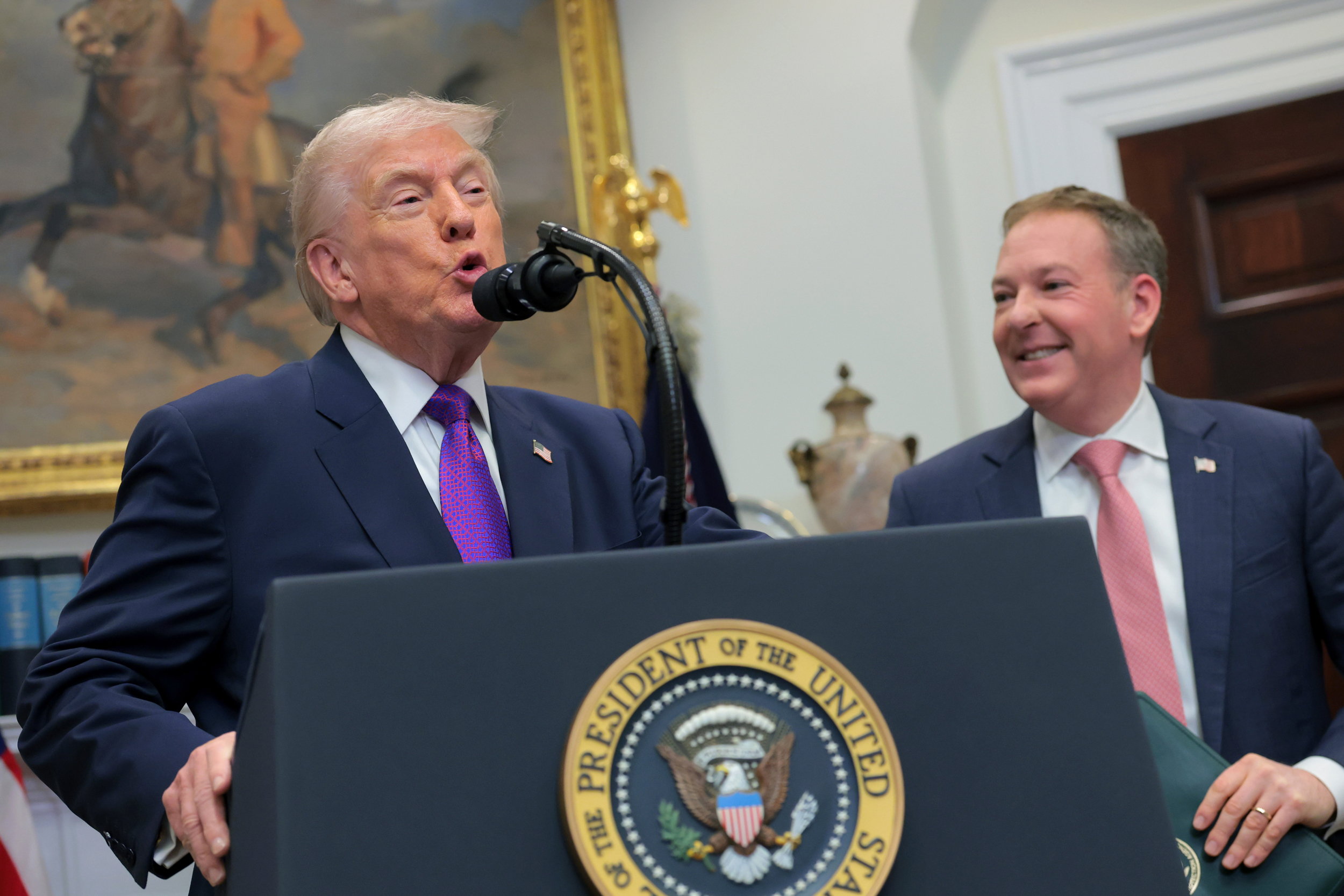
President Donald Trump speaks alongside EPA Administrator Lee Zeldin during an event announcing the rollback of the endangerment finding at the White House on Thursday. Credit: Anna Moneymaker/Getty Images
Congress can craft legislation to reinstate the endangerment finding and restore protections for the so-called “waters of the United States,” she said, though such laws would need a president who’s willing to sign them or a veto-proof majority in Congress. If the midterm elections give Democrats majorities in the House and Senate, she said, they could pass a budget that requires replacing all the staff this administration fired “as soon as possible.”
Ultimately, Boom said, exposure is not inevitable but the result of choices.
“We know how to filter PFAS from drinking water. We know how to replace lead-service lines, and we know how to reduce pesticide drift and develop safer alternatives,” Boom said. “Under the law, EPA’s mission is to protect human health and the environment. That mission was never meant to be optional.”
About This Story
Perhaps you noticed: This story, like all the news we publish, is free to read. That’s because Inside Climate News is a 501c3 nonprofit organization. We do not charge a subscription fee, lock our news behind a paywall, or clutter our website with ads. We make our news on climate and the environment freely available to you and anyone who wants it.
That’s not all. We also share our news for free with scores of other media organizations around the country. Many of them can’t afford to do environmental journalism of their own. We’ve built bureaus from coast to coast to report local stories, collaborate with local newsrooms and co-publish articles so that this vital work is shared as widely as possible.
Two of us launched ICN in 2007. Six years later we earned a Pulitzer Prize for National Reporting, and now we run the oldest and largest dedicated climate newsroom in the nation. We tell the story in all its complexity. We hold polluters accountable. We expose environmental injustice. We debunk misinformation. We scrutinize solutions and inspire action.
Donations from readers like you fund every aspect of what we do. If you don’t already, will you support our ongoing work, our reporting on the biggest crisis facing our planet, and help us reach even more readers in more places?
Please take a moment to make a tax-deductible donation. Every one of them makes a difference.
Liza Gross is a reporter for Inside Climate News based in Northern California. She is the author of The Science Writers’ Investigative Reporting Handbook and a contributor to The Science Writers’ Handbook, both funded by National Association of Science Writers’ Peggy Girshman Idea Grants. She has long covered science, conservation, agriculture, public and environmental health and justice with a focus on the misuse of science for private gain. Prior to joining ICN, she worked as a part-time magazine editor for the open-access journal PLOS Biology, a reporter for the Food & Environment Reporting Network and produced freelance stories for numerous national outlets, including The New York Times, The Washington Post, Discover and Mother Jones. Her work has won awards from the Association of Health Care Journalists, American Society of Journalists and Authors, Society of Professional Journalists NorCal and Association of Food Journalists.
Weekend Reading on Women’s Representation is a compilation of stories about women’s representation in politics, on boards, in sports and entertainment, in judicial offices and in the private sector in the U.S. and around the world—with a little gardening and goodwill mixed in for refreshment!
Milestones: Jocelyn Bell Burnell discovered pulsar, a rapidly rotating neutron star (1967); Loretta Lynch became the first African American woman to serve as U.S. Attorney General (2015); Frances Perkins, appointed secretary of labor (1933), U.S. Supreme Court upholds the 19th Amendment, guaranteeing women the right to vote (1922); Charlotte E. Ray becomes first woman graduate of Howard University School of Law, and the first female African American lawyer (1872); and Ngozi Okonjo-Iweala becomes the first woman and first African to lead the World Trade Organization (2021).
Birthdays: Ann Hendrix-Jenkins; Lois Romano, journalist; Linda Ryden, D.C. peace educator; Chelsea Handler, comedian and activist; Téa Leoni, actor; Liz Berry, Washington state representative; Jane Swift, former governor of Massachusetts; Paula Zahn, journalist; A’shanti Gholar, president of Emerge America; Nancy Vaughan, mayor of Greensboro, N.C.; Marian Anderson, first Black woman member of the New York Metropolitan Opera (1897) who performed at the Lincoln Memorial on April 9, 1939, at an event (attended by my mother and grandmother) organized by Eleanor Roosevelt after the Daughters of the American Revolution blocked her from singing at Constitution Hall; Suzanne Crouch, lieutenant governor of Indiana; Emma Petty Addams, co-executive director of Mormon Women for Ethical Government; Selvena Brooks-Powers, NYC councilwoman; Frieda Edgette, founder of Courage to Run; and Anne Tolstoi Wallach, author of Women’s Work (1929).
Democracy Solutions Summit: Join Our Three-Day Online Summit of Women Political Experts and Leaders
As we prepare for this year’s Democracy Solutions Summit (March 10-12 from 3-5 p.m. ET), I keep returning to a simple idea: Democracy is not self-executing. It does not expand or contract on its own. It evolves because people shape it through laws, institutions, culture and the incentives we embed into our political systems over time. That is why we structured this year’s Summit around three interconnected days focusing on where we’ve been, where we are and where we’re going. It felt like the most honest way to approach this moment—not as a single crisis or a single breakthrough, but as part of a longer arc.
We begin by grounding ourselves in history to understand the many ways trailblazing women have paved the way for us to walk on today. The Voting Rights Act did not simply symbolize progress; it structurally expanded representation. The Equal Rights Amendment continues to challenge us to define equality in constitutional terms. The infrastructure built in the wake of the “Year of the Woman” did more than elect candidates; it reshaped pathways into power. These were not isolated milestones, but were design decisions that altered who could lead and how.
From there, we turn to the present. We examine political violence not as a string of isolated incidents, but as a structural barrier. We assess institutional trust and the strength of leadership pipelines. We look beyond our borders to understand how other democracies have structured representation differently, and what lessons remain available to us. If we are serious about strengthening democracy, we must be willing to look clearly at the conditions shaping it today.
And then we turn to what comes next. On our final day, we will speak directly with leaders in the democracy reform movement and with elected officials navigating institutions in real time. Members of the Democratic Women’s Caucus will join us to discuss their Better Future Agenda and what it means to translate values into policy. We will hear from those building pipelines, shaping legislation and rethinking what durable representation truly requires.
We will also make space for something equally essential: hope. This year includes a special feature that centers on the next generation and reminds us that the future of democracy is not abstract. A new way of leading is already forming in the expectations we set, the systems we reinforce and the leadership we choose to cultivate.
Because ultimately, the forward-looking question is not only about policy, but about power: how it is shared, how it is sustained and how it is practiced. Women’s political power has never simply been about presence; it has been about reshaping the culture and structure of leadership itself.
If democracy is built, then it can be built differently—in ways that elevate steadiness over spectacle, collaboration over dominance and accountability over ego. We hope you will join us next month as we continue that work together
SAVE Act Blocks Women, Young and Low-Income Voters
Ms. magazine’s executive editor, Kathy Spillar, takes on the SAVE Act, which has passed the House. With Maine’s Susan Collins (R) a new convert in the Senate, the threat of a filibuster is the only barrier to passage. Spillar explains why that would be so dangerous:
Under the SAVE Act, people would have to show “proof of citizenship,” in the form of a passport or a birth certificate, in order to be allowed to register to vote.
But 21.3 million people (more than 9 percent of Americans) don’t have these documents readily available, and at least 3.8 million don’t have them at all, according to the Brennan Center for Justice. Just over half of Americans (51 percent) lack a passport, a document that is time-consuming and costly to acquire or replace.
In mandating these documents, the government would be effectively instituting a “poll tax” similar to that used in Southern states before the passage of the Voting Rights Act in 1965 to deny Black citizens their right to vote. The SAVE Act will also disproportionately impact women who have changed or hyphenated their names, which is over 80 percent of women married to men…
If this outrages you as much as it outrages us, call your senators—especially if you live in states with one or two Republican senators—and urge them to oppose the SAVE Act. Click here to find your senators’ information, or call the Capitol switchboard directly at (202) 224-3121, and ask for your senator’s office. We also urge you to call Sen. Majority Leader John Thune at (202) 224-2321. As the head of the Senate, he needs to hear from everyone outraged by this blatant attempt to curtail women’s voting power.
Women as Voters are Powerful—and Unhappy with Macho Governance
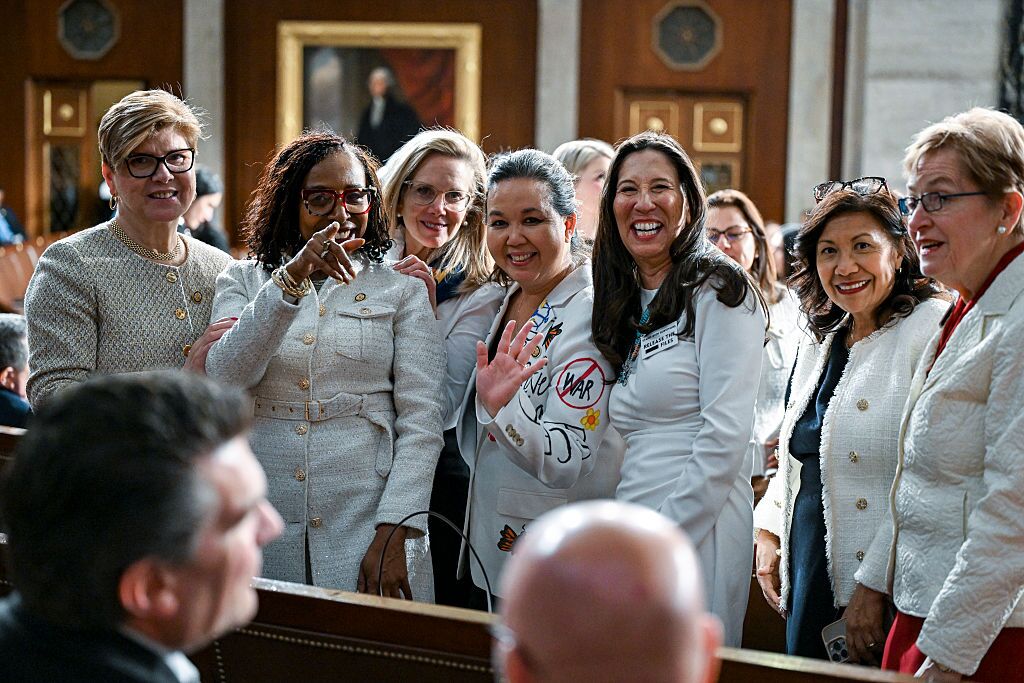
U.S. Reps. Nellie Pou (D-N.J.), Yvette Clarke (D-N.Y.), Jill Tokuda (D-Hawaii), Teresa Leger Fernandez (D-N.M.), Norma Torres (D-Calif.) and Marcy Kaptur (D-Ohio) prior to President Donald Trump’s State of the Union address on Feb. 24, 2026. (Kenny Holston / Getty Images)
Ron Brownstein asks (behind a CNN paywall) whether “The GOP’s Biggest 2026 Risk May Be Hiding in Plain Sight.” Here’s an extended excerpt that lifts up the broader reality of what issues matter more to women in men—and what they are seeking in their elected representatives.
Celinda Lake, a longtime Democratic pollster, has a simple formula for her party’s success: Democrats triumph in elections when they win among women by more than Republicans win among men.
Democrats passed that test in the 2018 midterm and 2020 presidential elections, and flunked it during the 2022 midterm and 2024 presidential elections, exit polls show. This year, polls offer Democrats encouragement that they could again come out on the right side of Lake’s equation in November.
Trump’s approval rating among men has run close to even in many recent national polls. But those same surveys now routinely show him confronting cavernous deficits among women, with 60 percent or more of them typically saying they disapprove of his performance in office.
Indeed, for all the understandable focus on Trump’s erosion among the untraditional groups of voters that moved toward him in 2024—young men, Latinos, working-class non-White voters—the GOP’s greatest threat in 2026 may be hiding in plain sight: towering discontent among female voters about what Trump has, and has not, done in his second term…
Women are also more likely than men to say Trump’s policies are compounding, rather than alleviating, their financial squeeze.In a recent Fox News poll, about three times as many female voters said they have been hurt than helped by Trump’s economic policies; male voters divided more closely. Likewise, in a January Marquette University Law School survey, almost two-thirds of women (compared with just over half of men) said Trump’s policies had increased rather than reduced inflation. Women are consistently much more hostile in polls to Trump’s tariffs than men.
I am so grateful to the team at the Center for American Women in Politics. As the 2026 primary season gets underway, here is CAWP’s summary of its resources associated with the 2026 elections.
2026 Summary of Women Candidates: All the numbers on women running for Congress, governor, other statewide elective executive offices, and state legislature, with accompanying data visualizations. Comparisons of 2026 data to historical records and previous election cycles.
2026 Potential and Filed Women Candidates: Full list of announced and potential women candidates for Congress, governor, and other statewide elective executive offices. Real-time updates throughout the primary season will become the official list of all filed candidates once filing deadlines have passed.
Election Results and Analysis: Results for women candidates in every primary election contest alongside analysis of trends and data in election 2026 from CAWP experts and external scholars.
Women, Money, & Politics Watch 2026: Launching in early March, this resource will analyze gender and campaign finance data throughout the 2026 election from both a candidate and donor perspective.
Rebound Candidates in 2026 Elections: List of candidates who lost a 2024 congressional or statewide election but are running again for the same or different office.
Woman vs. Woman: Congressional and Gubernatorial Races: Tracks every general election contest for Congress or governor in which both major-party nominees are women. Links to a full list of all such elections going back to 1944, when the first all-woman general election for these offices occurred.
Historical Facts on Women Candidates: Decades of CAWP data on women candidates and nominees for president, vice president, Congress, statewide elective executive offices, including governorships, and state legislatures. This page also includes information on the current records for women candidates and nominees for various levels of office, with breakdowns by party.
Data on Officeholders: Explore women’s current political representation from local office all the way up to Congress, and see women’s representation in your state with our interactive state-by-state map. Also see CAWP’s Women Elected Officials Database, which contains entries for every woman who has served in statewide executive office, state legislature, Congress, and federal executive office, dating back to 1893, when the first woman was elected to statewide office.
Data on Voters: Women vote in larger numbers and higher proportions than their male counterparts. Explore historical information on gender differences in registration and turnout, as well as gender gaps in vote choice and party identification.
Columnist: Crowded Illinois Primaries on March 17 Call for Ranked-Choice Voting
Holly Kim, one of the four women seeking the Democratic nomination for Illinois state comptroller. (Facebook)
Award-winning journalist Mar Halperin has a terrific Chicago Tribune column walking through the slew of Democratic primaries for U.S. Senate and U.S. House, where the winner will be heavily favored in November. Multiple women are running, yet the “choose-one” ballots undermine efforts to build coalitions and to be truly representative of voters. Here’s an excerpt where she proposes a solution that RepresentWomen has long seen as an advance for women and for our democracy.
Although attention in the Illinois race for U.S. Senate focuses on the three top contenders, there are seven others in the race; each can pull a small percentage of voters to distort the outcome in this race, too.
The candidate with the most votes in a congressional race—no matter how few—will be the winner of the Democratic primary, which generally determines the winner in November as well. This means Illinois can expect to seat new members of Congress with meager voter support, unless a record number of candidates choose to drop out and endorse another in the remaining weeks of this election. Even if candidates do coalesce, ballots are printed and early voting underway, so the opportunity to influence an outcome in this way is fading fast.
But why should the system put this pressure on (mostly) newcomers who want to serve? Why should voters have a limited choice in a field with abundant options?This ballot is the best argument I’ve seen for ranked-choice voting, or RCV.
RCV allows voters to state their second, third and sometimes more choices in a crowded field. If no candidate gets 50%, the lowest candidate is dropped, and their supporters’ votes go to their second choice. That tally is repeated until one candidate gets over 50 percent of the vote.
The benefits go beyond leveling the playing field and easing voter frustration, according to a comprehensive review by Fair Vote, the national group promoting RCV:
Voters in RCV jurisdictions are 17 percent more likely to turn out for municipal elections than those in non-RCV jurisdictions, according to a 2024 study.
Youth turnout in RCV cities was higher than youth turnout in non-RCV cities, according to a 2021 study by researchers in Iowa and Wisconsin.
And, despite fears that RCV discourages voters of color, a 2025 study finds that, “If anything, our results suggest that people from each race/ethnic group examined here had higher rates of turnout in RCV cities than these groups had in other places.”
So, why don’t we have RCV in Illinois? It’s been approved in several communities, including Evanston, Skokie and Oak Park, but lawsuits are stalling implementation. While legal challenges wind their way through state courts, lawmakers are trying to clarify the Illinois election code to make it easier to implement RCV.
Voters, let’s contact our representatives and urge them to get this job done in the current legislative session. It’ll give us a system that encourages and supports more candidates to run while giving voters more power in a crowded field, replacing the current system that weakens candidates and frustrates voters.
How Title IX Boosts American Women at the Olympics
Gold medalist Alysa Liu of Team United States celebrates on the podium during the medal ceremony for Women’s Single Skating at Milano Ice Skating Arena on Feb. 19, 2026, in Milan, Italy. (Andrzej Iwanczuk / NurPhoto via Getty Images)
Women were nearly half of all athletes in the 2026 Winter Olympics, their highest ever. Women’s events were among the most popular, from figure skating to skiing and hockey. While American men trailed in winning the most medals, American women led the world—a testament to their grit and skill, but also the importance of intentionality in tackling inequality. Christine Brennan in USA Today explains:
As the 2026 Winter Olympics have come to a close, for the third consecutive Winter Games, U.S. women have won more gold medals and more medals overall than U.S. men. The final tally here in Milan: American women won six gold medals and 17 medals overall. The U.S. men? Four golds and 12 overall. Two other gold medals and four overall (the U.S. ended up with a historic 12 golds and 33 overall) were in mixed gender events.
This mirrors what is happening in the much larger Summer Olympics, in which U.S. women have won more golds and more medals than U.S. men for the past four consecutive Summer Games, going back to the 2012 London Olympics. In Paris a year and a half ago, U.S. women won 65 percent of the 40 gold medals won by Americans (26-13, with one won in a mixed gender event.) And they won 68 medals overall to 52 for the men, with six in mixed events. ..
The reason for all the U.S. women’s success? It’s Title IX, the law signed by President Richard Nixon in June 1972 that opened the floodgates for girls and women to play sports and created the mindset of opportunity and participation that dominates American youth, high school and college sports to this day…
“These Olympics have showcased the global impact of Title IX more than 50 years after its passing,” women’s sports legend Billie Jean King texted USA TODAY Sports on Sunday. “One of the biggest indicators of the power of the legislation is the establishment of professional sports leagues, like the Professional Women’s Hockey League, which provides women athletes opportunities to continue to compete after the Olympics and make a living playing the sport they love. These opportunities in the future are why it is important we continue to protect the legislation and intent of Title IX for all.”
Kudos to the Class and Talents of the American Women’s Hockey Team
Hilary Knight #21 of United States celebrate during the Women’s Gold Medal match between United States and Canada at Milano Santagiulia Ice Hockey Arena on Feb. 19, 2026, in Milan, Italy. (RvS.Media / Monika Majer / Getty Images)
Women’s team captain Hilary Knight said Wednesday on ESPN’s “SportsCenter” that she found the joke “distasteful” but that she also felt the men’s team was “in a tough spot.”
““I think this is just a really good learning point to really focus on, you know, how we talk about women,” Knight said. “Not only in sport, but in industry. Women aren’t less than, and our achievements shouldn’t be overshadowed by anything else other than how great they are.”
She added that she felt the men’s and women’s teams had developed a good relationship at the Olympic Village. Knight said she doesn’t want what she described as a “quick lapse” to overshadow the gold medal wins. Speaking at a news conference hosted by her PWHL team, the Seattle Torrent, Knight said Wednesday that “it’s not my responsibility” to explain others’ behavior. “These women are amazing,” she said, signaling toward fellow Team USA and Seattle Torrent teammates Alex Carpenter, Cayla Barnes and Hannah Bilka, who were seated alongside her.
“And whatever’s going on should never outshine or minimize their work and our success on the world stage,” Knight continued. “This was the best American women’s hockey team — the best American team — we’ve ever put together on a world stage.
Jill Filipovic on the Plot Against American Women
Secretary of Health and Human Services Robert F. Kennedy Jr. speaks with president of The Heritage Foundation Kevin D. Roberts at The Heritage Foundation on Feb. 9, 2026. (Heather Diehl / Getty Images)
I have a history of working toward a better democracy and more women in office with women from across the political spectrum. That doesn’t mean going along with a party when its positions are against the values of democracy and equality. Jill Filipovic, in her Throughline (and cross-posted at Ms.) tackles the implications of the new Heritage Report, “Saving America by Saving the Family,” that I featured last week.
The fundamental problem with the conservative life script for women is that when women have choices, we don’t tend to follow the conservative life script. For any of you reading who are under the age of, say, 45: How old were you when you met your partner, if you have a partner? (I was 30). If you’re over 45, think of the younger people you know: how old were they when they met their partner? Overwhelmingly, the Americans who marry are meeting their spouses in their late 20s and into their 30s (and beyond). The average age of first marriage for an American woman is a touch older than 28, and for men it’s 30. These couples have largely not been together since they were 16 and simply chose to wait a decade-plus to wed. It took them a while to find the right person — and to become a person who felt mature enough and themselves enough to tie themselves to another for life.
This is a good thing, if what you care about is happiness and human flourishing. It is a bad thing if all you care about is women doing their maximal reproductive and wifely duties. And the only real way to force women to do their maximal reproductive and wifely duties is to, well, force them.
I am not exaggerating when I say that the forces of the New Right want to use the full force of the state to impose a national patriarchy. I read through the Heritage Foundation’s plan to save America by saving marriage. Here is the plan, in Heritage’s own words, with a little translation from me. They are explicit: Have fewer women go to college; push women to marry and start having babies when they’re very young; ban same-sex marriage; ban IVF; limit contraception access; strip basic rights even to physical safety from children; penalize single mothers; and impose conservative Christianity as a national religion.
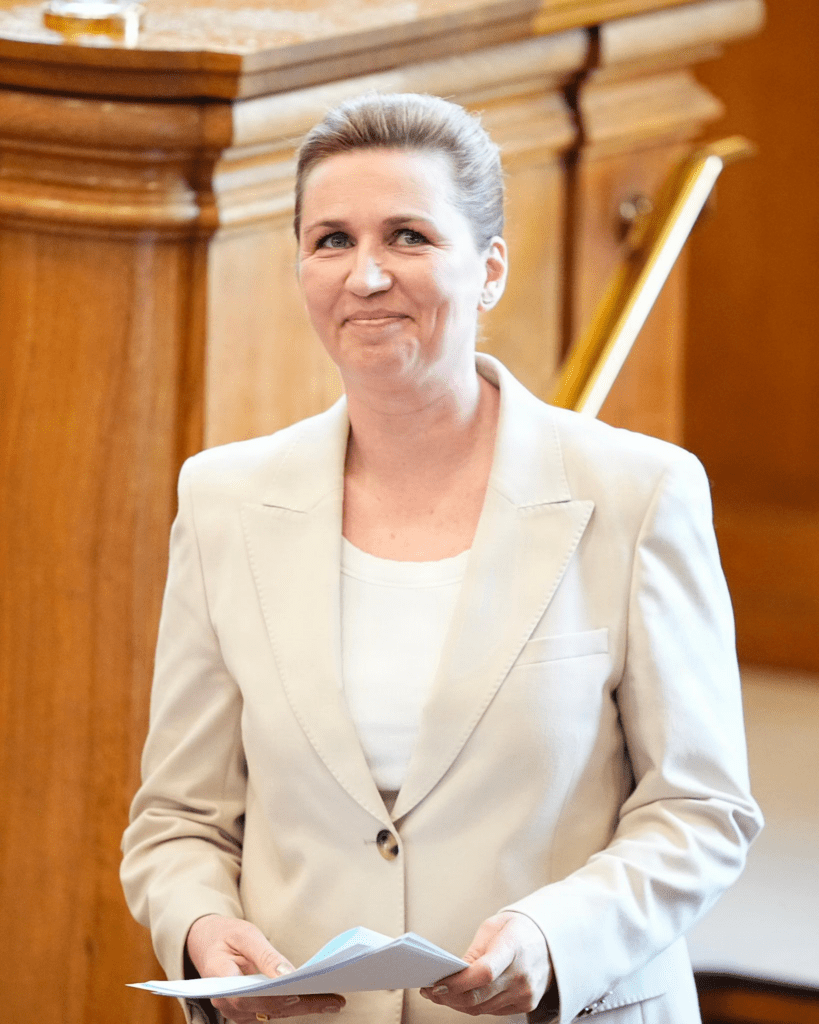
“Denmark will hold a parliamentary election on March 24, Prime Minister Mette Frederiksen said on Thursday, seeking to capitalize on a surge in support for her defiant stance against U.S. pressure over Greenland.
Frederiksen has spent recent months rallying European leaders against President Donald Trump’s renewed interest in annexing the Arctic island, an effort that opinion polls suggest has bolstered her popularity… “This will be a decisive election, because it will be in the next four years that we as Danes and as Europeans will really have to stand on our own feet,” Frederiksen said. “We must define our relationship with the United States, and we must rearm to ensure peace on our continent.”
The Greenland crisis has further raised Frederiksen’s profile on the international stage, boosting the standing she gained through her swift response to the COVID-19 pandemic and for building European support for Ukraine.”
Laura Fernandez Wins Presidency in Costa Rica
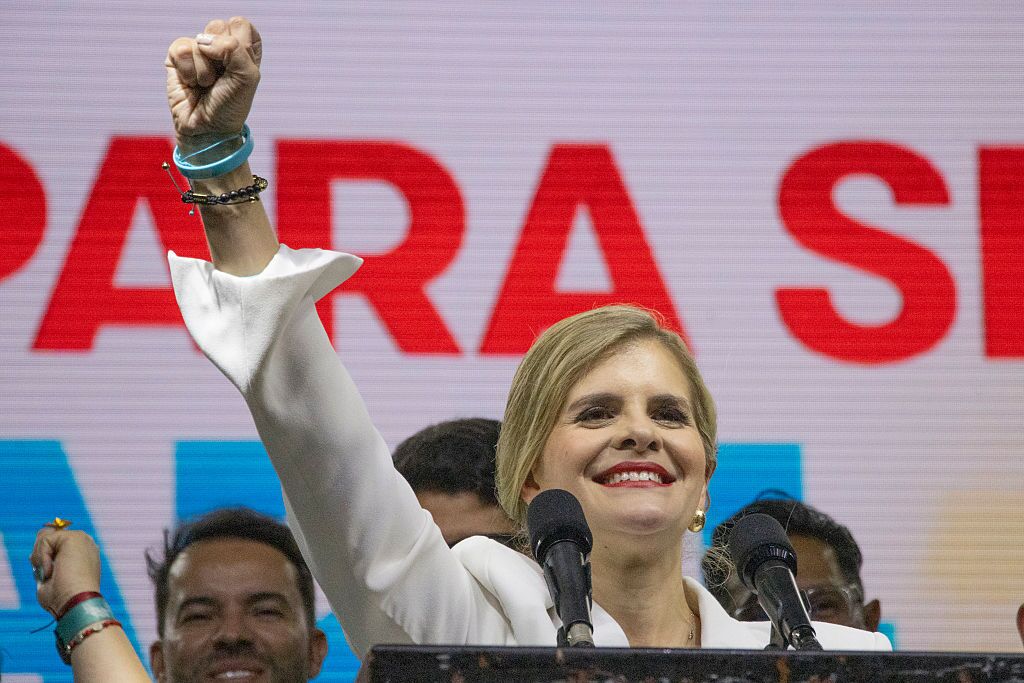
President-elect Laura Fernández after winning the presidential election on February 1, 2026, in San Jose, Costa Rica. (Arnoldo Robert / Getty Images)
Earlier this month, Costa Rica elected the nation’s second-ever female president, conservative candidate Laura Fernández. She overperformed other recent presidents, as reported in AmericasQuarterly.
“Fernández will become the 50th president, the second woman to assume the presidency in Costa Rica, after Laura Chinchilla Miranda did so in 2010. Exceeding the threshold of 40 percent of valid votes cast has not happened since that election, and this reflects significant support for the start of her term. The president-elect was emphatic in stating that she will continue the economic and political legacy of President Chaves, with rhetoric that continues the president’s confrontational line, on the one hand proposing a government of dialogue and national harmony, but on the other, warning the opposition that they must be respectful of the will of the people, not an “obstructionist and sabotaging” opposition, which she blamed for institutional erosion and obstacles to achieving prosperity and well-being.”
See You at Politics & Prose in D.C. on Friday, March 6
I am excited to be interviewing noted author Lorissa Rinehart next Friday, March 6, at Politics and Prose at the Wharf in Washington, D.C., to discuss her new book Winning the Earthquake—use this link to register.
US secretary of defense Pete Hegseth directed the Pentagon to designate Anthropic a “supply-chain risk” on Friday, sending shock waves through Silicon Valley and leaving many companies scrambling to understand whether they can keep using one of the industry’s most popular AI models.
“Effective immediately, no contractor, supplier, or partner that does business with the United States military may conduct any commercial activity with Anthropic,” Hegseth wrote in a social media post.
The designation comes after weeks of tense negotiations between the Pentagon and Anthropic over how the US military could use the startup’s AI models. In a blog post this week, Anthropic argued its contracts with the Pentagon should not allow for its technology to be used for mass domestic surveillance of Americans or fully autonomous weapons. The Pentagon asked that Anthropic agree to let the US military apply its AI to “all lawful uses” with no specific exceptions.
A supply-chain-risk designation allows the Pentagon to restrict or exclude certain vendors from defense contracts if they’re deemed to pose security vulnerabilities, such as risks related to foreign ownership, control, or influence. It is intended to protect sensitive military systems and data from potential compromise.
Anthropic responded in another blog post on Friday evening, saying it would “challenge any supply chain risk designation in court,” and that such a designation would “set a dangerous precedent for any American company that negotiates with the government.”
Anthropic added that it hadn’t received any direct communication from the Department of Defense or the White House regarding negotiations over the use of its AI models.
“Secretary Hegseth has implied this designation would restrict anyone who does business with the military from doing business with Anthropic. The Secretary does not have the statutory authority to back up this statement,” the company wrote.
The Pentagon declined to comment.
“This is the most shocking, damaging, and overreaching thing I have ever seen the United States government do,” says Dean Ball, a senior fellow at the Foundation for American Innovation and the former senior policy adviser for AI at the White House. “We have essentially just sanctioned an American company. If you are an American, you should be thinking about whether or not you should live here 10 years from now.”
People across Silicon Valley chimed in on social media expressing similar shock and dismay. “The people running this administration are impulsive and vindictive. I believe this is sufficient to explain their behavior,” Paul Graham, founder of the startup accelerator Y Combinator said.
Boaz Barak, an OpenAI researcher, said in a post that “kneecapping one of our leading AI companies is right about the worst own goal we can do. I hope very much that cooler heads prevail and this announcement is reversed.”
Meanwhile, OpenAI CEO Sam Altman announced on Friday night that the company reached an agreement with the Department of Defense to deploy its AI models in classified environments, seemingly with carve-outs. “Two of our most important safety principles are prohibitions on domestic mass surveillance and human responsibility for the use of force, including for autonomous weapon systems,” said Altman. “The DoW agrees with these principles, reflects them in law and policy, and we put them into our agreement.”
Confused Customers
In its Friday blog post, Anthropic said a supply-chain-risk designation, under the authority 10 USC 3252, only applies to Department of Defense contracts directly with suppliers, and doesn’t cover how contractors use its Claude AI software to serve other customers.
Three experts in federal contracts say it’s impossible at this point to determine which Anthropic customers, if any, must now cut ties with the company. Hegseth’s announcement “is not mired in any law we can divine right now,” says Alex Major, a partner at the law firm McCarter & English, which works with tech companies.
Great Job Maxwell Zeff, Will Knight, Lauren Goode, Paresh Dave & the Team @ WIRED for sharing this story.
The site of a school that more than a century ago served one of Texas’ first all-Black communities will once again be a gathering spot and resource for the community as officials begin the transformation of Mosier Valley Park.
Fort Worth leaders and members of the historic Mosier Valley neighborhood gathered Feb. 26, where they turned dirt on the first phase of the 6-acre park that will include a trail system, fitness stations and event spaces.
The parkland’s development is important to the neighborhood’s legacy as the state’s first freedmen’s town, or a community established by people formerly enslaved, officials added.
The park houses the little bit of open space left in the predominantly Black neighborhood, sandwiched between industrial and business facilities in far east Fort Worth.
“It gives us a sense of, ‘We didn’t let our ancestors down,’” said Jeff Pointer, president of the Mosier Valley Neighborhood Association. “They came in and left this to us, and to do exactly this. Our ancestors can rest.”
The park’s amenities will include an enhanced trail system, four basketball courts, fitness stations and more parking to support future events and increase accessibility, park and recreation director Dave Lewis said at the event.
The park will also house a new playground at some point in its development. City officials plan to spend just over $905,000 on the park, predominantly funded by the 2022 bond program.
Deborah Peoples, pictured Feb. 26, serves Fort Worth’s District 5, which encompasses the historically Black Mosier Valley community. (Nicole Lopez | Fort Worth Report)
City Council member Deborah Peoples, whose district includes the predominantly Black neighborhood, said she could not honor the park without thanking her council predecessor Gyna Bivens.
“This project has been long in the making,” Peoples said. Bivens, who gave up her district seat in 2025, asked her successor to “take care” of Mosier Valley when she took public office, Peoples said.
Bivens, who served District 5 since 2013, died earlier this month soon after announcing that she’d been diagnosed with cancer. Throughout her tenure, she adamantly called for city officials to prioritize the development and maintenance of Mosier Valley Park.
“Today we are starting the journey to take care of Mosier Valley,” Peoples said.
The area has historical and cultural significance, she stressed.
“It is important that we preserve and honor that legacy,” Peoples said. “I am so excited to see the diverse community members who are here today, because they have embraced this history and are committed to carrying it forward.”
Jeff Pointer attended Fort Worth’s Feb. 26 groundbreaking for Mosier Valley Park. He leads the community’s neighborhood association and has advocated for the park’s revitalization. (Nicole Lopez | Fort Worth Report)
The historic neighborhood was annexed into Fort Worth in 1960 ahead of the Dallas Fort Worth International Airport’s construction. The acquisition displaced some residents because they couldn’t afford to pay higher property taxes, according to previous Report coverage.
Remaining residents cited concerns about seeing little improvement in the neighborhood’s infrastructure since it was annexed, prompting the city to address dilapidated areas.
That outcry from the public included a lack of parkland. Fort Worth leaders acquired 4 acres of the parkland in 2014. The land is equipped with a historical marker commemorating Mosier Valley School from 1883, which once stood at the park.
The park’s development drew criticism from residents after progress stalled in 2019. That year, officials installed tables and parking spaces, while the area remained mostly a park in name only.
Now, the public can expect a recreation center and urban farm at the park by 2028, said Pointer, the association president.
Preserving the school’s history through the park and its amenities is important because the school once served as a center and resource for the community, Pointer said.
Construction on the first phase of the park is slated for a completion date of December.
“This is where everybody came, and we want to bring it back to that,” Lewis said.
A historical marker commemorates the site of Mosier Valley School, which educated generations of Black children in far east Fort Worth near Euless. Mosier Valley was the first community established by formerly enslaved people in Texas shortly after the Civil War. (Haley Samsel | Fort Worth Report)
At the Fort Worth Report, news decisions are made independently of our board members and financial supporters. Read more about our editorial independence policy here.
Great Job Nicole Lopez & the Team @ Fort Worth Report for sharing this story.
President Trump is terminating the government’s relationship with Anthropic, an AI company whose products, until recently, were used by Pentagon officials for classified operations. Following a weekslong standoff with the company, Trump posted on Truth Social this afternoon that all federal agencies must “IMMEDIATELY CEASE all use of Anthropic’s technology,” adding: “We don’t need it, we don’t want it, and will not do business with them again!” The General Services Administration announced that it would take action against Anthropic’s products, and indeed, according to an email I obtained that was sent to the leadership of all agencies using USAi—a GSA platform that provides chatbots from tech companies to government workers—access to Anthropic was suspended “immediately.” The government is also removing Anthropic from its primary procurement system, which is the key way for any federal agency to purchase a commercial product.
Anthropic was awarded a $200 million contract with the Pentagon last summer geared toward providing versions of its technology for military use. OpenAI, Google, and xAI were awarded similar contracts, though Anthropic’s Claude models are the only advanced generative-AI programs to receive Pentagon security clearance permitting the handling of secret and classified data. Claude had been integrated across the Department of Defense and was reportedly used to assist the raid on Venezuela that led to the capture of President Nicolás Maduro.
Anthropic has said that it will not allow Claude to be used for mass domestic surveillance or to enable fully autonomous weaponry, which could involve applications such as Claude selecting and killing targets with drones, and analyzing data that have been indiscriminately gathered on Americans by the intelligence community. Anthropic has also said that the Pentagon never included such uses in its contracts with the firm. But now DOD is demanding unrestricted use of Claude and accusing Anthropic of trying to control the military and “putting our nation’s safety at risk” by refusing to comply.
Following a heated meeting on Tuesday, DOD gave Anthropic until today at 5:01 p.m. eastern time to acquiesce to its demands. If not, the Pentagon would compel the company under an emergency wartime law called the Defense Production Act or, even more severe, designate Anthropic a “supply-chain risk,” which could forbid any organization that works with the U.S. military to do business with the AI company. Shortly after Trump’s announcement, Defense Secretary Pete Hegseth declared that he was doing just that. Dean Ball, an analyst who helped write some of the Trump administration’s AI policy, has called the threats “the most aggressive AI regulatory move I have ever seen, by any government anywhere in the world.”
Last night, Anthropic CEO Dario Amodei wrote in a public letter, “We cannot in good conscience accede to” the Pentagon’s request. Following Trump’s and Hegseth’s orders today, Anthropic said in a statement, “No amount of intimidation or punishment from the Department of War will change our position.” DOD, which the Trump administration refers to as the Department of War, did not immediately respond to requests for comment.
The situation signals a potentially seismic shift in relations between Silicon Valley and the federal government. Defense officials and technology companies alike are concerned that the U.S. military is losing its technological edge over its adversaries, particularly China—in part because the private sector, rather than the Pentagon, is where much American innovation comes from these days. And instead of federal grants, the massive investments needed for generative AI have come from tech companies themselves. Historically, companies the Pentagon works with have not set terms for how the government uses their products. But as Thomas Wright recently wrote in The Atlantic, this dynamic is complicated when it comes to AI tools made fully by a private sector that understands the technology far better than the government does.
Anthropic has shown itself to be eager to work with the government and the military, hence it being the first of the frontier AI firms to receive such a high security clearance from the military. Amodei is by far the most hawkish of any prominent AI executive, warning frequently about the need for democracies to use AI to vanquish authoritarianism and, especially, stay ahead of China. In the letter he published last night, Amodei wrote: “I believe deeply in the existential importance of using AI to defend the United States and other democracies, and to defeat our autocratic adversaries.” And although he took a principled stance against domestic surveillance, Amodei wrote that he is open to Claude eventually being used to power fully autonomous weapons—just not yet, because today’s best AI models “are simply not reliable enough” to do so. Developing such AI-powered weapons in the present, he wrote, would put American soldiers and civilians at risk.
Much remains uncertain about the unraveling relationship between the Trump administration and Anthropic, but the White House has been souring on Anthropic for months. Amodei has been publicly critical of Trump, and wrote a lengthy Facebook post in support of Kamala Harris during the 2024 election. White House officials have called the company “woke” and accused it of “fear mongering.”
We have ended up in a paradoxical situation in which the U.S. government is at once saying that Claude is so essential to national security that it could invoke an emergency law to exert extensive control over Anthropic and that the company is so woke and radical that using Claude would itself be a national-security risk. “I don’t understand it,” a former senior defense official who requested anonymity to speak freely told me. “It’s an existential risk if you use it or if you don’t.”
Many in Silicon Valley have rallied in support of Anthropic, even as the major companies have maintained their business with the government. (The precise terms of the Pentagon’s contracts with other AI companies have not been made public.) Jeff Dean, a top Google executive, wrote on X that generative AI should not be used for domestic mass surveillance. OpenAI CEO Sam Altman wrote in an internal memo circulated last night, a copy of which I obtained, that “we have long believed that AI should not be used for mass surveillance or autonomous lethal weapons,” and he has expressed similar sentiments publicly. More than 500 current employees of both OpenAI and Google—many of them anonymous—signed an open letter in support of Anthropic. On the sidewalk outside Anthropic’s headquarters in San Francisco today, passersby scribbled messages of support with chalk.
The fallout from the supply-chain-risk designation is still unclear. In theory, Google, Microsoft, Amazon, and several other behemoths that contract with the federal government will have to stop doing business with Anthropic, which would be a mess for everyone involved and potentially devastating for Anthropic; Amazon, for instance, is building data centers that will train future versions of Claude. But just how sweeping of an impact such a designation would have on Anthropic’s customers is up for debate, and the company said in its statement today that many applications of Claude, even for customers that partner with DOD, will not be affected.
Meanwhile, private AI firms will continue to be important to the federal government as it works to compete with China, Russia, and all manner of adversaries. Trump gave the Pentagon six months to phase out Claude, which suggests that the technology has indeed become essential—and is essential to replace. And at some point, the U.S. military may no longer find itself in a position to dictate its terms. Altman, in his internal memo, wrote that OpenAI is exploring a contract with the Pentagon to use its AI models for classified workloads that would still exclude uses that “are unlawful or unsuited to cloud deployments, such as domestic surveillance and autonomous offensive weapons.” The Pentagon reportedly agreed to those conditions shortly after announcing that it would sever ties with Anthropic, although no contract has been signed. But other figures in tech, including the Anduril co-founder Palmer Luckey and the investor Katherine Boyle, have come out in support of demands for unrestricted use. This showdown was between the Pentagon and Anthropic. The next may be a war within Silicon Valley itself.
Great Job Matteo Wong & the Team @ The Atlantic for sharing this story.
First, Happy Black History Month. I hope you have felt affirmed in knowing that you are an essential thread in the tapestry of this nation and across the globe. While we are still celebrating firsts, our history is deep and expansive. It has shaped, strengthened, and sustained the very fabric of this country. You are not an afterthought in that story. You are central to it. And you are worthy of being honored not just in February, but every single day.
I have been thinking a great deal about what is happening in this country and how, in many ways, it echoes the conditions that birthed the Civil Rights Movement. Some are calling this a golden age. Others are experiencing a golden rage. Both realities can exist at the same time.
I understand the tension. Like many of you, I have had a sleepless night or ten, wondering about my next move. Wondering about my family. Wondering about the future of this nation.
I have never felt like I did not belong here. We built this country. And if we did not carry immense power, there would not be such a layered, expensive effort to erase the contributions of our ancestors and elders. Erasure only happens when legacy is undeniable.
But what I also recognize in this moment is that we are being presented with an opportunity. An opportunity to be louder than ever before.
I am not talking about protest. I am talking about presence.
Being fully ourselves. Sharing our gifts without shrinking. Taking more adventures. Receiving more love in all its forms.
As women, and especially as Black women, we have been conditioned to lead and to caretake. Labels have been placed on our backs so early and so often that life can begin to feel heavy. The weight shows up in restless nights and overwhelming days.
I am not suggesting we abandon responsibility. We do have obligations. But I am saying we can redefine how we carry them.
The cape we wear was not designed by us. It was shaped by society, family expectations, peers, and culture. We put it on and flew anyway. We circled the sun with it.
Now life is asking something different.
It is asking us to make bold and meaningful choices that do not simply elevate everyone around us, but center our own dreams and desires.
I know there is something on your “one day” list. One day I will write the book. One day I will learn the language. One day I will leave the job.
Whatever your “one day” is, now is the time to move it into a plan.
Get clear. Get focused. Get centered on the desires of your heart.
Return to the genesis of who you are, before the titles and the status. Before mother, wife, partner, executive, director, daughter, and everything in between. Reconnect with the woman you were before the world told you who to be.
Listen to that voice within. Give your imagination room to speak. Ask yourself what life could look like if the dream were not deferred, but developed.
The truth is, dreams do not expire with age. Possibility does not have a deadline.
What it requires is clarity. Commitment. And a plan.
Step by step, we move away from the noise of the world and walk deeper into ourselves. Life is not something to merely survive. It is something to create and to experience fully.
You deserve that experience.
With care,
Monica Wisdom
PS.. Don’t forget to subscribe to the Black Women Amplifed Podcast for empowering conversations.
Great Job monicaamplified@gmail.com & the Team @ Black Women Amplified | Podcast. Newsletter. Connection. Source link for sharing this story.
President Donald Trump is starting to sound like a man who believes the knives are out, and not just from the outside.
In back-to-back White House appearances this week, the president floated the idea that members of his own inner circle are quietly eyeing his job, then suggested only half-jokingly that his time may be running out because people are “gunning” for him.
US President Donald Trump speaks at the White House on Feb. 23, 2025.(Photo: X/jackunheard)
The unsettling remarks came as Trump appeared visibly rattled by the latest security scare at his Mar-a-Lago estate, where Secret Service agents shot and killed a 21-year-old man from North Carolina who attempted to breach the property’s secure perimeter on Sunday, Feb. 22. Trump was not at the Florida estate at the time, but the incident seemed to sharpen an already suspicious worldview.
A day earlier, while hosting the annual governors’ dinner at the White House, Trump offered what he framed as a joke, but landed more like a confession of anxiety. Recounting a conversation with first lady Melania Trump about the evening’s guest list, the president veered into an odd riff about ambition inside his own administration.
According to Trump, many of the people in the room, governors and even Cabinet secretaries, wake up each morning believing they should be president instead of him.
“Every time they look in the mirror,” Trump said, “they say, ‘I should be president, not him.’”
He insisted the group was “very friendly,” but the implication lingered: Trump wasn’t talking about Democrats, the media, or shadowy outsiders. He was talking about his own team.
Then, the next day, Trump escalated the tone even further.
Speaking at a White House remembrance ceremony for Americans killed in violent crimes committed by undocumented immigrants, the president abruptly turned inward, hinting at his own mortality.
“I don’t know how long I’ll be around,” Trump said. “I got a lot of people gunning for me, don’t I?”
The comment landed with a thud and instantly ignited reactions across the internet.
Supporters rushed to reassure him. “I love my president!” one YouTube commenter wrote. Another blamed Democrats for “what they have done to the country” and urged Trump to “stay the course.”
Critics, meanwhile, were far less charitable. Social media quickly filled with dark speculation, gallows humor, and outright hostility about Trump’s comments and what they revealed about his state of mind.
Jack, I know you’re unheard, but you need to listen to this. He is not referring to the assassins, he is talking about the calls coming from inside the White House.
U.S. Blues commented on X, “I pray that he gets exactly what he deserves.” This X user remarked, “He won’t be around long because he’s old, fat, and extremely unhealthy. Not because Trump supporters are found within a mile of him with a gun.”
Investigators have not publicly identified a motive in the Mar-a-Lago incident, but it is only the latest in a string of alarming security threats surrounding the president.
Last summer, a 20-year-old man opened fire at a Trump rally in Pennsylvania, grazing Trump’s ear and killing an attendee before being shot dead by Secret Service agents. Two months later, another armed man was discovered hiding in the bushes at a Trump golf course in Florida, just one hole ahead of the president. That suspect was sentenced to life in prison earlier this month.
Taken together, the pattern is hard to ignore. As real-world threats mount, Trump appears increasingly fixated on betrayal, replacement, and the idea that danger is closing in—from all sides.






.png "Democracy Is Not Self-Executing: How We Shape a Better Government Through Laws, Institutions and Culture")




.png)