
Home News Page 2787

The Democratic Party Botched the 2024 Election

On November 5, 2024, the night of Donald Trump’s historic second election victory, it suddenly — and unexpectedly — looked as though he would win Pennsylvania. Of all the seven swing states Trump needed to win in this intense, closely fought race, Pennsylvania was said to be the most important, not least due to the fact that it was the birthplace of Joe Biden.

Among Kamala Harris’s senior staffers, a sickly feeling spread. It had been only four and a half months since Biden had suffered a professional catastrophe while debating Trump; the entire country witnessed a frail, mentally challenged man appearing as if he had scant knowledge of what was going on around him.

High-powered Democratic donors were the first to explode in their cell phones, followed by top party officials, often sitting alone in their living rooms, vaguely expecting something of what actually happened. This is covered for the first time in Fight: Inside the Wildest Battle for the White House, the new book by Jonathan Allen and Amie Parnes.

In Fight, these two veteran Washington, DC–based journalists portray a devastating inside-the-Beltway tale in which a small cadre of Democratic leaders — mainly Bill and Hillary Clinton, Nancy Pelosi, and Barack Obama — basically disagree about what to do next. As Allen and Parnes put it, “The same scene played out on the screens of politicians, party operatives, and progressive pundits across the country — a widespread freakout unlike any other in American history.”

In all, it took twenty-four days for the Democratic apparatus to finally turn on an enraged Biden, forcing him to leave the race. His family and small circle of insiders insisted he had only been suffering from a cold that night. A furious First Lady Jill Biden attacked his detractors, buoyed by Hunter, the family’s scandal-plagued son, who played a leading role in bashing his father’s “enemies.”

“People close to [Biden] would never cop to the complicity of their own silence,” the authors write. To them, “it wasn’t a linear process” and Biden was not always exhibiting what could be called dementia-like symptoms. But still, his condition was disturbing, as everyone now understood. Even before his fateful debate, Biden’s ratings had significantly fallen, with the party gearing themselves up for a very tough battle.

The first decision was to coax Biden to remove himself from the running — a very difficult chore. The second decision was to choose, in some manner, a new party nominee. Harris was eventually settled upon as the replacement by his longest friends, Bill and Hillary Clinton, who had worked hard to develop statewide Democratic coalitions in response to what they saw as Obama’s neglect of the party faithful. Led by long-standing loyalist Donna Brazile, there was a large groundswell for Harris as Biden’s loyal vice president.

Obama — never a big Harris fan, according to the authors — wanted to stage a series of mini primaries so that the public could decide for itself. Beyond that, Obama was a big fan of Michigan governor Gretchen Whitmer for her intellectual heft. Pelosi, a fellow Californian, wanted another candidate — as one staffer put it, “She doesn’t like Harris.”

Clintonworld — the term widely used for the huge informal network of political staffers who have passed through Bill and Hillary’s operations over the years — effectively controlled the decision to give Harris the job. Some in other factions of the party, usually never named, complained that she had made little, if any, impact in her own presidential run, dropping out early because of mismanagement and money problems. Others pointed out her reputation for gaffes during interviews and lack of vision. “You know who did that,” said one unhappy insider, “Bill and Hillary motherfucking Clinton.”

“It had just been a couple of hours earlier when I was looking at a six-hour line of college students in fucking Altoona, PA,” said one overwrought Harris staffer. “But once it switched, man, it went down quick and hard.”

Turnout in Philadelphia was only a little bit lower than in 2020. But, as the same staffer explained, “Trump was winning more of it.” It would be slightly up in nearby Bucks County, but Trump was doing better there too. Harris had massive crowds in Philadelphia itself but was lost in nearby mostly white middle- and upper-middle-class towns after choosing to campaign with Liz Cheney, the noted Trump-basher and daughter of Iraq policy leader Dick Cheney.

Trump, incredibly cunning and playing to working-class financial problems, campaigned near Bristol, aiming at the working-class whites that Harris usually avoided. During his extensive campaigning through that state, Trump made repeated promises to bring down grocery prices and bring in new jobs, never hinting he’d be signing off on the destruction of Medicaid and social security just months later. In the end, Trump would win in Pennsylvania by 50.4 percent to 48.7 percent, as well as Michigan, Georgia, Wisconsin, Arizona, Nevada, and North Carolina — making up more than ninety electoral votes.

Residents of Dearborn, Michigan — home to the United States’ largest Arab community — voted Trump rather than Harris, believing his promises that he would end the war in Gaza, even though his actual plan was to collaborate closely with Israeli prime minister Benjamin Netanyahu and advocate the removal of Palestinians to make Gaza into a luxury resort for the rich.

But this isn’t to say that Biden hadn’t manipulated voters. Always used as for gauzy photo shoots near Independence Hall, Philadelphia had become over the years “the country’s poorest big city,” stealing that title from Detroit. A fifth of the city’s residents live in poverty, trying to make ends meet on the federally mandated $7.25 an hour. In contrast, Philadelphia’s suburbs are mostly prosperous, and along with Center City competed with legal, medical, architectural, and design peers up and down the East Coast.

Nevertheless, rusting factories — often shut down as a result of Clinton’s neoliberal 1990s trade policies — still remained for miles, despite Biden’s ongoing braggadocio about reindustrialization. In the ongoing economic malaise, many working-class men and women in Pennsylvania were in no mood for Harris’s “happy talk” campaign, totally bereft of Bernie Sanders’s important “laundry list” of political demands. With Harris, there were few specifics.

The Clintons, however, had conjured up a plan in restructuring state organizations — as the authors point out, “in large part it was designed to stop the party’s left wing from taking control” — to keep “progressive outsiders” out of the picture. And at the Democratic Convention, Harris saw to it that no pro-Palestinian voices would address her convention.

On the night of the convention, Biden was seething. His speech was pushed out of prime time to 11:30. “They were all so eager to get rid of him,” the authors surmise. “This final insult, his gold watch retirement ceremony playing out to an emptying arena and a smaller TV audience, really burned.”

During the previous few months, Biden had repeatedly reminded Harris that loyalty to him meant everything. And she had complied, never once wavering in her support. The way he put it was “no daylight, kid” — any attempt to encourage intrigue and disunity was not helpful to her campaign.

“Most voters did not see Biden’s first term as the most compelling recommendation to give him a second term,” said one staffer. When Harris was interviewed on the extremely popular show The View, she was asked what she would have done differently than Biden. She replied, “There is not a thing that comes to mind,” creating a response that would hurt the campaign to the end.

In a very dramatic way, the ludicrous mid-August debate highlighted the difference between the two candidates. In an incredibly tense atmosphere, the general sense was that Harris “ran circles around Trump,” the authors wrote, but that he “landed serious blows that previewed his fall campaign.”

Trump countered Harris’s policy comments by calling her a “radical-left liberal” who “wants to do transgender operations on illegal aliens that are in prison” and accusing the Haitian community of Springfield, Ohio, of “eating the dogs, eating the cats. . . . They’re eating the pets of the people that live there.” Harris laughed at these remarks but failed in adequately responding when asked whether people were financially better off than they were before Biden took office.

What her aides soon discovered was that the debate had only given her a statistically insignificant bump in national polling — less than a point in the RealClearPolitics average. She had effectively hit a ceiling that would trail her campaign until Election Day.

Only a couple of weeks before the election, Biden upended Harris’s carefully planned speech by making a bizarre call appearance that went instantly viral. Saying in a strange, disjointed way that “the only garbage I see floating out there is [Trump] supporters,” Biden enraged many Trump voters who were instantly reminded of Hillary Clinton’s 2016 mockery of Trump supporters as “a basket of deplorables.” “It was a gift,” a senior Trump aide reflected.

In a final projection of the race, Harris aides presented her numbers showing she would probably lose Georgia, North Carolina, Arizona, and Nevada, while she seemed poised to win Michigan and Wisconsin (which never happened). And while Harris would never renounce Biden’s close relationship with the Israeli government, Trump traveled to Dearborn to convince them that he was sympathetic to the Palestinian people’s plight. He increased his share of Latino votes from 32 to 46 percent, Asian American votes from 34 to 40 percent, black women from 13 to 14 percent, and black men from 19 to 21 percent.

In the end, Fight is a profoundly unsettling microcosm of the Democratic leadership as it currently stands. Since Trump’s administration has veered so hard to the Right, there has been a noticeable shift — at least for now — toward attacking Trump’s actions in a direct manner.

It can only be hoped that this is a growing progressive fightback, and that it is not strangled at its infancy by those forces in the Democratic leadership who have been so low on ideas for much of this century so far — and proven completely incapable of providing their own responses beyond the maintenance of neoliberalism.

Great Job Anne Colamosca & the Team @ Jacobin Source link for sharing this story.

Does Trump Want to Be the President Who Lost Ukraine?

Happy Saturday!

Overtime is for everyone. If you’re a Bulwark+ member: thank you. If you’re not, there’s no better time to subscribe to Bulwark+ than today. If you like today’s issue, you can share this newsletter with someone you think would value it.

Does Trump Want to Be the President Who Lost Ukraine?

DONALD TRUMP HATES NOTHING more than a “loser.” To him, losing is shameful and the worst insult he can imagine. But he could end up being tagged as a loser for the way he has abandoned more than three decades of U.S. support for Ukraine’s sovereignty. He is walking away from a tougher Euro…

ICYMI: Here are links to each newsletter section so you can quickly get back to that edition you may have missed this week.

Morning ShotsTriadHuddled MassesPress PassBulwark Goes to HollywoodThe Opposition False FlagThe Breakdown

The Gulf of Anti-America

The Gulf of Anti-America

ON FRIDAY, AS HE RETURNED to the United States from a four-day tour of the Persian Gulf, Donald Trump berated Bruce Springsteen for criticizing him on …

How to Take Medicaid from Millions of Americans, in Less Than 72 Hours

How to Take Medicaid from Millions of Americans, in Less Than 72 Hours

How Americans Can Cease Being Rich

How Americans Can Cease Being Rich

Kristi Noem Embarrasses Herself Again

Kristi Noem Embarrasses Herself Again

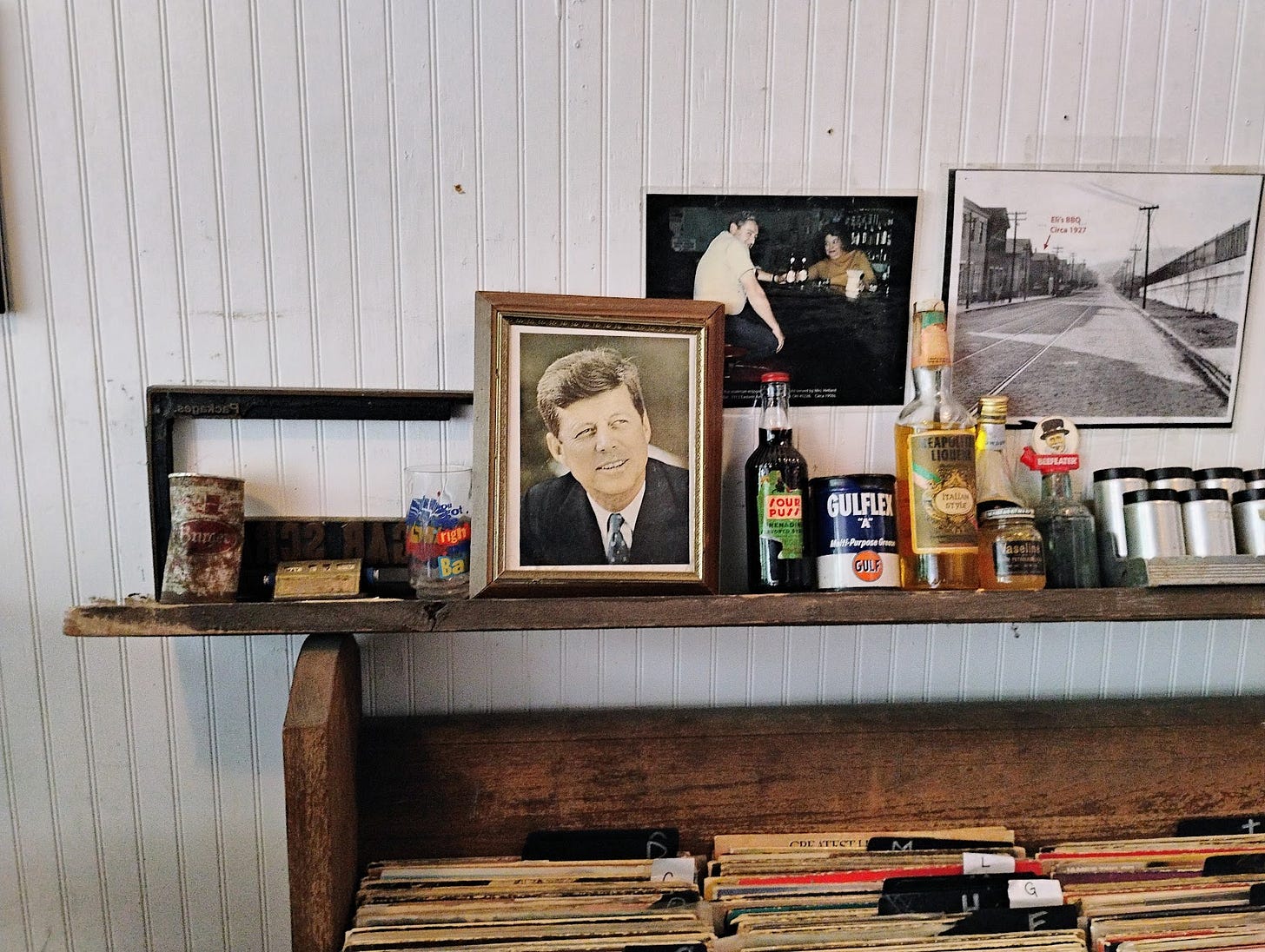
Eli’s BBQ, Cincinnati, Ohio.

Happy Saturday! I hope if it is your last Saturday before summer, that you do something memorable that is spring-like. Don’t give into summer just yet! Plenty of time for that. I look forward to seeing those of you attending our live events in Chicago and Nashville.

If you’re in the Cincinnati area… Save the date! I will be moderating a Principles First panel on June 5 with Amy McGrath and Trey Grayson on the importance of tamping down executive overreach.

And if you’re in D.C… Save the date for June 6, as The Bulwark teams up with Crooked Media for a joint event to raise funds for Andry Hernandez Romero.

Declarations And Graduations… Declaring against declarations, plus, when your children leave childhood. New from Matt Labash.

Patriotism, True and False… Some thoughts from Jay Nordlinger on an important and somewhat slippery concept.

This New Orleans-based podcaster… reaches millions from his Uptown home. Read the Tim Miller profile in the Times-Picayune.

Trump’s image of dead ‘white farmers’… came from Reuters footage in Congo, not South Africa (Reuters). The Shares from Your Aunt presidency.

Tech support questions? Email members@thebulwark.com. Questions for me? Respond to this message.

—30—

Editorial photos provided by Getty Images. For full credits, please consult the article.

Great Job Jim Swift & the Team @ The Bulwark Source link for sharing this story.

Tony Benn’s Words for Today’s Left

We are fortunate that the three pillars of Tony Benn’s socialism — the radical democratization of politics, the Alternative Economic Strategy, and antiwar internationalism — were explored in so many of his articles and interviews, and in his speeches to Parliament, demonstrations, conferences, and picket lines. Looking around at the world today and the challenges we face, Benn’s analysis is as relevant as ever and can help guide us through the tasks that lie ahead. So the publication of The Most Dangerous Man in Britain?, a new anthology of his political writing, couldn’t be more timely.

I would recommend this book as essential reading for every socialist activist inside and outside the Labour Party and everyone interested in building a fairer, better world of peace and justice.

Tony Benn and his writings have been — and remain — a huge inspiration for me. As someone lucky enough to have known and been generously encouraged by him, I was excited to hear about the publication of this anthology. I did wonder, however, whether there would be anything in it that I hadn’t previously come across. But given that it includes some great pieces I have never read (despite my keen consumption of Benn’s books), I was right to be excited.

To have this new anthology is to have Tony Benn with us again. It makes me reflect not only on how much the Left misses him today but on what a valuable asset he would have been if we had had him with us, with his great experience and insight, between 2015 and 2019.

What this new anthology does so well, in just under three hundred pages, is to distill the key strands of Benn’s political thought through brilliantly chosen speeches, articles, and letters. Some of them have never been published in book form and have been very hard to find, despite being key to understanding Benn’s politics.

This new anthology is split into six sections: “The British State,” “The Many Faces of Democracy,” “Industry,” “Britain in the World,” “The Radical Tradition,” and “Politics After Politics.” It starts with a superb foreword by Tony Benn’s daughter, the journalist, activist, and educator Melissa Benn, who describes his political thought as a “socialist, democratic, anti-imperialist analysis.”

What is striking throughout the book is the profound depth, seriousness, and ambition of Benn’s political thought across a vast range of subjects. A few hours spent in the company of these detailed but readable writings is a refreshing tour of the fabric of socialist thought we have inherited. They are a reminder of the scale of the thinking, planning, persuasion, and organization needed to put real alternatives into practice and to avoid a world increasingly scarred by inequality, injustice, war, and the environmental crisis.

Running through the whole anthology is Benn’s unshakeable belief in democratic progress coming from pressure from below, instead of being handed down from upon high. The anthology includes “The Politician Today,” a speech he made to an international conference of political consultants in 1970, in which he powerfully articulates this conviction:

Looking back over a hundred years of British parliamentary democracy and seeing why great changes occur, I have become convinced that these were not the products of enlightened leaders but of the pressure of people from below, who have worked through the agency of political leaders, whose greatest quality may well have been their realism. We would never have had the vote in Britain for men — and certainly not for women — if it had not been demanded and conceded. We should never have had state education, the welfare state, the National Health Service or many of the other civilised developments of which we are proud if the demands of these things had not bubbled up from below. And the present vigorous campaigns against pollution, for a better quality of life and for a greater respect for ecology, were not thought up by inspired ministers or far-sighted civil servants. They came from the people and we are now conceding what they want.

Throughout the book, it is clear how this fundamental belief informed Benn’s proposed reforms to the political process, the economy, and the workplace and his vision of a more democratic international system for peace and cooperation. It also demonstrates how his ideas were shaped by his reading of British history, from the Levellers and Diggers to the Chartists, Suffragettes, and movements of the early twenty-first century, as an ongoing struggle for democratic control for the many in place of an undemocratic hoarding of power and wealth by a privileged few.

Benn said that experience is the greatest teacher. This anthology shows how his own political views were formed, and his own leftward political journey significantly shaped, by his experience of listening to and learning from constituents, trade unionists in struggle, campaigning students, and marginalized and discriminated-against groups. His belief was that real progress comes in Parliament when sufficient MPs feel the pressure to do the same kind of learning and act upon it.

The “Industry” section includes “A Ten-Year Industrial Strategy for Britain,” written in 1975 by Tony Benn, Frances Morrell, and Francis Cripps, which became known as the Alternative Economic Strategy. While the then Labour government sadly followed the neoliberal prescription of the International Monetary Fund (IMF) for dealing with Britain’s economic woes in the ’70s and paved the way for Thatcherism, the Alternative Economic Strategy remains as a reminder of what could have been. As the 1975 document concludes:

It is essential that the labour movement should now adopt a strategy which meets the needs of working people by securing an extension of public ownership, industrial democracy in the organisations of work and the planning for industrial recovery so that government, managements and union representatives can jointly devise means of safeguarding existing production and plan new investment needed to restore Britain’s economy as a manufacturing nation.

As we face the challenges of the current economic situation, in which we are told that cuts to disability benefits are necessary to “balance the books” while demands for a wealth tax are still refused, there is relevance to be found in studying the Alternative Economy Strategy and the political results of rejecting it for an IMF-friendly, establishment-endorsed approach.

The anthology also superbly showcases Tony Benn’s antiwar internationalism across the decades, starting with a 1964 article for the Guardian in which he argues with passion and precision for sanctions against the apartheid regime in South Africa. He writes with real moral force when he says,

What greater folly can be imagined in this situation than to fail to see it, or to see it and try not to notice it? Yet that is what this present government is doing, voting against apartheid at the UN [United Nations] and simultaneously supplying arms that will maintain it in force. It is just this sort of hypocrisy that reduces Britain’s influence in the world.

The power of Benn’s words on Britain’s role in the world resonates with urgency as we push for strong sanctions on Israel for its war on Gaza — sanctions to match the scale of the sanctions the government rightly imposed on Russia following its unlawful invasion of Ukraine. In a rich sweep of his contributions on international issues, the anthology includes his February 17, 1998, House of Commons speech opposing the bombing of Iraq, with its famous section in which he reflects upon his own experience in Blitz-era London and relates it to the plight of those about to suffer the same way:

Every night, I went to the shelter in Thames House. Every morning, I saw Docklands burning. Five hundred people were killed in Westminster one night by a land mine. It was terrifying. Are not Arabs and Iraqis terrified? Do not Arab and Iraqi women weep when their children die? Does not bombing strengthen their determination? What fools we are to live as if war is a computer game for our children or just an interesting little Channel 4 News item.

The anthology finishes with a section dedicated to Benn’s political activity after standing down from Parliament in the 2001 general election, including, most notably, the text of his speech to the million-strong February 15, 2003, march against the government joining the United States’ war on Iraq. He covers an awful lot of ground in what had to be, by necessity at a demonstration with so many speakers, a very short speech. I was there that day, and it’s wonderful to now have the text of Tony’s words.

The inclusion of these two antiwar speeches showcases Benn speaking truth to power in two very different places where he was equally effective: in Parliament and at protests. Key to his politics, as this anthology shows, is the idea of socialist Labour MPs being the bridge linking progressive movements outside Parliament with determined activity inside. As he puts it in one of the pieces included, “the people we represent can only look to an advance of their interests and of the prospects of socialism if Labour MPs harness themselves to the movement outside and develop a strong partnership, which alone can infuse fresh life into Parliament as an agent of democratic change.”

In the same speech, Benn warns that the potential consequence of the exclusion of socialists from Parliament — and thereby of the bridge they provide between struggles outside and activity within — is the rise of the far right:

If the Labour Party could be bullied or persuaded to denounce its Marxists, the media — having tasted blood — would next demand that it expelled all its socialists and reunited the remaining Labour Party with the SDP [Social Democratic Party] to form a harmless alternative to the Conservatives, which could then be allowed to take office now and again when the Conservatives fell out favour with the public. Thus, British capitalism, it is argued, would be made safe forever, and socialism could be squeezed off the national agenda. But if such a strategy were to succeed — which it will not — it would in fact profoundly endanger British society. For it would open up the danger of a swing to the far right, as we have seen in Europe over the last fifty years.

This passage has often been quoted in recent years. But as we look at the opinion polls in this country, and see what has happened in Italy, the United States, and Germany, this warning seems as urgent as ever.

There is so much more of value and interest in this new anthology than that which can be covered in this review. But I would make mention of Benn’s September 1984 article on the 1984–85 miners’ strike, which really demonstrates the clarity with which he — unlike the leadership of Labour and some trade unions at the time — understood its totemic significance. As he put it, “when the history of the miners’ strike of 1984 comes to be written I believe it will be seen to have been much more than an ordinary dispute.” As Melissa Benn adds, “the miners’ strike of 1984–5 was for him a seminal conflict, pitting the destructive and exploitative forces of the state and capitalism against the just might of the organised industrial working classes.”

There is also a moving piece for Melody Maker in 1970 written as part of a debate with a leader of the youth movement in the United States. Its inclusion shows what a rich treasury this anthology is — including pieces that even some of those who already have great knowledge of Benn’s writings will not have come across before.

The inclusion of Tony Benn’s last speech in Parliament, after almost fifty years as a Labour MP, is very useful and thought-provoking, as is the wonderful last interview that Melissa conducted with him in 2011. In her foreword, Melissa writes that she has two distinct hopes for this anthology: first, to lay to rest some of the myths about Tony Benn and the Left in general (“that collection of clichés and half-truths, laden with the usual lazy adjectives”) and, second, to inspire a new and younger audience.

This anthology definitely succeeds in this first objective, showing the intellect, vision, and seriousness of Tony Benn’s political thinking, which represents the very best of the inheritance that my generation of Labour socialists in Britain was lucky enough to receive. And it will succeed in inspiring a new and younger audience if it is read as widely as I hope and believe it will be.

Tony Benn wrote that “from the beginning of time in the hearts of every civilisation there have always been two flames burning, the flame of anger against injustice and the flame of hope that we can build a better world.” To date, this anthology is the best book of Benn’s writings to help fuel both of those flames in the hearts of new generations. I hope every socialist inside and outside the Labour Party and everyone who is interested in building a better world reads it.

Great Job Richard Burgon & the Team @ Jacobin Source link for sharing this story.

Congress: Trump’s Super-Staffers (with Annie Karni)

Donald Trump is looking to pass his Big, Not-So-Beautiful Bill through Congress. To do it, he needs to get it past congressional Republicans. So what do Republican voters think of congressional leaders, and whether this bill is as big and beautiful as it seems? New York Times congressional reporter Annie Karni joins Sarah.

By Annie Karni:

Mad House: How Donald Trump, MAGA Mean Girls, a Former Used Car Salesman, a Florida Nepo Baby, and a Man with Rats in His Walls Broke Congress

Leave a comment

Watch, listen, and leave a comment. The Focus Group podcast is available wherever you get your podcasts and on YouTube. Add this podcast to your player of choice, here.

Don’t care for video? Use the control on the left-side of the player to toggle to the audio-only version of the show.

Ad-free editions are available exclusively for Bulwark+ members. Upgrade to now to listen without ads.

Great Job Sarah Longwell & the Team @ The Bulwark Source link for sharing this story.

DOJ Abandons Effort to Address Phoenix’s Treatment of Homeless People

When a homeless man questioned the Phoenix police’s authority to stop him in February 2020, an officer grabbed him and knelt on his neck while another officer shocked him with a Taser. Another unhoused man said officers threw away his belongings, telling him, “You guys are trash and this is trash.” Other people experiencing homelessness were regularly cited and arrested by the city’s officers during early morning hours for “conduct that is plainly not a crime.”

Those were among the abuses alleged by the Department of Justice last June, following a nearly three-year investigation into the city of Phoenix and its police department. The investigation marked the first time the DOJ had found a pattern of violations against homeless people, including that officers and other city employees illegally threw away their belongings.

In addition, DOJ investigators found that officers disproportionately cited and arrested people experiencing homelessness. They comprised 37% of all Phoenix Police Department arrests from 2016 to 2022, though homeless people account for less than 1% of the population. Investigators said many of those stops, citations and arrests were unconstitutional.

The wide-ranging probe also found officers used excessive force, discriminated against people of color, retaliated against protesters and violated the rights of people with behavioral health disabilities — similar issues to those the DOJ has documented in troubled law enforcement agencies in other cities.

But federal officials announced Wednesday that they had abandoned efforts to compel the city and police to address those issues. The DOJ closed its investigations and retracted findings of constitutional violations in Phoenix and five other jurisdictions, including Trenton, New Jersey. Beyond that, the Department of Justice said it was dismissing Biden-era lawsuits against several other police departments, including in Louisville, Kentucky, and Minneapolis, where George Floyd was killed by police five years ago.

The DOJ said requiring the cities to enter consent decrees, which are intended to ensure reforms are enacted, would have “imposed years of micromanagement of local police departments by federal courts and expensive independent monitors, and potentially hundreds of millions of dollars of compliance costs, without a legally or factually adequate basis for doing so.”

The city of Phoenix said in a statement that it has “tirelessly focused on enhancing policy, training and accountability measures to ensure the best public safety for everyone who lives, works and plays in Phoenix.” In recent years, the city has enacted policy changes including employee training and the implementation of body-worn cameras.

Legal experts told ProPublica the wrongdoing the DOJ uncovered in Phoenix should be corrected — even though city officials will be under less pressure to act.

“It is a very real shame and a disservice to the residents of these communities to end the work, to stand down and unwind the investigations and to purport to retract the findings,” said Justin Levitt, a law professor at Loyola Marymount University and former deputy assistant attorney general in the Civil Rights Division of the Department of Justice.

The report’s retraction, along with last year’s Supreme Court decision allowing cities to arrest and cite people for sleeping outside even when they have nowhere else to go, could further embolden cities and police departments to marginalize homeless people, said Brook Hill, senior counsel with the Lawyers’ Committee for Civil Rights Under Law, a legal advocacy group that focuses on racial justice issues. “They will feel like they have a license to do the sweeps and to otherwise make life in public view uncomfortable for unhoused people,” he said.

Indeed, just last week California Gov. Gavin Newsom urged all local governments in that state to “use their authority affirmed by the U.S. Supreme Court” to address encampments.

After the DOJ began the Phoenix investigation in August 2021, Fund for Empowerment, an Arizona advocacy group for homeless people, and the American Civil Liberties Union of Arizona sued the city and police department to stop what attorneys called “unconstitutional raids” on unsheltered people. Its lawsuit accused the city of failing to provide housing and instead turning to encampment removals to clear sidewalks and other areas. “The City has made its message to unhoused individuals clear: engaging in sleep and other essential life activities on the city’s public grounds will lead to detention, arrest, displacement, and the loss of the individual’s personal effects,” the Fund for Empowerment alleged in court documents.

Nearly a month later, a judge issued an injunction preventing the city from enforcing its camping ban against people who can’t find shelter, as well as from seizing and throwing away people’s belongings. The lawsuit is ongoing.

The DOJ’s June 2024 report stated that even after the injunction and new city policies were in place, city officials continued to arrest people for camping and to destroy people’s belongings without notice or the opportunity to reclaim them.

ProPublica, as part of its investigation into cities’ handling of homeless people’s possessions, found that Phoenix rarely stored property seized from encampments. From May 2023 to 2024, the city responded to 4,900 reports from the public involving encampments, according to its records. The city said workers, trained to assess which items are property and which are trash, found items that could be stored at only 405 of the locations it visited. Not all of those belongings required storage because people may have removed them between a report of an encampment and the city’s arrival. The city stored belongings 69 times.

In January 2024, the city issued its own report in anticipation of the DOJ’s allegations. The city said it found nothing to support accusations that police “interfered with the possessions of people experiencing homelessness.” Phoenix officials also said in the report that although the city and police department “welcome additional insights” from the DOJ, they were unwilling to be subjected to a consent decree, a binding plan in which an appointed monitor oversees implementation of reforms.

Attorneys and advocates said that the DOJ’s decision has no bearing on lawsuits filed by private attorneys alleging civil rights violations, including against people who are homeless. The ACLU this week also launched a seven-state effort to file records requests to hold police departments accountable, it said.

Elizabeth Venable, lead community organizer with the Fund for Empowerment, who also helped the DOJ connect with the unhoused community in Phoenix, said she viewed the federal findings as a victory for unhoused people. Despite the retraction by U.S. Attorney General Pam Bondi, Venable said, the report still has weight.

“No matter what Pam Bondi says, people are not going to forget it, especially people who learned about something that they were horrified by,” she said.

Great Job by Nicole Santa Cruz & the Team @ ProPublica Source link for sharing this story.

Why a GOP congresswoman has joined the call to free Tory Lanez

Since President Donald Trump reentered the White House, politicians have opened the floodgates on conspiracy theories and unfounded claims against public figures, ranging from a fumbled release of documents surrounding victims of financier Jeffrey Epstein to hearings about the assassination of former President John F. Kennedy.

Now, Rep. Anna Paulina Luna, a Florida Republican, has joined calls to free Tory Lanez, a Canadian rapper who was sentenced to prison after a 2020 altercation with rapper Megan Thee Stallion. The case itself has been scrutinized by online critics — despite Lanez’s conviction — who claimed Megan Thee Stallion’s testimony was fabricated, that powerful music executives have tried to orchestrate a “cover-up” and that the DNA evidence linking Lanez to a gun was inadmissible or flawed.

While Luna posted what she called evidence of Lanez’s innocence, Megan Thee Stallion’s team pushed back — and there’s no indication prosecutors are reopening the case. Lanez’s trial highlighted how often Black women who seek justice are doubted, by both the legal system and society. Luna’s attempt to draw attention to the case and assert that Lanez was wrongly convicted represents both a doubling down on that dynamic and an indication of how pop culture and politics combine in online spaces full of misinformation. 

As a member of the Oversight Committee, the House’s powerful main investigative branch, Luna told NewsNation this week that she had come across new DNA evidence that would disprove Lanez’s involvement and Ring camera footage that shows the case as “he-said-she-said.”

After receiving a tip from Amber Rose — a media personality who has strengthened her connections with the Republican Party in the past year, including speaking at their nominating convention — Luna said she has been working with members of the California delegation, including Democrats, to urge Gov. Gavin Newsom to pardon Lanez.

“[This was] pretty egregious, the way this was handled — I think it was largely driven by headlines,” Luna told NewsNation during an interview. “Obviously, domestic violence I take very seriously, but I also take very seriously the fact that I do believe, based on the evidence that I’ve seen, that Tory’s innocent.”

Police arrested Lanez during a traffic stop on July 12, 2020, after receiving reports of gunfire from a group leaving celebrity Kylie Jenner’s Hollywood Hills home in Los Angeles. At the time, Megan Thee Stallion, whose real name is Megan Pete, was taken to the hospital for a foot injury — one she initially told police was the result of stepping on broken glass and later said was actually the result of having been shot in the foot by Lanez. The surgeon who treated Megan Thee Stallion testified to seeing gunshot wounds in her foot, as well as seeing bullet fragments on X-ray imaging. 

Lanez was sentenced to 10 years in prison in August 2023 after a jury found him guilty of assault with a firearm, illegal possession and negligent discharge of the weapon. As a Canadian citizen, Lanez could also face deportation from the United States after serving his sentence. The judge had previously denied a request for a retrial.

But almost two years later, persistent theories and conspiracies, combined with doubts about evidence in the now-closed court case, continue to circulate online. Podcasters and social media users have tried to cast doubt on the fact that Megan Thee Stallion was actually shot for years, which prosecutors called a “weaponized information” campaign orchestrated by Lanez and his team. Other Black men celebrities currently facing claims of assault, abuse or trafficking — including producer Sean “Diddy” Combs, singer Chris Brown and rapper DDG — have seen similar waves of support across social media this week in the face of allegations against them.

Lanez’s case has reemerged after the artist was stabbed 14 times while in prison earlier this month.

Christine Scartz, director of the Family Justice Clinic at the University of Georgia School of Law, said that while it’s good for people with influence, like lawmakers, to call attention to possible miscarriages of justice, she worries about what the attention on this case means for Megan Thee Stallion and other Black women.

“For Black women victims of violence, it’s not just a struggle for individual justice, but it’s a struggle against all these other competing priorities that people who either are not involved in the case directly or who don’t know exactly what it is they’re talking about or how the system works,” Scartz said. “You have to struggle against all these competing priorities for other people who are then going to shade you when you’re just looking for individual justice.”

Luna had never posted about his case on her official X account until May 19, when she started circulating a petition from the Caldwell Institute for Public Safety, a conservative effort run by TV host and Fox political analyst Gianno Caldwell. Attorney General Pam Bondi; Rep. Burgess Owens, a Black Utah Republican; and media personality Dr. Drew Pinsky are all on the Caldwell Institute’s board. Luna and Caldwell did not respond to requests for comment.

Luna posted that she had “compelling evidence” proving Lanez’s innocence, claiming that the singer had not received due process. She then posted a thread, tagging Newsom, listing concerns she had with the trial process, citing the First, Sixth and Fourteenth amendments. On Thursday, she posted another thread, claiming a new affidavit from a bodyguard “shatters the original narrative used to convict” Lanez.

“This guy’s an innocently incarcerated man,” Luna told a reporter Wednesday. “When the evidence was brought forward and presented to me, I was pretty baffled that he was even charged after what I saw.” 

She also said she spoke with the rapper Tuesday, saying that once Lanez gets a pardon — which Luna said she is confident will happen — he will work on prison reform.

On Thursday, Megan Thee Stallion’s lawyers released a 31-page report seeking to dismantle “unsworn rumors being spread as fact,” dismissing the circulating Ring camera footage and claims about DNA evidence.

“Despite Mr. Lanez being convicted at trial by overwhelming evidence (that included his own admission of his guilt), he and his team — flanked by any ignorant person they can find — have pushed whatever misleading narrative they can,” said Alex Spiro, Megan Thee Stallion’s lawyer, who headed the report.

Great Job Marissa Martinez & the Team @ The 19th Source link for sharing this story.

Profiles in Courage: Colonel Susan Meyers Defied Trump’s Greenland Annexation Push—And Was Relieved of Command

Profiles in Courage is a series honoring the extraordinary women and men who have transformed American institutions through principled public service. At a time when trust in government is fragile, these stories offer a powerful reminder of what ethical leadership looks like—from those who litigate for civil rights and resign on principle, to those who break military barriers and defend democracy on the front lines.

This month, we spotlight women in the Department of Justice, federal agencies and the military whose careers have been defined by integrity, resilience and reform. Their quiet heroism—often at personal cost—reaffirms the enduring role of public servants who choose justice over self-interest. Through their stories, Ms. pays tribute to a tradition of service that safeguards democracy and inspires the next generation to lead with courage.


When Colonel Susan Meyers assumed command of Pituffik Space Base, America’s northernmost military installation, in July 2024, she inherited more than a remote outpost carved from the Arctic ice. She inherited an unbroken 70-year alliance with Denmark and Greenland, 200 airmen and guardians under her care, and a delicate diplomatic balance in an era of rising political tension.

Meyers, an officer who had spent nearly two decades in the Air Force before transferring to the U.S. Space Force in 2021, understood that every flag flown at Pituffik signified a hard-won partnership in one of the planet’s harshest environments.

On March 29, 2025, that equilibrium was shaken. Vice President JD Vance, visiting to promote President Donald Trump’s renewed push to annex Greenland, publicly rebuked Denmark for “neglecting” Greenlanders and hinted that military force might be justified. The remarks ignited unease among Danish officials, Greenlandic leaders and the American service members posted at Pituffik who had long worked side-by-side with their allies.

Vice President JD Vance walks with Col. Susan Meyers, then-commander of the U.S. military’s Pituffik Space Base, on March 28, 2025, in Pituffik, Greenland. The visit was viewed by Copenhagen and Nuuk as a provocation amid President Donald Trump’s bid to annex the Danish territory. (Jim Watson / Getty Images)

The Email That Cost a Command

Three days later, following a weekend spent assessing base morale, rereading Vance’s statements and listening to her international partners, Colonel Meyers drafted an email addressed to every member of her garrison:

“I do not presume to understand current politics, but what I do know is the concerns of the US administration discussed by Vice President Vance on Friday are not reflective of Pituffik Space Base … For as long as I am lucky enough to lead this base, all of our flags will fly proudly—together.”

Her message neither mentioned annexation nor invoked partisan language. It simply reaffirmed the base’s long-standing commitment to a non-political military partnership with Denmark and Greenland.

However, in an environment where senior leaders had been warned to remain “scrupulously nonpartisan,” the email was perceived as an act of defiance.

Immediate Repercussions

On April 10, 2025, the U.S. Space Force relieved Colonel Meyers of command, citing “a loss of confidence.” Chief Pentagon spokesman Sean Parnell posted on X, writing: “Actions [that] undermine the chain of command or subvert President [Donald] Trump’s agenda will not be tolerated at the Department of Defense.”

Meyers was replaced within hours by Colonel Shawn Lee.

In Washington, some hailed her firing as necessary discipline, while others condemned it as the politicization of a uniformed officer who merely upheld the long-held values of joint defense. In Copenhagen and Nuuk, Danish and Greenlandic leaders quietly praised her “steadfast professionalism.”

An Arctic Command, a Defining Stand

Commanding Pituffik involves dealing with constant winter darkness, encountering 24-hour daylight during summer, and facing temperatures that can plunge below –60°F. It also necessitates protecting crucial satellite tracking radars and missile warning systems that bolster North American defense. Colonel Meyers achieved this while honoring the treaty commitments that have sustained the base as sovereign Danish territory since 1951.

Vice President Vance and Second Lady Usha Vance attend a briefing alongside Col. Susan Meyers (center right) on March 28, 2025. (Jim Watson / Getty Images)

Her decision to speak—measured, nonpartisan, yet unmistakably principled—was rooted in a conviction that military loyalty to allies transcends political cycles. She did not seek confrontation with her civilian leadership; rather, she aimed to steady a shaken force and reassure partners who felt blindsided by annexation rhetoric.

Legacy of Integrity

Colonel Susan Meyers now joins a lineage of officers who accepted personal costs to uphold the apolitical ethos of the U.S. armed forces. In the frozen expanse of northwest Greenland, where auroras are as typical a sight as radar domes, her brief command will be remembered for a single email affirming that allied flags fly together or not at all.

In an age when strategic competition converges once more on the Arctic, her stand serves as a stark reminder that “true” command is not measured solely by tenure but by the courage to defend the principles that unite allies on the world’s most remote frontiers.

!function(f,b,e,v,n,t,s)
{if(f.fbq)return;n=f.fbq=function(){n.callMethod?
n.callMethod.apply(n,arguments):n.queue.push(arguments)};
if(!f._fbq)f._fbq=n;n.push=n;n.loaded=!0;n.version=’2.0′;
n.queue=[];t=b.createElement(e);t.async=!0;
t.src=v;s=b.getElementsByTagName(e)[0];
s.parentNode.insertBefore(t,s)}(window,document,’script’,

fbq(‘init’, ‘200522034604820’);
fbq(‘track’, ‘PageView’);

Great Job Sheree L. Williams & the Team @ Ms. Magazine Source link for sharing this story.

Daily Show for May 23, 2025

The job of a journalist is to go to where the silence is — especially when those in power seek to silence voices that question or challenge power. That is what we do at Democracy Now! day in and day out, and we’re able to do it because of financial support from people like you — people who trust and depend on our independent reporting. If you believe that freedom of speech and freedom of the press are essential to the functioning of a democratic society, please donate today. Every dollar makes a difference. Thank you so much.

Democracy Now!


Amy Goodman

We rely on contributions from you, our viewers and listeners to do our work. If you visit us daily or weekly or even just once a month, now is a great time to make your monthly contribution.

Please do your part today.

Great Job Democracy Now! & the Team @ Democracy Now! Audio Source link for sharing this story.

India’s richest man can’t crack e-commerce, even with Shein

Online retail continues to elude India’s richest man.

The SheiniSheinFounded in China in 2008 and headquartered in Singapore, Shein is a fast fashion brand that grew rapidly through exposure on social media.READ MORE India app, launched by Mukesh Ambani’s Reliance Retail in partnership with the Chinese fast-fashion giant, has struggled to gain traction in a market where Amazon and Walmart have been fighting neck-to-neck for nearly a decade. Downloads for Shein India nosedived from 50,000 a day shortly after its launch in early February to 3,311 in early April, according to AppMagic, a U.S.-based app performance tracker.

In April, when U.S. tariffs hit China, the app saw renewed interest as it was in the news, but experts are unclear on whether this growth is sustainable.

“Unlike earlier times, now … [the] market is saturated with multiple options and offers, and user interest can quickly dwindle,” Yugal Joshi, partner at global research firm Everest Group, told Rest of World.

Kushal Bhatnagar of Indian consulting firm Redseer, however, sees the late-April spike as a healthy sign, given that Reliance has yet to run paid marketing campaigns for Shein. 

Reliance Retail declined to respond to Rest of World’s queries about its partnership with Shein.

Reliance launched Shein for India five years after the original Shein app was banned in the country over border tensions with China. But the Shein that has returned is entirely separate from Shein’s global platform: Rather than selling made-in-China clothes and accessories directly to consumers, Shein now operates as a technology partner, while Reliance Retail handles the heavy lifting — from sourcing and manufacturing to distribution. All consumer data is managed by the Indian company.

The partnership is part of Ambani’s broader effort to overhaul his retail business, whose valuation fell to $50 billion in 2025 from $125 billion in 2022. Although the company has made a push into digital platforms like JioMart, Ajio, and most recently Shein India, the bulk of its retail revenue still comes from its 18,000 physical stores.

Lagging behind Amazon and Walmart-backed FlipkartiFlipkartFlipkart, founded in 2007, is one of India’s oldest e-commerce companies, and is owned by Walmart.READ MORE, which together control nearly 60% of India’s e-commerce market, Reliance has spent years trying to break into the sector. Between 2020 and 2025, Ambani’s group acquired majority stakes in companies spanning digital services, online pharmaceuticals, and quick commerce. But the investments have yet to position Reliance as a serious challenger to Amazon and Flipkart. 

Analysts say the Indian behemoth hopes to leverage Shein’s artificial intelligence-powered trendspotting and automated inventory systems to pursue an ambitious goal: capturing a major share of India’s e-commerce market, projected to hit $345 billion by 2030.

According to Kaustav Sengupta, director of insights at VisionNxt, an Indian government-funded initiative that uses AI to forecast fashion trends, such a model is likely to make good use of Reliance’s humongous customer data sets: more than 476 million subscribers for its Jio telecom brand, 300 million users for e-commerce platform JioMart, and 452 million subscribers for its news and entertainment portfolio, consisting of 63 channels, a streaming service, and digital news outlets.

“With these data points, Reliance wants to now sell fashion products, so all it needs is a system where it can feed all these data points,” Sengupta told Rest of World. He said the model would be able to predict best-selling products and suggest the right prices for them.

The original Shein app uses AI-driven models for intelligent warehousing and to spot customer trends before manufacturing a new product. It scales the manufacturing up or tweaks the designs based on the feedback. At any given time, the Shein website has a catalogue of more than 600,000 items. Its Indian iteration does not match up, according to reviews on the Google Play store. Several customer reviews for Reliance’s Shein app are critical of higher prices and reduced options. The app’s rating hovered at 2 out of 5 until February; in May, it climbed to 4.4, but reviews were still a mixed bag. 

As of April 25, Reliance Retail said only 12,000 products were live on Shein India, a stark contrast to the 600,000 items available on Shein’s global platforms. While Shein is reportedly set to debut on the London Stock Exchange this year, Ambani’s years-old promise to take Reliance Retail public remains unfulfilled.

Reliance Retail, which accounts for around 30% of the conglomerate’s overall business, is facing a slowdown in annual growth. Its sales rose just 7.9% in the fiscal year ending March 2025, down from 17.8% the previous year. Meanwhile, shares of rival Tata Group’s retail and fashion arm, Trent, have soared by 133%.

“Reliance would have looked at reviving that momentum and riding on it, while for Shein, adding India back on its portfolio of markets could be a plus point before its proposed public listing,” Devangshu Dutta, founder of Third Eyesight, a brand management consultancy that has worked with various global e-commerce brands including Ikea, told Rest of World.

A Reliance Retail official privy to information about its fast fashion expansion plans told Rest of World the partnership with Shein also hinges on global manufacturing ambitions as the Chinese company is trying to “source its products from other countries like India” to meet the “additional demand that is coming from newer markets.” Reliance Retail has tapped a network of small and midsize Indian manufacturers to locally source products, and its subsidiary Nextgen Fast Fashion Limited is leading the charge. “We need to first scale up our domestic manufacturing, before our partnership starts manufacturing for global markets. Let us see how that goes, first,” the official said, requesting anonymity as he is not authorized to share this information publicly. 

India’s Gen Z population is at 377 million and counting, and their spending power is set to surpass $2 trillion by 2035, according to a 2024 report by Boston Consulting Group. Every fast-fashion retailer wants to capture this market, but it “is very new even for Reliance,” Rimjim Deka, founder of Indian fast-fashion platform Littlebox, told Rest of World.

Deka said smaller brands like hers “just see [a trend] and implement it,” which could take a large conglomerate months to do, by which time the trend may have lost relevance.

Reliance’s previous attempts to attract young shoppers with clothing brands like Foundry and Yousta failed to find much success. Anandita Bhuyan, who works in trend forecasting and product creation for fast-fashion clients like Urbanic and Myntra, told Rest of World the company has struggled to effectively leverage consumer data and target India’s youth.

According to the Reliance Retail official, the company is confident that if “there are 10 existing brands, the 11th brand will also get picked up as long as there is value and there is fashion.”

“Shein already has a recall among the youth. It gives us yet another brand in our portfolio through which we can cater to the youth,” the official said.

Shein was built in China on the back of more than 5,400 micro manufacturers — a scattered and loosely organized network of small and midsize factories.

In January this year, on a visit to China, Deka met with manufacturers working for Shein and Temu. On the outskirts of Guangzhou, Deka saw factories set up in areas that appeared residential, with “women sitting inside houses” making clothes.

“The tech is built in a way that somebody sitting there is able to see that, okay, next 15 days or next one month, how much I should be making … that is the kind of integration they have done,” Deka said.

Deka told Rest of World this model is easier to replicate at a smaller scale. “Me, coming from [the] supply chain industry, I understand that it is much easier for a brand like us because we are at a very smaller scale. We can still go to those people, we can still build it in a very unorganized way and then pull it off,” she said. Her company’s annual net revenue is 750 million Indian rupees ($8.6 million).

“[But] somebody like Reliance, they just cannot go haphazard here. … It has to be always organized,” Deka said.

Shein moved its headquarters to Singapore sometime between late 2021 and early  2022, a strategic departure to distance itself from its Chinese origins and facilitate hassle-free international expansion amid the U.S.-China trade war.

India is part of Shein’s wider strategy to diversify its supply chain — one that also includes a newly leased warehouse near Ho Chi Minh City in Vietnam, and efforts to establish alternative manufacturing hubs in Brazil and Turkey.

But in India, Reliance needs Shein as much as Shein needs Reliance for its global pivot. According to Bloomberg, Reliance Retail is focusing on creating leaner operations to weather a wider consumption slump in the Indian economy.

“It remains to be seen whether the Reliance-Shein combine can deliver on the brand’s promise with a wide range of products, fast and on-trend,” Dutta said. “In the years that Shein has been absent, the Indian market has evolved further, competition has intensified, and past goodwill is not enough to provide sales momentum.”

#Indias #richest #man #crack #ecommerce #Shein

Thanks to the Team @ Rest of World – Source link & Great Job Kunal Purohit and Ananya Bhattacharya

Will Democrats Learn From the Biden Disaster? Probably Not.

There is no other rational response to the cover-up of Joe Biden’s decline and infirmity than anger.

If you’re an American, it should make you angry that the many people who knew better stayed silent about, even actively conspired to hide, the fact that Biden wasn’t actually capable of executing his responsibilities as president, handing untold amounts of power to a cabal of advisors you never voted for.

And if you’re a Democratic voter, it should make you angry that a party that spent years promising they would, at very least, stop Donald Trump (and maybe not do much more), and that their blocking his reelection justified asking for your money and demanding your votes, ended up putting Trump in the White House again, in large part by installing and then keeping in power a man they knew was unfit for office.

Questions about Biden’s ill health, and who knew what about it and when, have been reignited in recent weeks, thanks to the release of two complementary books that have added new, scandalous details to the already scandalous litany of details about Biden’s condition that erupted after his disturbing June 2024 debate performance. One is Jonathan Allen and Amie Parnes’s Fight, the third in a trilogy of Trump-era behind-the-scenes campaign accounts by the pair that dropped last month; the other, which has been dominating political coverage the past couple of weeks, is Alex Thompson and Jake Tapper’s Original Sin, an autopsy of how Biden’s condition was hidden from the public for so long.

The other reason the issue has exploded yet again — just as the former president has stepped back into the public eye, while he gets ready to release his own, self-exculpatory book — is because we’ve just found out Biden has prostate cancer, and a particularly “aggressive” one at that, which has spread to his bones. Despite his spokesperson’s insistence that this was the first anyone knew about it, speculation has swirled that there may have been an effort to hide the diagnosis while he was president, fueled by the fact that Biden is the only president going back to Bill Clinton at least not to be tested for prostate cancer, that an oncologist who served as his own COVID advisor has called this “a little strange,” and this 2022 clip features Biden casually saying he has cancer.

Whether or not you buy into this speculation, at this point it’s a legitimate line of inquiry. It’s legitimate, because as both Fight and Original Sin show, Biden’s four years as president were defined by a vast, concerted effort by both the people closest to him and a constellation of friends, colleagues, and acquaintances to, generously, keep what they knew about his deteriorating health from the public.

Time and again in Original Sin, the same story is told and retold: one of Biden’s advisors, allies, old friends, or donors interacts with him face to face; they are either alarmed by his frail and confused physical appearance, by the fact that he doesn’t know who they are, or by the fact that he’s seemingly unable to speak off the cuff without serious assistance; and they proceed to say and do nothing about it, or even double down in their public insistence that he’s never been better.

In many cases, it is elected officials in Biden’s own party who are horrified but too cowardly to speak up. And in both books, this cowardice continues, with only a few exceptions, well past the point where the entire country has seen the truth and it has become clear keeping him on would be a disaster.

It wasn’t always cowardice. The reporting by both pairs of authors establishes that the insular team of the president’s closest advisors — both longtime Biden loyalists and family members, all of whom became unhealthily enamored with the trappings of power — went to great lengths to disguise Biden’s decline. They made sure he was well made-up, had events scheduled only during certain hours, always had clear visual aids to help him walk from point A to B, was furnished with notes, teleprompters, and other assistance to help him speak, or that events where he was meant to interact with others, like cabinet meetings, were scripted in advance — though even that was not always enough.

In hindsight, many of the most cynical theories about what was going on in the Biden White House turned out to be true. Biden’s advisors closed ranks around him (“You can’t talk about this stuff. We’re backing Biden,” one alarmed Democrat was told), and the Democratic National Committee (DNC) abruptly rearranged the 2024 primary schedule, which nonsensically put South Carolina first, for the exact reason everyone said at the time: purely to put Biden in the best position of beating any challenger. And they worked to aggressively shut down any attempt to ask questions about, investigate, or expose his decline.

Thompson and Tapper report that Biden’s team enlisted a coalition of influencers, Democratic operatives, and loyalist media to publicly shame anyone looking into Biden’s condition and create a “disincentive structure” for them to do so, gave out talking points that were then dutifully used by allies, and at one point threatened to deny a Wall Street Journal reporter’s story on the matter to scare her away from going forward with it. Meanwhile, they kept Biden isolated from his colleagues, to the point that cabinet members went months without seeing him.

While Biden’s decline seems to have become markedly worse and more rapid over the course of 2023 and 2024, both books make clear, as other reporting has, that it started much earlier. Each recounts a disastrous late 2021 meeting that was meant to offer Biden a chance to persuade the Democratic caucus to pass his infrastructure bill, but saw the president instead ramble endlessly and leave the room without ever making the ask.

But Original Sin dates the start of it much earlier, with insiders noticing changes around the time his eldest son was dying in 2015. Biden’s brain “seemed to dissolve,” a senior White House official told the authors, while another insider said the death “aged him significantly.” He struggled to remember his longtime aide Mike Donilon’s name in 2019. And he was so bad in 2020 that the conversations with ordinary voters he filmed for that year’s Democratic convention required heavy, “creative” editing, with those who watched the raw footage left alarmed and convinced he couldn’t serve as president.

For many readers, this won’t be a surprise, but a vindication of what they saw again and again during that year’s primary but were told to pay no mind to: pundits and rivals openly commenting on the difficulties he exhibited in debates; Biden forgetting Barack Obama’s name and the preamble to the Declaration of Independence, saying he was running for the Senate, and confusing two separate world leaders with the long-dead Margaret Thatcher; MSNBC anchor Nicole Wallace laughing and encouraging him through a disastrous interview like he was a preschooler; Biden visibly gesturing for aides to scroll up on an off-screen teleprompter, openly reading off notes and sometimes still struggling to articulate a thought.

This problem hasn’t gone away with Biden’s exit. Elderly party officials’ insistence on clinging to power as long as possible has had other real-world ramifications, including just this week, when the death of three septuagenarian Democrats in Congress over the past three months — including one who had cancer, but whom the party elevated to a leadership position over a younger member anyway — allowed Trump’s budget to pass the House. The party is currently trying to punish and remove the sole official, Parkland shooting survivor David Hogg, who has called out this problem and suggested longtime incumbents should be primaried.

These revelations are shocking, but the concern is much bigger than mere party politics. One anecdote in particular drives home the kind of fire those who hid Biden’s deterioration were playing with.

One of the scariest moments in the Ukraine war happened after a particularly grueling week for the president, which saw him travel through three countries and end up too tired to even attend a closing dinner with G20 leaders and going to bed early. Hours later, rockets that Ukrainian officials falsely claimed were Russian landed in NATO member Poland’s territory, killing two people — and bringing the world dangerously close to World War III.

“That rest came in handy,” Tapper and Thompson write, since Biden had to quickly coordinate the international response.

It’s one of the rare insights we get into the running of Biden’s foreign policy, a subject mostly absent from both books, despite the fact that he was running at least two separate wars whose waking hours fell well outside the six-hour timeframe we are told he was most functional during. The reporting on Biden’s decline is largely based on the testimony of outsiders willing to talk about the glimpses they saw of it, and of how those closest to him worked to conceal it to hang on to power. Not surprisingly, those who did the concealing may not have been the most forthcoming sources.

This is not a story told through the eyes of his foreign policy team. National security advisor Jake Sullivan mostly hovers in the background in Original Sin, appearing next to Biden in meetings and trips or sitting with other advisors. He’s a focal point in only two anecdotes: in one, Biden can’t remember his name; in another, in a January 2024 meeting to get more military aid for Ukraine, he takes the lead after Biden stumbles through reading a bullet-pointed set of remarks that one attendee called “a shitshow.”

There is only one section of the book told from the point of view of longtime advisor and secretary of state Antony Blinken, and it takes care to mention how Blinken “continually witnessed the president fully able to meet the moment” behind the scenes. It’s an incongruous passage by that point, both because of the many tales leading up to it where people with far less contact are shocked by one of Biden’s increasingly common bad days, and because we’ve learned this is the stock talking point his team used to misleadingly reassure doubters he was fine.

Given how tightly Biden was cocooned, and the growing incentive for everyone involved to plead ignorance, it’s an open question if we’ll ever get anything close to the truth about how exactly Biden’s foreign policy came to be. That’s too bad, because by the end of his term, it made up the bulk of his presidency and was not only objectively a disaster and a moral stain on both himself and the country, but played a central role in unraveling his presidency.

Still, we get some hints. Again and again, we’re told that everything that came to Biden was filtered through a tight circle of advisors, that they presented information encouraging him to run for reelection without the counterarguments, and that they kept bad data from him and fed him wildly overoptimistic polling results that didn’t actually exist. At the peak of the post-debate crisis, Biden was so ignorant about Democrats’ concerns about him running that it led House Democratic Caucus chair Pete Aguilar to wonder “if Biden was being told the truth about anything.”

Biden’s own cabinet members told Thompson and Tapper that they abruptly lost access to him in 2024, that aside from national security officials like Blinken “the cabinet was kept at bay,” and that they suspected his advisors were cloistering a president who, in the few times he was seen, appeared “disoriented” — all to feed him only the information they wanted him to know and to shape his decision-making.

At their heart, neither Fight, nor Original Sin, nor the scandal itself are really about Biden’s infirmity. The United States is not the first country, and the Democrats are not the first party, to wind up with a leader who is unfit, unpopular, and incapable of continuing to lead. But other political parties are able to swiftly and ruthlessly change their leadership when the time comes.

Not so in the case of the Democrats, who the four authors show not only struggled to do anything about Biden even when they knew full well he was taking them all off a cliff, but then begrudgingly replaced him with a leader they had equally little faith in. That speaks to a dysfunction at the core of the party that’s much bigger than one sick leader.

Common to both books is a broad, behind-the-scenes consensus within the party that Kamala Harris, the most likely person to replace Biden on the ticket, was, even with her youth and full health, nearly as much of a disaster as her addled boss. Harris’s weaknesses as a politician are well known now after being put in the harsh glare of the 2024 campaign, but the reporting gives us new details: her need to prepare for everything to the point that her staff did a mock simulation of an upcoming off-the-record dinner with socialites, according to Thompson and Tapper; or the fact that, according to Parnes and Allen, Harris wasn’t able to come up with a bold economic vision to campaign on in part because she struggled to grasp economic issues  — “Wall Street jargon hit her ears like a foreign language,” they write. The party had such little confidence in her, her candidacy was repeatedly used as a potent threat to ward off efforts to roll Biden.

And yet, as each book recounts, she quickly locked up full party support anyway, and Democrats simply swapped out one candidate they desperately didn’t want for another. Part of it was the same cowardice that paralyzed them to move against Biden. Another part was Biden’s ego, the president quickly agreeing to endorse her to validate his own political judgement.

Still another was the crude and shallow style of identity politics that, for all their attempts to pin it on the Left after the election, has always been most dominant among the party’s corporate elite: the Clintons still wanted to see a woman become president and quickly backed Harris; key leaders like Hakeem Jeffries and Jim Clyburn wouldn’t countenance letting the party pass over the first black, female vice president; while others feared that doing so would lose them African-American votes.

But maybe most important was the party’s ironically undemocratic nature, and its willingness to use that to stop a leftward shift. The true original sin of the entire, cascading crisis around Biden — his infirmity, the crisis of confidence in the party it caused, his saddling of the party with a weak successor, his final, fatal extraction from her to promise not to break from him — wasn’t really Biden’s decision to run again. It had been the Democratic establishment’s desperation to stop Bernie Sanders and his movement from taking over the party in 2020, something they could only do by saddling themselves with a man whose political abilities many of them had little faith in.

But it was worth it: Several high-profile Democrats have since come out and openly admitted they had gone with Biden only as a last-minute play to stop Sanders, and as Parnes and Allen had reported four years ago, for many of the party’s establishment centrists, “their fears of losing their party to socialism competed with their fears of Trump winning a second term.”

After 2020, establishment Democrats thought they had escaped the consequences for this, with the pandemic’s onset luckily giving them the perfect excuse to keep Biden out of the public eye as much as possible while still kneecapping Trump’s reelection chances. In hindsight, we can see they only delayed them.

The other side effect of having won their war on progressives: this same machinery was then used to stick Democrats with Harris. In Fight, Allen and Parnes write that Biden, the Clintons, and a group of centrist black party officials that included Donna Brazile — infamous for secretly feeding Clinton debate questions in advance while working for CNN during the 2016 primaries — had rebuilt the party infrastructure post-Obama and installed loyalists at national and state committees, to protect any future Biden or Harris run, but also in a way that was “designed to stop the party’s left wing from taking control.”

They recount how after Biden’s exit, as many in the party pushed for some kind of contest to choose the best possible candidate, these loyalists in state party chair positions moved quickly to prevent that from happening by putting out a unanimous endorsement of Harris. As one of them put it, “this has got to feel like it came from the base of the party, the grassroots side of things.” (One of those involved, Ken Martin, was just elected chair of the DNC this past February.)

They got exactly what they wanted: the candidate they worked to install ran a campaign where she personally refused to sever herself from the unpopular incumbent, was deathly afraid of interviews and speaking off-script, and couldn’t overrule her nickel-and-diming advisors to present a bold and exciting economic pitch, all of which sunk her. As a result, Democrats have not only been thrown back into the minority and face the exact kind of authoritarian intimidation they warned they had to beat Trump at all costs to stop, but are, for the first time in modern memory, immensely unpopular with their own voter base.

You would think this might have been a learning experience. Not for the Democratic establishment, whose members quickly scrambled to blame — what else? — the progressive left for their own failure, spent the months since thinking their comeback lay in posturing as socially conservative or trying to bankroll podcasters, and have been soothing themselves that they will win the 2026 midterms by default, even if they’re loathed by voters.

The careerism, elite myopia, and poor judgement that led the party establishment to run an ailing man the entire country could see was plainly unfit to be president don’t seem to have gone anywhere. If the electoral disaster they knowingly created for themselves wasn’t enough to force a meaningful change, it’s hard to know what will.

Great Job Branko Marcetic & the Team @ Jacobin Source link for sharing this story.

Secret Link