A LITTLE-KNOWN OFFICIAL from the George H.W. Bush administration has become the face of a growing conspiracy theory on the right: that some sort of “geophysical event” will soon kill off most of humanity, and world elites know about it and are stealing our tax money to prepare to live underground.
In April, Tucker Carlson interviewed Catherine Fitts, who served as an assistant secretary of housing and urban development in the first Bush administration. The interview covered a wide range of conspiracy theories, from secret forms of energy to an attempt by shadowy forces to control world currencies.
But the claim that has really taken off is Fitts’s belief that trillions of dollars are being siphoned out of the federal government through HUD’s budget to build bunkers to protect the global 1 percent from an impending world-shattering event.
“Where’s all this money going?” Fitts said. “And one of the things I’ve looked at in the process of looking where all this money is going, is the underground base and city infrastructure and transportation that’s been built.”
“I’m sorry?” Carlson said.
Fitts said that roughly 170 bunkers are being built underground and even under the ocean because world elites are preparing for a “near-extinction” event, perhaps a shift of the magnetic poles.
Share
She claimed that Barack Obama hinted at the impending geophysical catastrophe in 2017, when, days before leaving office, he recommended the Chinese science-fiction book The Three-Body Problem.
“Obama made some cryptic comment about, ‘People oughta read this book,’” She said. “It was like, ‘Hint hint, these are the problems I’m dealing with.’” In fact, Obama said exactly the opposite: He explained that he enjoyed the novel because its vast interstellar tale of an alien invasion made “my day-to-day problems with Congress seem fairly petty—not something to worry about.”
Fitts also showed confusion about the novel’s plot, claiming that it is “about other bodies that come into the solar system and you, it’s, they’re—it’s impossible to predict their trajectory and then when they do they create this catastrophic flooding and earthquakes and all this other stuff.” In fact, the part of the book she’s referring to involves an imaginary alien planet with an unstable orbit around three suns that causes randomly timed climate disasters.
In other words, it has nothing at all to do with our planet. And this work of fiction in no way supports Fitts’s theory that Earth undergoes a “near-extinction event” every 10,000 to 12,000 years.
Fitts, who lasted only eighteen months at HUD and whose tenure there may be best remembered for her attempt to change the scandal-plagued agency’s name from HUD to the cozier-sounding “HOME,” might not seem like the kind of person who’d be clued-in to a conspiracy of international elites. But she’s been fascinated for decades by money transfers at the agency, and now claims that’s where the bunker-cash came from.
Fitts told Carlson she believes she lost her own spot in the future troglodyte elite when she refused to join the Council on Foreign Relations, a popular bogeyman in conspiracy theories.
“I saw in my mind a locker in the underground base, and they were taking my name off of the locker,” she said.
If you’re thinking Fitts’s theory sounds like the plots of recent streaming hits—including Amazon’s Fallout, Apple’s Silo, and especially Hulu’s Paradise—you’re not wrong. Maybe she’s been watching too much TV—or maybe they’re trying to tell us something!
A popular X account called “Open Minded Approach” that’s supportive of Fitts’s vision nicknamed the coming crisis the “geophysical event.” Now the account’s anonymous operator (or operators) pumps out videos about our future extinction, with every meeting between world leaders cast as a summit to prepare for the impending armageddon.
As for the actual impending geophysical event, climate change, Fitts feels confident it’s fake. As both Carlson and Fitts laughed, she explained that it’s an “operation” meant to fool the public.
“It’s just an op!” she said.
Leave a comment
I WROTE EARLIER THIS MONTH about the troubling good fortune of Shiloh Hendrix, a Minnesota woman who called a child the n-word on a playground, then became a right-wing cause célèbre for it. As of this morning, she has raised more than $785,000 in a crowdfunding campaign.
Hendrix’s financial windfall was bound to inspire copycats. But in a twist, the most prominent copycat was the person already running Hendrix’s own fundraiser, and his own slur-based crowdfunding scheme has blown up in his face.
A week after Hendrix raised hundreds of thousands of dollars, racist activist Avi Rachlin tried to get in on the action himself. Rachlin, who has described himself as the “mastermind” of Hendrix’s successful fundraising campaign as a sort of anti–cancel culture hero, posted a separate video of himself working as a rideshare driver and berating a black customer with the n-word.
That video gained some popularity in far-right circles, but naturally, Rachlin was fired from the rideshare service. So he immediately launched a crowdfunding page of his own—suspiciously quickly, with one racist X account complaining Rachlin had the fundraiser “cocked and loaded.”
Share
In a contentious livestream on May 12, various white-supremacist social media bigwigs accused Rachlin of grifting them. A far-right figure who goes by the name “Wurzelroot” complained that Rachlin was doing “essentially a rerun a week later” of Hendrix’s effort.
“But you’re the guy who gets the money now,” he said.
Much of the backlash to Rachlin focused on the fact that, unlike Hendrix, he had posted the racist video himself. How could he now complain that he had lost his job?
“You posted the video, what did you think was going to happen when you posted the video?” Wurzelroot asked.
On Monday, Hendrix—already flush with hundreds of thousands of dollars Rachlin helped her raise—denounced him in a video.
“As soon as we found out the truth about all that, I severed ties with him immediately,” Hendrix said, while also stressing, for some reason, that she wasn’t married to Rachlin either.
The situation was made worse when Rachlin’s extremely antisemitic erstwhile allies realized that he’s Jewish. In response, Rachlin issued a long statement claiming that he’s still white, in part because he has to wear sunscreen.
“I have to wear SPF 50 when I’m out in the sun for more than 30 minutes, or I’ll burn,” he wrote in an X post.
As of this writing, Rachlin has raised just $7,000—not anything close to what he made for Hendrix, but it’ll buy a lot of sunscreen.
Leave a comment
Share The Bulwark
Great Job Will Sommer & the Team @ The Bulwark Source link for sharing this story.
There were lots of last-minute tweaks to the Big, Beautiful Bill the House passed this morning, but here, per the New York Times, is the most openly stupid one:
When Republicans first rolled out a proposal last week to invest $1,000 on behalf of every American baby born over the next four years, they were not exactly subtle about whom the public should credit for the cash.
The original draft called for the funds to be put into new a “money account for growth and advancement,” or, as the bill suggested they be called, a “MAGA account.”
Apparently, though, endowing the accounts with the name of President Trump’s political movement was not clear enough. As part of a series of last-minute changes House Republicans made to their broad fiscal package Wednesday night, they decided to just cut to the chase. The money would now be deposited in a “Trump account.”
Happy Thursday.
Speaker of the House Mike Johnson (R-La.) talks with reporters as he departs for the White House on May 21, 2025. (Photo by Andrew Harnik/Getty Images)
by Andrew Egger
What happened to the modern age of Republican-led economic populism?
In one sense, it’s no surprise that the Big Beautiful Bill, which the House passed this morning by a 215–214 vote, slashes taxes primarily for the wealthy while cutting spending on entitlement programs geared toward the poor. That’s been GOP SOP for ages.
But even as the package was being hammered out, MAGA’s populist wing was clanging a bell asking Donald Trump to intervene. After all, many of the Americans who stand to be harmed by this bill were the very voters who had migrated into the GOP in recent years. Was Donald Trump really going to let GOP lawmakers slip back into their old plutocratic ways?
Answer: You bet he was.
In the end, Trump was content to check the “populist” box with a few flashy proposals (no tax on tips!). When it came to the more radical departures from GOP orthodoxy championed by the likes of Steve Bannon—like raising the top marginal tax rate on the very wealthiest Americans—Trump was lukewarm. Two weeks ago, he posted on Truth Social that “I and all others would graciously accept” a “TINY tax increase for the RICH” in order to “help the lower and middle income workers”—but added that “Republicans should probably not do it, but I’m OK if they do!!!” Unsurprisingly, congressional Republicans declined to take him up on the offer, and no more was said about it.
The absence of such sources of new revenue to help pay for all the other tax cuts meant that leadership had to turn to items like slashing Medicaid and rolling back green-energy tax credits. Trump reportedly told them not to “fuck” with the program. But then they did anyway, expediting the date by which work requirements would kick in. Did the president let them slip back into their old slash-the-safety-net ways?
Answer: You bet he did.
But cutting Medicaid and Inflation Reduction Act subsidies can only get you so far. And that means the Republican package is likely to add trillions more to the federal deficit, on top of the already totally unsustainable fiscal path the country was already on.
The House’s supposed budget hawks were by no means prepared to accept this—until last night, when they suddenly were. Rep. Tim Burchett (R-Tenn.) bemoaned the $3.8 trillion in new deficit spending, but said that “I don’t know what the other option is right now.”
Count Bannon among those who isn’t satisfied with that outcome—not just because of Medicaid cuts soaking the MAGA base, but because of the massive deficit hit as well. “Told folks, bond market’s gonna get a vote here,” he said on his War Room podcast yesterday, “and we don’t want the bond market dictating the terms of what the United States does.”
The decades-long U.S. debt bacchanal is all fun and games until suddenly nobody wants to buy that debt. Good thing the president’s not doing anything to unsettle global confidence in America as a safe place to park their assets . . . right? Right?
by William Kristol
“Early to bed and early to rise, makes a man healthy, wealthy, and wise.”
We purveyors of Morning Shots, condemned to early rising, certainly hope Ben Franklin is right about its salutary effects. But today I want to focus not on the benefits of dragging oneself out of bed at an ungodly hour, but on the other side of Franklin’s aphorism. In the trilogy of the good things that “early to bed and early to rise” leads to, health comes first.
As it so often does in politics, too.
The two biggest midterm swings in modern times were in 1994 and 2010. In each case, out-of-power Republicans attacked a new Democratic administration and their allied Democratic Congress, over health care legislation that Republicans asserted would damage the quality and availability of Americans’ health care. Similarly, in 2018 the Democrats’ message that led to winning the House focused on the Republican assault on health care—in this case on the Affordable Care Act—the year before.
So: Three newly elected administrations, with their party controlling Congress. Three major pieces of legislation focused on health care. Three midterm defeats. It turns out it’s risky to mess with health care. Because for all that Americans would like to see improvements in our health care system, they are aware of its achievements and are nervous about changing it.
And the opposition party’s victorious message in these cases wasn’t particularly complicated. They stipulated that the system needed reforms, and said that they were committed to pursuing them. But the overwhelming thrust of their message was an attack on the destructive effects of the effort being undertaken by the party in power.
Which leads us to the current Republican Congress’s “Big Beautiful Bill.” This budget reconciliation bill, as Andrew notes above, imposes large and consequential cuts on health care, particularly Medicaid. (For some deep dives on that please read the fine work of our Bulwark colleague Jonathan Cohn here and here.)
A new poll out this morning from the progressive firm Navigator Research shows that Americans’ views are mixed on the tax cuts in the budget bill, though Americans oppose them when it’s explained they mostly benefit the rich. But if the issue is just “tax cuts, yes or no?” Trump and the Republicans have a fighting chance.
Share
If the issue is Medicaid cuts, however, you don’t need to get to the second step of explanation. Medicaid is popular: 75 percent of Americans have a favorable opinion of Medicaid; only 15 percent have an unfavorable view. Americans want to protect Medicaid because they understand it provides health care coverage to people who can’t afford it, including lower-income kids and many nursing home residents. Surely Americans can easily be alarmed about the $700 billion of Medicaid cuts in the bill.
But Americans can only be alarmed about these cuts if they hear about them. And therein lies the task for the Democrats. The Navigator poll shows that just 27 percent of Americans have heard “a lot” about Congress proposing cuts to Medicaid.
Democrats need to focus even more than they have so far on the Medicaid part of this bill. They can correctly describe the Medicaid cuts as large and radical. They can also point out that the bill will lead to increased costs of private health insurance on the health care exchanges, and to knock-on effects that would lead to cuts in Medicare. They can remind Americans that the Trump administration slashed funds for NIH and medical research more broadly.
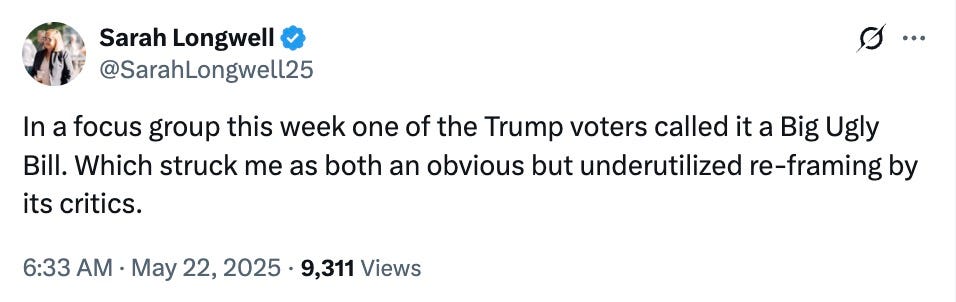
Democrats would be well within their rights to describe this administration and Congress as carrying out the biggest assault ever on American health care. They can call the budget bill an anti-health care bill; a Big Destructive Attack on American Health Care Bill.
Of course Democrats will need a fresh, positive agenda on the economy and on health care. But that’s mostly for 2028. For now, Democrats and their allies can explain to voters that we have to stop the attacks and destruction. This “conservative” message for 2026 can be followed up with a more reformist message in 2028.
So when Democrats go to their home districts next week, don’t talk about the Republican budget or tax cuts. Talk about the Republican anti-health care agenda. Have doctors and nurses and technicians and researchers—and yes, patients and those benefiting from various health care programs—front and center at their town halls. Defend our health care. Defend our health.
Early to bed and early to rise, focus on health care and win the prize.
Share The Bulwark
ANOTHER ORDER FLOUTED: First it was El Salvador. Now it’s South Sudan. The White House this week ignored a federal judge’s ruling to not put a handful of violent offenders on a deportation flight to the east African nation, although where the flight actually landed is unclear.
Yesterday, Judge Brian Murphy denounced the action as having “unquestionably” violated a court order and raised the possibility of holding administration officials in contempt. Politico reports:
At a court hearing Wednesday, Murphy accused immigration officials of defying his earlier directives to provide “meaningful” due process to people whom the administration is trying to deport to countries where they have no ties and could face violence.. . .
Last month, Murphy barred the Trump administration from deporting people to so-called “third-party countries,” rather than their countries of origin, without first giving them a meaningful chance to challenge their deportation on the basis that they might be killed or tortured there. Despite that ruling, the administration on Tuesday morning gathered detainees who were being held in immigration custody in Texas and put them on a plane to be deported. The men were told they were being sent to South Sudan, one of the most dangerous and war-torn nations on Earth. They were given only about 12 hours notice of the deportations and no ability to consult with their lawyers.
The episode illustrates how rapidly the White House’s court-flouting immigration strategy is starting to bog down: Enduring who knows how many contempt charges for the sake of eight removals is no way to run a mass-deportation regime.
EEL TURN: We have to acknowledge that the following sentence is pure Bulwark bait: Vice President JD Vance sat for an interview with the New York Times’s Ross Douthat in Rome yesterday, and Douthat questioned him extensively about how he reconciles his Catholic faith with the White House’s immigration regime. Vance is a slippery speaker, and his answers contained lots of soothing flourishes about the importance of balancing the need to enforce a nation’s borders with respect for the humanity of migrants. Here’s part of one response:
On the migration question in particular, you have to think about what [the church] has said, and when the church says yes, we respect the right of a country to enforce its borders, you also have to respect the rights of migrants, the dignity of migrants, when you think about questions like deportation and so forth. You have to be able to hold two ideas in your head at the same time.
And I’m not saying I’m always perfect at it, but I at least try to think about, OK, there are obligations that we have to people who in some ways are fleeing violence, or at least fleeing poverty. I also have a very sacred obligation, I think, to enforce the laws and to promote the common good of my own country, defined as the people with the legal right to be here.
It is possible, we suppose, to imagine a deportation regime for which this is a worthy defense. But it’s an absurdity of the highest order to suggest it applies to what the White House is carrying out. As judge after judge has found, the apparatus Vance is defending routinely violates the rights of migrants: A Cato Institute analysis this week found that more than fifty of the Venezuelan migrants now locked up in El Salvador came to the United States legally. And “dignity”? The White House relishes the opportunity to strip migrants of their dignity. They routinely play it for laughs in the most grotesque terms—remember the ASMR deportation flight?
TRAGEDY IN D.C.: Some devastating news overnight in the nation’s capital where two members of the Israeli embassy staff were shot and killed outside at an event at the Capital Jewish Museum. The two victims were a young couple, about to get engaged. The alleged shooter, who is in custody, reportedly shouted “free, free Palestine” following the shooting.
The shock of it all was still being absorbed Thursday morning. Undoubtedly, it will soon be thrown into our collective debate over the war in Gaza. But for the Jewish community, it was abject horror. Ted Deutsch, who heads the American Jewish Committee—which hosted the event—called it the “realization of the Jewish community’s worst fears,” during an appearance on Morning Joe.
“How can this be the reality we are living in?” he asked. “How is the Jewish community supposed to feel now?”
How we are supposed to feel is difficult to properly answer at this moment. How we do feel is easier. Fear and pain. Fear because of how unremarkable the event where the shooting took place was. Every week, there are these types of gatherings of Jewish officials and activists. Indeed, there was another, unrelated one that took place just last night. Pain because of the senselessness of the loss. Two young people were slaughtered last night. It did nothing to advance peace. They died simply because they were Jewish.
—Sam Stein
Brighten someone’s inbox or social media feed by sharing this edition of Morning Shots:
Share
Great Job William Kristol & the Team @ The Bulwark Source link for sharing this story.
In a recent CNN town hall, an audience member named Grace Thomas asked Bernie Sanders how the Democrats could win back men, particularly white men, without abandoning marginalized communities. A fiery Sanders, who moments later would be shouting at Anderson Cooper about CNN’s insufficient attention to America’s health care crisis, answered Grace with his nice-Jewish-grandpa-explains-right-and-wrong voice. There are certainly things that Americans disagree over, he said, but there are also many things most of us agree on, particularly when it comes to economic issues that impact people’s daily lives.
To illustrate, Sanders asked the bipartisan audience a question of his own: “Who thinks the American health care system is broken?” Everyone raised their hands.
While President Donald Trump and his brigade of billionaires ransack the federal government, Sanders is one of the few opposition politicians actually trying to do politics. His tour with Alexandria Ocasio-Cortez (AOC) has drawn packed crowds across the country. Their message: fight oligarchy by standing up to corporations and addressing the pressing needs of the working majority.
Despite drawing these huge crowds, the energy that Bernie and AOC are gathering has few places to go in electoral politics. There is no way to get the kinds of policies they talk about through the current legislature, neither of them are running for office at the moment, and the Democratic Party has proven that it will resist its social democratic wing harder than it does MAGA.
The Fighting Oligarchy Tour’s success is driven by Bernie’s and AOC’s ability to validate the frustrations of the American majority and connect working-class grievances to commonsense solutions that put people before profit. Sanders’s unifying move in that bipartisan CNN town hall was a perfect example. Now imagine if we could take all those raised hands agreeing that our health care system is broken and convert them into votes for a solution. With ballot initiatives, we can.
At the Center for Work and Democracy, my colleagues and I have spent the past four years cataloguing and studying the results of citizen-initiated ballot measures. Put simply, people vote a lot differently on policies than they do on politicians. Setting partisan politics aside, strong majorities around the country are voting for egalitarian measures like raising minimum wages, expanding Medicaid, and defending abortion rights.
Bernie and AOC have a national platform, an audience primed for action, and the infrastructure to gather enough small donations to stand up to the billionaire class. If we really want to fight oligarchy with a policy agenda that tangibly improves working people’s lives now, ballot initiatives are the best chance we have. Bernie and AOC should throw their weight behind direct democracy and back initiatives for people-first policies.
The American political system doesn’t give ordinary people many opportunities to weigh in directly on the laws that govern us. In half the states and in most municipalities, however, voters can propose and pass their own legislation through ballot initiatives. The results of these votes show an American population that agrees on a lot of core issues.
Over the last fifteen years, citizen-initiated ballot measures at the state level passed just under 55 percent of the time. Egalitarian policies, meaning policies that broadly equalize society, passed over 65 percent of the time. This category includes everything from minimum-wage increases to labor protections to abortion rights to un-gerrymandering districts.
Egalitarian measures that focused on economic redistribution passed 75 percent of the time. Here we’re talking about policies like raising the minimum wage, expanding access to Medicaid, curbing predatory debt collection, and taxing the rich to fund public services.
Most importantly, these wins are happening in “red” and “blue” states alike.
In fact, in states controlled by the Republican Party, economic justice initiatives passed 92 percent of the time. 92 percent! When given the chance to choose policies that make society fairer and more equal, red state voters vote “yes” more than nine times out of ten.
As Kelly Hall, director of the Fairness Project, the organization with the best track record of supporting successful egalitarian measures, told Jacobin: “People want Medicaid expansion, so let’s get out there and get people covered. Otherwise, there isn’t much for anybody in the legislative minority to do except rend their garments and gnash their teeth.”
After the Barack Obama presidency’s Affordable Care Act, Republicans made Medicaid expansion enemy number one. But when voters in eight red and purple states put Medicaid expansion on the ballot, it passed in all but one — with an average 60 percent majority. There is no other way to expand Medicaid in Republican-controlled states, and this one works.
Let’s look at some other examples. In the twenty-first century, there have been twenty-eight statewide votes to raise minimum wages and twenty-seven passed — again, with an average 60 percent majority. The success shouldn’t be surprising. A majority of people work for a living, and many jobs don’t pay enough for workers to make ends meet without taking on additional jobs or going into debt. At a time when the cost of living is one of Americans’ most pressing concerns, voting to raise wage floors is a no-brainer for most people.
For half a century, partisan politics made abortion seem like a political third rail dividing the country down the middle. Yet of the seventeen states where the issue has appeared on the ballot since 2022, fourteen supported reproductive freedom, including in red states like Arizona, Missouri, and Montana. And one of the three losses, a failed bid to put abortion rights in the Florida state constitution, received 57 percent of the vote despite all manner of repression; it only failed because of the state’s 60 percent rule for initiatives.
“For abortion, we let people tell their stories,” Lisbeth Espinosa, organizer at Healthcare Rising Arizona (HRA), told Jacobin. HRA led Arizona’s successful 2024 initiative to protect abortion rights, along with the Fairness Project and a host of other local organizations. She continued, “And we connected people’s stories to the exercise of direct democracy, so we let people grab a hold of it, and democracy goes from a noun to a verb. It’s way more powerful than political parties right now.”
The Democratic Party behaves as though passing genuinely people-first policies requires a nearly impossible feat of political gymnastics. But it turns out that when it comes to a lot of these issues, you can just ask people. Tellingly, these initiatives commonly outperform the winning politicians on the same ballot.
The tools of direct democracy were intended for moments like ours, when the majority wants and needs policies that neither party will deliver. Grassroots campaigns for egalitarian ballot initiatives present a unique opportunity to channel popular resentment toward real solutions.
The best part? It’s already happening. Egalitarian measures, especially those that focus on economic justice, are winning around the country.
In fact, ballot measures have been so effective at passing egalitarian policies that statehouses around the country have declared war on direct democracy, with dozens of legislative and bureaucratic maneuvers designed to kneecap citizen initiatives or kill the initiative process altogether.
“There are a lot of politicians who are incessant on coming up with more and more ways to take power out of the people’s hands,” said Quentin Savwoir, director of programs and strategy at the Ballot Initiative Strategy Center, a think tank and hub for progressive ballot initiative campaigns. “It’s mostly coming from the Republican Party, but if we’re being honest, it’s the Democrats too in spots.”
In this context, egalitarian wins can’t rely on an issue’s raw popularity. They require strategic, well-organized campaigns.
The Fairness Project has gone twenty-nine for thirty-two at state-level egalitarian measures in the past decade, mostly in red states, in addition to a dozen other initiative victories. Despite operating with a tiny national staff, the wins they have racked up are a major component of the staggering success rates we see for egalitarian initiatives. Their model is simple: focus on achievable, high-impact, popular issues in red states, provide the best resources to local grassroots coalitions, keep partisan politics out of it, and commit to year-round organizing.
“We get rid of the performative and focus on what things are highly effective,” Hall told Jacobin.
It works. A prime example: their abortion rights campaign in Arizona gathered so many signatures that the deep-pocketed anti-choice opposition basically folded. Prop 139 won with 62 percent of the vote — hundreds of thousands more votes than either Trump or Kamala Harris got in the state.
Grounding our movement in direct votes for people-first policies doesn’t just enable us to get these laws on the books. It also changes our political terrain. “The best defense is a good offense,” said Hall. “I still am very concerned about what they will do at the federal level on abortion, but I’d be far more concerned that we would be facing a national abortion ban if we had not shown just how unpopular that is even in red states.”
We are already seeing a similar effect with Medicaid. Missouri senator Josh Hawley, darling of the January 6 contingent and sworn enemy of Medicaid circa 2018, did an abrupt about-face after his state voted to expand Medicaid in 2020. He is now one of the Republicans defending Medicaid against Trump’s threats.
“These citizen initiatives are people’s way of reclaiming some autonomy in the political system,” Savwoir told Jacobin.
Ballot initiatives are the best tool for the task at hand, but they are no miracle cure. Only twenty-three states currently have citizen initiatives at the state level, and putting something on the ballot is difficult and expensive (though less so than candidate elections). Meanwhile, the rules are complicated and restrictive, and the entire process is facing a coordinated assault from legislators and wealthy interest groups who would rather keep the policymaking domain to themselves. Wins that stand to redistribute significant resources from the rich are sometimes typically attacked by the statehouse and courts after they pass, like Arizona’s 2020 initiative taxing high incomes to fund public education.
Ultimately, the full implementation of egalitarian policies will require a national, cross-sectoral movement to uphold and expand popular measures. But with the Republican Party off the rails and Democrats committed to hiding under the bed, citizen initiatives offer the only realistic path to forcing people-first policies onto the political agenda and passing them directly.
The United States is at a critical juncture. Trump and his billionaire friends are attacking the services, programs, and functions of government that until now have prevented society from collapsing into profit-driven mayhem. They are openly flouting the courts and even having judges arrested when they rule against the regime.
At the same time, the destruction of the liberal status quo is forcing Americans to confront big questions about what kind of country we want to live in and how we achieve necessary reforms. As the popularity of the Fighting Oligarchy Tour demonstrates, most people want a society that works for everyone, not just the 1 percent.
So how do we get there?
The shortest path from one place to another is a straight line. Direct votes cut through the disaster that is two-party politics and allow popular movements to go on offense. Health care for all? Guaranteed paid sick and family leave? More affordable housing? Environmental protection? Tax billionaires to fund public education and transportation? We could vote on it, and we don’t need to wait for a hypothetical third-party surge or fantasy future when an insurgent-led Democratic Party seizes a filibuster-proof trifecta. We can do it right now.
Many organizations are leading the fight to pass impactful ballot initiatives on the ground. They need resources and support, but the real missing piece is a coherent national movement connecting these efforts. That is exactly what Bernie and AOC can provide.
Americans are ready to directly legislate the ideas being put forth by the Fighting Oligarchy Tour. Bernie and AOC should use their platform to support and expand local ballot initiative fights across the country and consolidate that momentum into a coherent, national people-first agenda.
Great Job Ben Case & the Team @ Jacobin Source link for sharing this story.
Even before police apprehended Luigi Mangione, Tik Tok users bestowed a nickname on the alleged killer of UnitedHealthcare CEO Brian Thompson: the adjustor. The label refers to insurance adjustors who evaluate claims to determine liability and negotiate settlements. The play on words points to the intense anger that many Americans feel for a health care system that seems more concerned with generating profits than saving and enhancing lives. Now, finally, someone was taking action to even the scales. The term, and the act that inspired it, are closely tied to our present moment. Yet they also sit within a historical tradition, that of the giustiziere or “avenging executioner” that dates to the nineteenth century. The most iconic example is Gaetano Bresci, a thirty-year-old silk weaver who assassinated the King of Italy, Umberto I, on July 29, 1900.
On that day, as the king was about to depart from the Parco Reale in Monza, a city not far from Milan, where he had presided over a gymnastics contest, Bresci shot him three times. The king died within minutes. Bresci, who was born in Tuscany and later moved to Paterson, New Jersey, had returned to Italy in spring 1900. He assassinated the king as punishment for his having signed a decree imposing martial law to quell the May 1898 protests in Milan against rising food prices — before bestowing Italy’s highest military honors on the general who ordered grapeshot to be used against the unarmed demonstrators, killing hundreds. The government’s lethal response was the latest in a series of repressive measures intended to thwart efforts by industrial and agricultural workers to fight economic exploitation and force their way into a political process that had long excluded them and ignored their interests.
The youngest of four children, Bresci was born in the town of Coiano, near Prato, on November 11, 1869. The Bresci family lived a precarious existence. At age eleven, Gaetano began work as an apprentice in Prato’s expanding silk weaving industry. By age fifteen, he had become a fully qualified silk weaver as well as an active member of Prato’s anarchist group. Bresci’s conversion to anarchism resulted from the poverty he and his family had endured, which generated resentment toward Italy’s social order.
The exploitation he observed and experienced firsthand as a factory worker only served to increase his resentment. Hostility toward the system he perceived responsible for his suffering and the suffering of others translated into overt political consciousness by direct contact with the anarchist artisans and factory workers of Prato, where the movement enjoyed a sizable following. His willingness to defend those he considered victims of exploitation and arbitrary authority led him to be actively involved in strikes, to be imprisoned for defending fellow workers from police brutality, and eventually to internal exile on a remote island off the coast of Sicily.
Along with many of his comrades, Bresci emerged from these experiences a more resolute and committed militant. After his release, Bresci migrated to the United States, arriving in New York on January 29, 1898. Soon after, he moved to Paterson, where he joined some ten thousand Italians employed in the city’s silk mills and dye houses. In addition to its thriving silk industry, Paterson at that time boasted the highest percentage of avowed anarchists and anarchist sympathizers in the United States and possibly the world.
Bresci eventually found work as a skilled decorator in a silk mill in Paterson, for the relatively good wage of fourteen dollars a week. Adjusting easily to his new environment, in quick succession he married and became a father. Shortly before his return to Italy, his wife become pregnant with their second child.
Bresci was neither a madman nor a terrorist. He gave no indication of possessing the capacity to commit a political assassination. On the contrary, by any external measure, he lived a normal life, economically comfortable and emotionally secure in a stable environment with a loving family. He undoubtedly knew that to assassinate King Umberto (or to fail in the effort) constituted a suicide mission. Yet Bresci was prepared not only to forfeit his own life but also to risk the dire consequences that would surely befall his entire family. His willingness to sacrifice so much was obviously the product of his commitment to exact revenge for the injustices committed by King Umberto and the Italian government.
Having learned from newspapers that King Umberto planned to travel to Monza, Bresci spent two days reconnoitering the scene. He decided that the best time to strike would be at the conclusion of the festivities. The night before the gymnastics competition, he cleaned his revolver and cut crosses into the lead bullets with scissors to increase their lethality. On the day of the fatal encounter, Bresci left his hotel around noon, stopping first at a dairy bar for ice cream; half an hour later, he sat down in an outdoor seat at the Caffè del Vapore and ordered lunch. To pass the time, Bresci spent the rest of the day walking around town. He returned to the dairy bar four more times for ice cream.
By evening, Bresci had entered the royal park. He had intended to position himself along the road by which the king would enter, but the crowd was so dense that he was pushed toward the center of activities. As luck (for Bresci) would have it, he was now within three meters of the spot where the king’s carriage would park. With three well-aimed bullets he hit his target.
The carabinieri, aided by members of the public, immediately surrounded Bresci and led him away. A lengthy investigation ensued, during which authorities in Italy and the United States worked diligently but unsuccessfully to prove that Bresci was part of a conspiracy. They found no evidence that he had acted in concert with anyone else and he was tried for murder. He was found guilty and issued the maximum sentence, which, because Italy had no death penalty, was life in prison.
In the court of public opinion, reactions were mixed. Supporters on both sides of the Atlantic saw Bresci as a noble, pure, and selfless avenging executioner who exacted retributive justice for the victims of state violence. In Italy, during the weeks and months following the assassination, the cry “Viva Bresci” reverberated in all forms of public gatherings and was scrawled on walls across the country. By some accounts close to 2,700 people — only a few of them anarchists, comprising all social classes, from peasants, artisans, and shopkeepers to priests, soldiers, and even some aristocrats — were tried for expressing their support for Bresci in one form or another.
In contrast, leaders of the Partito Socialista Italiano (PSI), founded in 1892, who were seeking political legitimacy by participating in the parliamentary system, distanced themselves from the regicide. Others reviled Bresci as a terrorist who killed a good man and sought to destabilize society. Bresci disputed this charge, claiming a distinction between violence perpetrated against individuals and acts of retaliation against a repressive social order. When interrogators asked why he had killed Umberto, he answered, “I did not kill Umberto, I killed the King,” thus dissociating the official position of his target from the flesh and blood man who occupied it. He manifested the same determination and sangfroid at every stage of his ordeal, which eventually resulted in his murder at the hands of prison guards in 1901.
Although they are separated by more than a century, Gaetano Bresci’s response to his interrogators in which he provided a political justification for his act of violence resonates in Luigi Mangione’s manifesto. By taking issue with the US health care system, which, he noted, has reaped enormous profits at the expense of the well-being of ordinary Americans, Mangione did not kill Brian Thompson, to — in the words of the Manhattan district attorney — “sow fear” among the public. He shot the CEO of UnitedHealthcare to extract retribution on a person in power responsible for the suffering and death of many. For Mangione, “these parasites simply had it coming.”
Surely, there are important differences between Bresci’s Italy and Mangione’s United States. In late nineteenth-century Italy, the right to vote extended only to middle- and upper-class males and restrictions on freedom of speech, press, association, and trade unions severely limited avenues available for peaceful protest. This is not the same as contemporary America. However, despite these differences, the attentats carried out by Bresci and Mangione have the same targets: elites indifferent to human suffering and a political system in which all dominant parties are beholden to moneyed interests. The way to prevent this kind of political violence from recurring is not by increased surveillance and repression, but by fostering democratic alternatives to effect real change by peaceful means.
Great Job Fraser Ottanelli & the Team @ Jacobin Source link for sharing this story.
ProPublica is a nonprofit newsroom that investigates abuses of power. Sign up for Dispatches, a newsletter that spotlights wrongdoing around the country, to receive our stories in your inbox every week.
When Hurricane Helene plowed over the Southeast last September, it caused more inland deaths than any hurricane in recorded history. The highest per capita death toll occurred in Yancey County, a rural expanse in the rugged Black Mountains of North Carolina devastated by flash flooding and landslides.
On Monday, we published a story recounting what happened in Yancey. Our intent was to show, through those horrific events, how highly accurate weather warnings did not reach many of those most in harm’s way — and that inland communities are not nearly as prepared for catastrophic storms as coastal ones. No one in Yancey received evacuation orders — and many, including those living in high-risk areas and caring for young children and frail older people, didn’t flee because they didn’t see clearer signs of urgency from the county.
Much has been written about Helene, but very little focused on evacuation orders. During four months of reporting, we found that the responses of local officials across western North Carolina’s mountain counties differed a great deal. We also found that the state lags behind others in terms of what it requires of its county-level emergency managers and that legislators paused for almost a decade an effort to map landslide hazards in the counties that were hardest hit by Helene.
Here are five key discoveries from our reporting:
1. Some counties in harm’s way issued evacuation orders. Others did not.
To determine which cities and counties communicated evacuation orders, we reviewed more than 500 social media posts and other types of messaging that more than three dozen North Carolina jurisdictions shared with their residents in the lead-up to the storm. We compared that with a letter Gov. Roy Cooper sent to then-President Joe Biden seeking expedited disaster relief.
We found that by nightfall on Sept. 26, the day before Helene hit, three counties near Yancey issued mandatory evacuations, targeted toward people living close to specific dams and rivers, and at least five counties issued voluntary evacuation orders.
McDowell County, just southeast of Yancey, took particularly robust actions to warn residents about the storm, including issuing both mandatory and voluntary evacuation orders in enough time for people to leave. Henderson County, southwest of Yancey, targeted a voluntary evacuation order at residents living in floodplains that have a 1 in 500 chance of flooding annually, and its directions were clear: “The time is now for residents to self-evacuate.”
Yancey and at least four other nearby counties also did not issue evacuation orders. Yancey’s emergency manager, Jeff Howell, told us he doubted the county commissioners would support issuing orders or that local residents would heed them given the area’s culture of self-reliance and disdain for government mandates, especially regarding property rights. But some Yancey residents said they would have left or at least prepared better.
Although local officials received repeated warnings — including one that said the storm would be among the worst weather events “in the modern era” — some argued that they couldn’t have done more to prepare because the storm’s ferocity was so unprecedented.
We found that inland mountain communities too often lack the infrastructure or planning to use evacuations to get residents out of harm’s way in advance of a destructive storm like Helene. Some officials in Yancey, for instance, said that they weren’t sure where they would have directed people to go in the face of such an unprecedented onslaught of rain and wind.
In recent years, far more people died in the continental U.S. from hurricanes’ freshwater flooding than from their coastal storm surges — a dramatic reversal from a decade earlier. That’s largely due to improved evacuations along the coasts.
Several Eastern states — including Florida, North Carolina, South Carolina and Virginia — have adopted plans called Know Your Zone to execute targeted evacuations when storms approach. But these plans don’t often extend very far inland, even though warming ocean temperatures create stronger storms. Powerful storms that are not hurricanes can also turn deadly. In February, storms killed at least 24 people in Kentucky. More have died since in other storms.
2. Disaster messaging varied considerably by county.
To understand how local officials communicated disaster warnings to their residents, we compiled a timeline of alerts and warnings sent out by the National Weather Service and then scoured contemporaneous social media posts that more than three dozen jurisdictions were sharing with their residents. We found big disparities.
For instance, in addition to issuing evacuation orders, McDowell County put out flyers in English and Spanish that warned of life-threatening flash floods and urged all people in vulnerable areas to “evacuate as soon as possible.” Many did.
And about 36 hours before Helene hit, Haywood County’s sheriff warned in a brief video message that a “catastrophic, life-threatening event is about to befall” the county, which has one of the larger populations in western North Carolina. The emergency services director, standing beside him, emphasized: “This message is urgent.” The sheriff then asked residents, starting that night, to “make plans or preparations to leave low-lying areas or areas that are threatened by flooding.” He ended with: “Please, seek safety — and do so now.”
Almost an entire day later, with Helene closing in, officials in rural Yancey were among those who used less-direct wording. In Facebook posts, they asked residents to “please prepare to move to higher ground as soon as you are able” and advised “now is the time to make plans” to go elsewhere as the final hours to leave before nightfall wound down. In one post, they softened the message, adding, “This information is not to frighten anyone.”
ProPublica interviewed dozens of survivors in Yancey, including many who told us that in retrospect they were looking for clearer directives from their leaders.
3. Unlike several nearby states, North Carolina does not require training for local emergency managers.
At the heart of evacuations are emergency managers, the often little-known public officials tasked with preparing their areas for potential disasters. Yet, education and training requirements for these posts vary considerably by state and community.
Yancey’s emergency manager had taken the job seven years before Helene hit after a long and robust Army career. He had no emergency management experience, however. In the years before Helene, he had been asking the county for more help — but by the time the storm arrived, it was still only him and a part-time employee.
Florida recently enacted a law mandating minimum training, experience and education for its counties’ emergency managers starting in 2026. Georgia requires its emergency managers to get the state’s emergency management certification within six months. But North Carolina doesn’t require any specific training for its local emergency managers.
4. North Carolina began examining landslide risks by county, but powerful interests stood in the way.
More than 20 years ago, North Carolina legislators passed a law requiring that landslide hazards be mapped across 19 mountain counties. They did so after two hurricanes drenched the mountains, dumping more than 27 inches of rain that caused at least 85 landslides and multiple deaths.
But a few years later, after only four of those counties were mapped, a majority of largely Republican lawmakers gave in to real estate agents and developers who said the work could harm property values and curb growth. They halted the program, cutting the funding and laying off the six geologists at work on it.
Almost a decade later, in 2018, lawmakers jump-started the program after still more landslide deaths. But it takes at least a year to map one county, so by the time Helene hit, Yancey and four others in the storm’s path of destruction weren’t yet mapped.
Without this detailed hazard mapping, emergency managers and residents in those areas lacked the detailed assessment of risk to specific areas to make plans before landslides clawed down the mountains, killing far more people. The U.S. Geological Survey has so far identified 2,015 Helene-induced landslides across western North Carolina.
The geologists back at work on the project are almost done mapping McDowell County. They would have finished it last year, but Helene derailed their work for a time.
5. We could find no comprehensive effort (yet) to examine lessons learned from Helene to determine how counties can prevent deaths from future inland storms.
Helene left many lessons to be learned among inland communities in the paths of increasingly virulent storms. But as North Carolina figures out how to direct millions of dollars in rebuilding aid, there has so far been no state inquiry into the preparedness of local areas — or what could better equip them for the next unprecedented storm.
Yancey County’s board chair said that he expects the county will do so later, but for now its officials are focused on rebuilding efforts.
A review commissioned by North Carolina Emergency Management examined its own actions and how its staff interacted with local officials. It found the agency severely understaffed. But it didn’t examine such preparedness issues as planning for evacuations or the training requirements for local emergency managers.
Great Job by Jennifer Berry Hawes and Mollie Simon, with additional reporting by Cassandra Garibay & the Team @ ProPublica Source link for sharing this story.
When Roe v. Wade was overturned in the summer of 2022, Anna Malaika Tubbs was in the middle of writing her second book about how fabricated hierarchies of race and gender have become deeply ingrained – and unnoticed – in the United States. When federal protections for abortion access were lost, Tubbs said people were so shocked, asking “How did this happen?” and “Why did this happen?”
“It just really felt like I had to get this book out there,” Tubbs said. “It’s a book on understanding the system of American patriarchy, how that came from the minds of the founding fathers, how they systemized their vision and how we still see traces of it.”
Tubbs, who holds a doctorate in sociology and master’s degree in multidisciplinary gender studies from the University of Cambridge, again felt urgency to publish this book one year later when the Barbie movie came out in the summer of 2023. The film grossed over $1.4 billion worldwide, making it one of the highest-grossing of all time and spurring widespread conversation about gender roles and societal norms.
“So many people saw this as sort of revolutionary, and there were so many people in the audience around me crying about this film,” Tubbs said. “The only thing the film said was that women need to wake up to the fact that patriarchy exists, spread the word to each other and now everything’s going to be just fine. And that is not the full picture. We’re blaming the victim, especially mothers, and telling them they just need to become more empowered — and that’s absolutely not the case.”
The following year, as the presidential election was coming to a close, people around Tubbs, including her husband, were excited and hopeful for then-Vice President Kamala Harris, the Democratic nominee. But Tubbs, still working on her book, was fairly positive that President Donald Trump was going to win. She saw connections between her research and the whispers about Project 2025, Trump’s rhetoric around what it means to make America great again and how his campaign spoke about people of color and immigrants.
Read Next:
Read Next:
‘The Three Mothers’ honors the women who raised Martin Luther King Jr., Malcolm X and James Baldwin
“I was so angry in the sense that I kept hoping and wishing that this book could be out right now,” she said. “This could help so many people understand what’s going on and why this is happening. I think we can understand who to turn to for solutions, how we need to vote differently and what kind of policies we need in place so that this doesn’t repeat itself.”
Tubbs’ new book, “Erased: What American Patriarchy Has Hidden From Us,” hit the stands on May 20. In an interview with The 19th, Tubbs discussed how an unjust system has been perpetuated and outlined concrete steps for how to create a new more equitable country.
This interview has been edited for length and clarity.
Mariel Padilla: You mention in the book that American patriarchy is distinct from other countries and cultures. Can you elaborate on how?
Anna Malaika Tubbs: When I say American patriarchy, I’m not trying to say that it’s the only patriarchal system by any means at all. I have seen patriarchy across the world — the premise being that men should hold more power over women. What I am saying is that one of the reasons we haven’t been able to really challenge patriarchy in the United States is that we haven’t contextualized it.
American patriarchy is going to be different than Mexican patriarchy, for instance, because of our history with slavery. Who is defined as a man and woman and how we define that binary is largely connected with our history: The founding fathers wrote into the Constitution that to be a man was to have control over other people, to own land and to have the ability to vote. Women were completely left out of that. Black men certainly didn’t have access to this and even some poor White men weren’t included.
I think one of the primary ways in which patriarchy has persisted is by tricking us into thinking that race and gender aren’t intertwined with each other. When we go back to that breakdown of what it meant to hold power in the United States, we were talking about White, cisgendered, able-bodied, privileged men. It was a very specific, very limited group on purpose because they wanted to maintain their own power. And so we can’t think about humanity in the U.S. without understanding race, and we can’t think about that without understanding gender.
Let’s appreciate the gains we’ve made. But also ask ourselves why we’re still so vulnerable. We’re still coming up against a system that is at the core of our nation, and we’re not challenging it. We’re only kind of putting band-aids on some of its symptoms and not really addressing the disease where all of those are stemming from.
Elaine Welteroth and Anna Malaika Tubbs attend the VIP Preview of “Erased,” the new book from Anna Malaika Tubbs, NYT Bestselling Author of “The Three Mothers” at Getty House on April 24, 2025 in Los Angeles, California.
(Araya Doheny/Getty Images)
The title of the book is “Erased.” For me, it called attention to the fact that there are actors actively doing the erasing, something is being erased and therefore what’s left is not the full picture. Can you walk through how you came to this title?
I feel like American patriarchy is doing the erasure, but it also has purposely erased itself from the picture so that we think that everything happening to us is natural and unavoidable. We think things have to happen a certain way, and we continue to sort of be surprised because we can’t actually trace it.
In another way, it’s like a pencil mark that you try to erase, but it is still there. You can’t ever fully erase it, and that’s where the recovery part comes in. Because while you try to take something away, we can always access it by retracing the lines and piecing things together. This is especially important at a time when books are being banned and really blatant erasure is happening — we have to reclaim.
The last several parts of your book discuss solutions. How can people — particularly women and people of color — take action, resist unjust systems and create a more equitable society?
It’s a step-by-step process. I always say we have to start individually. Once you’ve gone through the book and you understand what has been so ingrained, how even maybe our parents have parented us and our teachers have taught us — ask yourself how you see yourself. Do you see yourself as someone who’s supposed to dominate other people? Do you see yourself on this trajectory of needing more power to finally be treated the way you want to be treated? Do you feel the need to wield control over people around you? Or do you see yourself as somebody who’s supposed to be silenced? The individual piece of this is just a general reflection on how the system has already influenced you.
The second part is our relationships. How are we interacting with each other as a result of this system? How are we parenting our children? Are we trying to dominate them? Are we trying to make them fit into this social order because we’re afraid of what might happen to them otherwise? How are we allowing American patriarchy and its ideals to infiltrate our closest relationships, our marriages, our ties to our parents?
The third part is a community-level reflection. What are the ways in which we can start fighting against the system by meeting each other’s needs? You don’t have to wait for a national shift. We can start making shifts in our own families and our immediate communities. We can think about how someone else’s pain is hurting me and start to find solutions together. This will change how we vote and who we vote for and the policies we support that bring us back to the things that American patriarchy has taken from us.
The 19th has a relationship with Bookshop.org. If you make a purchase through the Bookshop links on our site, we may earn an affiliate commission.
Great Job Mariel Padilla & the Team @ The 19th Source link for sharing this story.
The effects of Trump’s reshaping of NSF and other national science agencies will be felt far beyond these institutions.
(Getty Images)
Trump’s aversion to science and research is well-known. So, it is not surprising that the country’s top scientific research agencies, including the National Science Foundation (NSF) and the National Institutes of Health (NIH), were among those targeted under his anti-Diversity, Equity and Inclusion executive orders and reckless federal funding cuts. At the NSF—where, along with the NIH, about 40 percent of all basic research in the U.S. is conducted—the fallout was immediate and extensive. Grant money was frozen, and any new grant reviews were halted, plunging thousands of researchers into uncertainty.
Research projects focused on race and gender are facing the brunt of these executive actions. These include projects doing critical work to understand gender and racial disparities in the sciences and develop initiatives to make them more equitable.
In the U.S., STEM professions are highly inequitable and continue to be male and white-dominated. According to one 2023 estimate, only 28 percent of the U.S. STEM workforce is women. Women professors in STEM face significant barriers to achieving tenure and promotion compared to their male colleagues. Women professors also often leave their jobs at a much higher rate. These are just a few among the many issues that DEI initiatives like the ADVANCE program sought to address within NSF and NIH.
The ADVANCE program website was archived on Jan. 31, 2025. On Apr. 18, 2025, after weeks of uncertainty, the NSF posted an update on its new priorities. According to this update, awards that will be terminated include, but are not limited to, those celebrating diversity, equity, and inclusion. Since then, hundreds of NSF and NIH grants at institutions across the country, including ADVANCE grants, have been terminated.
According to one 2023 estimate, only 28 percent of the U.S. STEM workforce is women.
The ADVANCE grant program was founded in 2001 by NSF to support institutional change and increase the representation and advancement of women in academic STEM fields. NSF recognized that despite two decades of efforts to create more opportunities for women in STEM, systemic barriers remained. By its 20th year, the ADVANCE program had supported over 200 institutions with over $365 million in grants. These grants fund various multi-year initiatives to support women faculty through seminars, peer mentoring, professional development, advocates and allies’ programs, as well as institutional surveys to identify barriers and bias. The ADVANCE program has also evolved to become more inclusive. In 2016, it mandated that all funded initiatives should have an intersectional lens by addressing race, nationality, ability, and other factors that shape the barriers faced by women and minority faculty.
ADVANCE grants, large and small, have positively impacted women faculty at various institutions. They have produced a nationwide inter-institutional support network of women faculty members and administrators in STEM higher education. They have allowed women faculty to initiate meaningful conversations about gender, racial equity, and intersectionality within their STEM departments. For many women in STEM higher education, ADVANCE grants were a critical lifeline.
For Dr. Sue Rosser, who has served as the Principal Investigator on numerous ADVANCE grants, the significance of initiatives such as ADVANCE is clear. “Several studies have documented that in both basic and applied research, diverse teams are more productive and innovative than non-diverse teams,” Rosser explained. “Restricting gender and racial equity and inclusion efforts undercuts U.S. science and technology.”
Certainly, there are critiques of institutional DEI initiatives worth discussing. However, the Trump administration is not interested in reforming programs or making them more efficient. Labeling all equity-focused initiatives as “wokeness,” “discrimination,” and “wasteful spending” is really about putting up new barriers for women and minorities. If you’re not convinced, simply look at the press release published by the U.S. Senate Committee on Commerce, Science, and Transportation in February. Titled “Cruz-led investigation uncovers $2 Billion in woke DEI grants at NSF,” it includes a list of federally funded projects that the administration deems to be noncompliant with its executive orders. The grounds for non-compliance are broadly identified as race, gender, social justice, and environmental justice. Unsurprisingly, several projects funded by the ADVANCE program are on the list.
Labeling all equity-focused initiatives as “wokeness,” “discrimination,” and “wasteful spending” is really about putting up new barriers for women and minorities
A few months ago, creating mentoring groups and other resources for women faculty, or publishing research articles about gender and racial equity issues in STEM, was commonplace. These types of initiatives would never land you on a government “hit list.” But that is the reality we live in now. Dr. Susan Shaw, Professor at Oregon State University, Ms. contributor, and Senior Editor of the ADVANCE Journal, which publishes research on gender equity and institutional transformation in STEM higher education, laments this shift. “The uncertainty created by the threats to grant funding is incredibly demoralizing,” she said. “We have been working to create more inclusive, equitable, and just working environments for women and other minoritized people in academic STEM through publishing research, narratives, and artworks. Now, suddenly, that’s a bad thing?” The NSF ADVANCE grant, which funded the journal, was terminated just a few weeks ago.
Trump’s attack on what his administration deems “illegal DEI” ignores several critical and validating aspects of these inclusivity projects. First, any project funded by the national science agencies undergoes a rigorous selection and review process by experts. Second, funding for equity projects is not a handout: it is the result of decades of work by women and minorities demanding an end to systemic discrimination and equal opportunities. For instance, the ADVANCE program was created soon after the release of the explosive “MIT report,” which was compiled through the relentless efforts of Professor Nancy Hopkins in 1999. The report detailed the gender inequities and discrimination, including pay disparity, faced by women in the sciences at MIT.
Further, it is important to remember that what breaks the law is not diversity, equity and inclusion work but the elimination of DEI at agencies like the NSF. NSF’s initiative to expand opportunities for women and minorities is coded into various laws going back to the Science and Engineering Equal Opportunities Act of 1980. The NSF is congressionally mandated to assess how its projects increase the participation of women and minorities in STEM.
As Trump’s war on inclusion and science continues, the future of NSF’s 45-year-long commitment to creating equity in STEM looks bleak. NSF’s new policies state that “projects that have limited impact or rely on DEI frameworks or advocacy do not effectuate NSF priorities.” The effects of such reshaping of NSF and other national science agencies will be felt far beyond these institutions. Not only will equity in STEM remain a faraway dream; we will lose the progress we have worked so hard to make.
Great Job Theoria Praxis & the Team @ Ms. Magazine Source link for sharing this story.
The job of a journalist is to go to where the silence is — especially when those in power seek to silence voices that question or challenge power. That is what we do at Democracy Now! day in and day out, and we’re able to do it because of financial support from people like you — people who trust and depend on our independent reporting. If you believe that freedom of speech and freedom of the press are essential to the functioning of a democratic society, please donate today. Thanks to a group of generous donors, all donations made today will be DOUBLED, which means your $15 gift is worth $30. Every dollar makes a difference. Thank you so much.
Democracy Now!
Amy Goodman
The job of a journalist is to go to where the silence is — especially when those in power seek to silence voices that question or challenge power. That is what we do at Democracy Now! day in and day out, and we’re able to do it because of financial support from people like you — people who trust and depend on our independent reporting. If you believe that freedom of speech and freedom of the press are essential to the functioning of a democratic society, please donate today. Thanks to a group of generous donors, all donations made today will be DOUBLED, which means your $15 gift is worth $30. Every dollar makes a difference. Thank you so much.
Democracy Now!
Amy Goodman
We rely on contributions from you, our viewers and listeners to do our work. If you visit us daily or weekly or even just once a month, now is a great time to make your monthly contribution.
Please do your part today.
Great Job Democracy Now! & the Team @ Democracy Now! Audio Source link for sharing this story.
Welcome back to World Brief, where we’re looking at Israel’s expanded offensive in Gaza, Hungary preparing to leave the International Criminal Court, and G-7 finance ministers seeking unity.
Deadly Offensive
As Israel pursues an expanded military campaign against Hamas in Gaza, foreign pressure is mounting on Israeli Prime Minister Benjamin Netanyahu to halt the new offensive or else risk diplomatic and economic consequences.
Welcome back to World Brief, where we’re looking at Israel’s expanded offensive in Gaza, Hungary preparing to leave the International Criminal Court, and G-7 finance ministers seeking unity.
Sign up to receive World Brief in your inbox every weekday.
Sign up to receive World Brief in your inbox every weekday.
By submitting your email, you agree to the Privacy Policy and Terms of Use and to receive email correspondence from us. You may opt out at any time.
Deadly Offensive
As Israel pursues an expanded military campaign against Hamas in Gaza, foreign pressure is mounting on Israeli Prime Minister Benjamin Netanyahu to halt the new offensive or else risk diplomatic and economic consequences.
Leading this charge is the United Kingdom, which announced on Tuesday that it will be suspending free trade negotiations with Israel over its conduct in the territory. London also imposed new sanctions on Israeli settlers whom it said were linked to violent attacks on Palestinians in the West Bank, and it summoned Israel’s ambassador to the British Foreign Office.
“I want to put on record today that we’re horrified by the escalation from Israel,” British Prime Minister Keir Starmer told Parliament on Tuesday, with Foreign Minister David Lammy calling the offensive “incompatible with the principles that underpin our bilateral relationship.”
Israel’s new ground offensive, which the Israel Defense Forces announced on Sunday, came after days of renewed airstrikes on the territory, and more than 300 people have been killed in the latest spate of fighting. The expanded operation is also expected to further displace many of Gaza’s 2 million residents and exacerbate already dire humanitarian concerns there.
Israel has so far resisted foreign efforts to persuade it to stop its military action. “External pressure will not divert Israel from its path in defending its existence and security against enemies who seek its destruction,” Israeli Foreign Ministry spokesperson Oren Marmorstein posted on X on Tuesday.
But international pressure and warnings of famine in Gaza have pushed Israel to concede to some demands. On Sunday, Netanyahu allowed his cabinet to approve the resumption of aid deliveries into Gaza. “We cannot reach a point of starvation, for practical and diplomatic reasons,” Netanyahu said, alluding to threats by key allies that Israel would lose support if its monthslong blockade on humanitarian assistance continued.
Since Monday, dozens of trucks carrying baby food and medical supplies have entered the territory. But this number is far less than the 600 vehicles that traveled in and out of Gaza daily during the last cease-fire deal.
“If Israel does not cease the renewed military offensive and lift its restrictions on humanitarian aid, we will take further concrete actions in response,” the leaders of Canada, France, and the United Kingdom said in a joint statement on Monday. French leadership went further, with Foreign Minister Jean-Noël Barrot telling local radio on Tuesday that “indiscriminate violence and the blocking of humanitarian aid by the Israeli government” has turned the territory into “a death trap.”
Israel’s closest ally, the United States, has been less publicly vocal, but behind the scenes, the Trump administration has reportedly begun to increase the pressure. According to Axios, U.S. President Donald Trump is upset by images of starving Palestinian children and wants the conflict to end soon. The White House has been pushing Israel and Hamas to accept a new cease-fire and hostage-release deal since Trump concluded his Middle East trip last week. But such negotiations have made little progress, and this week, U.S. Vice President J.D. Vance canceled his trip to Israel, with one U.S. official saying that Vance did not want his visit to be construed as the Trump administration condoning Israel’s offensive.
Trump has “made it very clear to Hamas that he wanted to see all hostages released” and “made it very clear he wants to see this conflict in the region end,” White House press secretary Karoline Leavitt said on Monday. Both Israel and the United States deny that Trump is prepared to abandon Israel or apply more pressure on Netanyahu.
Today’s Most Read
What We’re Following
Leaving the ICC. Hungary’s parliament approved a bill on Tuesday to formally begin the yearlong process of leaving the International Criminal Court (ICC). Hungarian Prime Minister Viktor Orban announced his intention to do so last month, after Budapest defied an ICC arrest warrant by not detaining Israeli Prime Minister Benjamin Netanyahu when he visited the country in March. Netanyahu is accused of war crimes and crimes against humanity for Israel’s military conduct in Gaza.
The ICC is “no longer an impartial court, a rule-of-law court, but rather a political court,” Orban said at the time, with Netanyahu praising his actions as a “bold and principled decision.” The Hungarian leader has accused the 125-member court of “interfering in an ongoing conflict for political purposes” and escalating regional tensions.
The ICC’s Rome Statute was adopted in 1998 to prosecute those accused of genocide, war crimes, and crimes against humanity. Hungary will become the first European country to leave the global authority since its founding. China, Russia, Israel, and the United States are also not members.
Striving for consensus. G-7 finance ministers and central bank governors convened in Canada on Tuesday to try to seek unity on non-tariff issues, namely efforts to counter China. Six of the seven nations hope to keep the powerful grouping of leading industrialized democracies on the same page, but Washington’s differing priorities—particularly the Trump administration’s disruptive trade war and hostility to climate change mitigation efforts—have hindered the bloc’s effectiveness.
G-7 officials familiar with ongoing talks have suggested that a draft communique is in the works to demonstrate group solidarity. This could include a broad statement of support for Ukraine, backing for the International Monetary Fund and World Bank, and global collaboration on combatting financial crimes.
According to one U.S. source, the White House is not likely to “do a communique just for the sake of doing a communique.”
For his part, U.S. Treasury Secretary Scott Bessent said he plans to use the three-day conference to brainstorm ways to generate more private-sector growth. The Trump administration wants to cut government spending and “reprivatize” the U.S. economy.
Arson attacks. A Romanian man was charged in London on Tuesday with conspiracy to commit arson with the intent to endanger life. Prosecutors accused Stanislav Carpiuc, 26, of being linked to three fires within the past two weeks that targeted two properties and one car all tied to the British prime minister. Carpiuc is the second man charged with involvement and one of three currently in custody. He has denied the allegations.
The first incident occurred on May 8, when a car once owned by Starmer was set ablaze in Kentish Town, North London. Three days later, a fire erupted at an Islington property that Starmer once lived in. The next day, a small blaze broke out at Starmer’s private home in Kentish Town; he has been living at Downing Street since taking office last year. No injuries were reported in any of the fires, though some damage occurred.
These assaults are “an attack on all of us, on our democracy and the values we stand for,” Starmer said. British counterterrorism police are leading the investigation.
Odds and Ends
In 2019, five individuals broke into England’s Blenheim Palace to steal the satirical art piece “America,” a fully functioning, 18-karat gold toilet worth $6.4 million. On Monday, the man convicted of helping the burglars sell the commode was granted leniency. “You no doubt, for the last five and a half years, regret doing [that] … every day since your arrest,” British judge Ian Pringle told the accused. Instead of prison time, the individual was given a two-year suspended term and ordered to perform 240 hours of unpaid work.
Tim Miller talks the latest developments with President Trump’s economic roller coaster.
Leave a comment
As always: Watch, listen, and leave a comment. Bulwark+ Takes is home to short videos, livestreams, and event archives exclusively for Bulwark+ members.
Don’t care for video? Use the controls on the left side of the player to toggle to audio.
Add Bulwark+ Takes feed to your player of choice, here.
Great Job Tim Miller & the Team @ The Bulwark Source link for sharing this story.