Home News Page 6

‘The Audacity’: Rep. Al Green Gets Kicked Out of State of the Union for Holding Sign Defending Black People After He Is Accosted By Steve Scalise

‘The Audacity’: Rep. Al Green Gets Kicked Out of State of the Union for Holding Sign Defending Black People After He Is Accosted By Steve Scalise

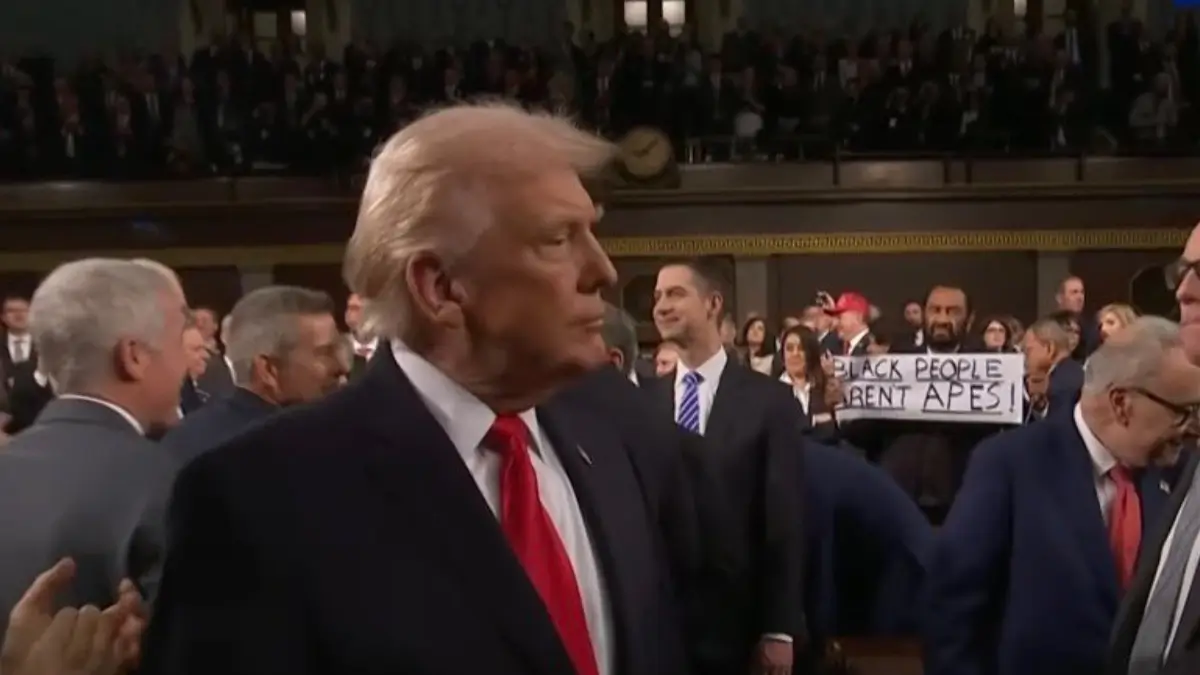
Rep. Al Green didn’t raise his voice or shout over the president during this year’s State of the Union. He raised a sign.

It read: “Black people aren’t apes.”

‘The Audacity’: Rep. Al Green Gets Kicked Out of State of the Union for Holding Sign Defending Black People After He Is Accosted By Steve Scalise
Rep. Al Green (D-TX) has a sign behind the president reading “Black people aren’t apes!” (Photo: @PollTracker2024)

It’s the bare minimum, according to Trump critics, and is a statement of fact. And somehow, still too much for the room.

Within moments, Green was escorted out of the chamber for the second consecutive year, just as House Majority Leader Steve Scalise, as seen in the video, snatched the sign away. The message never even had time to fully land before decorum swooped in to silence it.

‘What Now?’: Gavin Newsom Drops F-Bombs at Fox News Host Over Racism Claims — Then Black Pundits Step in and Blow the Whole Thing Wide Open

The sign was a direct response to a video President Donald Trump recently reposted on Truth Social that depicted the Obamas as apes, a racist trope so old it barely deserves explanation, yet apparently still circulating freely at the highest levels of American politics.

Online reactions came fast and unfiltered.

“Al Green doing the lord’s work,” said one Threads user.

Another reaction captured the moment’s absurdity and audacity perfectly:

“Rep. Al Green bringing a sign that literally states the bare minimum of human decency—Black people are not apes—only for Steve Scalise to snatch it down like a frustrated substitute teacher is a level of petty I didn’t have on my 2026 bingo card. It’s the audacity for me. Imagine being so triggered by a factual statement about basic humanity that you have to physically remove the visual aid. The decorum police are working overtime while the actual point flies right over their heads.”

This wasn’t Green’s first removal from the chamber. Last year, he was escorted out after shaking his cane at Trump during a joint address, an act he has since folded directly into his reelection messaging.

Green is currently locked in a hotly contested Democratic primary in Texas’ newly drawn 18th District, facing Rep. Christian Menefee, who won a special election to replace the late Rep. Sylvester Turner. The primary is set for March 3, and Green has made clear that moments like these are not accidents; they’re the point.

In a recent campaign ad, Green leaned into his reputation for disruption, saying:

When I stood up, it wasn’t for attention. It was because some things are worth standing for.

This year, he didn’t stand. He held up a sign. And once again, that alone was enough to get him removed, not for lying, not for threatening anyone, but for stating a truth so basic it shouldn’t need defending in 2026 America.

“Al Green got removed from the chamber. So happy annual ‘Al Green got removed from the State of the Union’ to all who celebrate,” another Threads user said.

Great Job Nyamekye Daniel & the Team @ Atlanta Black Star for sharing this story.

The Kubuntu Focus Zr Gen 1 Laptop Offers Powerhouse Specs and Stellar Support

The Kubuntu Focus Zr Gen 1 Laptop Offers Powerhouse Specs and Stellar Support

Inside, the Zr Gen 1 features an Intel Core Ultra 9 275HX, with 24 cores, an RTX 5090 graphics card, 24 GB GDDR7 RAM (expandable up to 192 GB), and two SSDs, one with a capacity of 1 TB and the other with 2 TB. (You can have up to four drives, one of them being a PCIe GEN 5×4 NVMe.) Along with the discrete GPU, there’s an integrated one as well, which means you can turn off the discrete one to maximize battery life. I spent about 90 percent of the time with the discrete card off and just turned it on when editing photos and video.

Thanks to the size of the Zr, there’s plenty of room for a full size keyboard with a numeric pad. The keyboard is user-configurable and features a 65,536-color LED backlight system that you can tweak to your liking with the Focus tool. Typing on the keyboard is comfortable. There’s 3.5 mm of travel to the keys, so they’re plenty springy and responsive. As is generally the case with dedicated Linux laptops, there’s a Kubuntu (gear icon) key rather than a Windows key.

Did I mention the Zr Gen 1 weighs 8 pounds? It is a big thing, too big for a shoulder bag. You’ll definitely want a backpack for this one, but even then this isn’t the sort of thing you bring to the coffee shop. It’s more the sort of thing you cart to the lab and back, or perhaps just leave on your desk connected to your home lab. To that end I would say that, when I tell you battery life averaged around four hours, I would also add that it doesn’t matter. This isn’t a laptop you carry around. That you can take it to the couch and watch a movie on it when you want is an added bonus, but not really the point of the machine.

What is the point of a laptop like this? Anything that requires serious computing power, be it machine learning (running TensorFlow), local LLMs, big data crunching workflows, even high-end video editing. I should note that Davinci Resolve ran unlike it has ever run on anything else when I installed it on the Zr Gen 1. I always thought everyone had to wait a couple of seconds before applying a LUT to a large clip. It turns out that can be instantaneous, if you have the GPU for it. I wouldn’t go so far as to say you could edit video without proxy clips, but … maybe you could, depending on the length of your clips.

Bring It in Focus

Photograph: Scott Gilbertson

The advantage of buying a laptop with Linux support is that you don’t have to deal with the potential complexities of managing a Linux system. I am typing this on an Arch-based machine. If I install an update right now and it breaks vim, or tmux, or rxvt-unicode, or any other bit of software from the kernel all the way up to these three, fixing that is on me. What Kubuntu Focus offers is that you don’t have to worry about any of that stuff breaking.

Great Job Scott Gilbertson & the Team @ WIRED for sharing this story.

Michigan Earns A Share Of the Big Ten Title After Beating Minnesota

Michigan Earns A Share Of the Big Ten Title After Beating Minnesota

Elliot Cadeau had 15 points and L.J. Cason scored 11 of his 14 points in the second half as No. 3 Michigan beat Minnesota 77-67 on Tuesday night to clinch at least a share of the Big Ten title for the first time in five years.

The Wolverines (26-2, 16-1) can earn an outright championship with a win at No. 10 Illinois on Friday night or next week at Iowa or at home against 15th-ranked Michigan State.

Michigan was coming off a 68-63 loss to Duke that dropped the Wolverines down from No. 1 and vaulted the Blue Devils to the top spot in the AP Top 25.

The Gophers (13-15, 6-11) trailed by just four at halftime before giving up too many 3-pointers. Michigan made 9 of 18 shots from beyond the arc in the second half.

Minnesota’s Cade Tyson scored 20 points, Langston Reynolds had 15 points and Isaac Asuma and Bobby Durkin scored 12 apiece.

Wolverines forward Yaxel Lendeborg, a preseason All-America player, was held to a season-low three points. Center Morez Johnson scored just six points.

Michigan has matched a school record with 16 Big Ten wins, equaling the 1984-85 and 1976-77 teams. The Wolverines’ 26-2 start is the best in program history.

Reporting by The Associated Press.

Great Job & the Team @ Latest Sports News & Videos from FOX Sports for sharing this story.

Judge bars government from ‘wholesale’ search of Washington Post reporter’s seized devices

Judge bars government from ‘wholesale’ search of Washington Post reporter’s seized devices

WASHINGTON – Federal authorities are barred from conducting an “unsupervised, wholesale search” of electronic devices that they seized from a Washington Post reporter’s Virginia home while investigating allegations that a Pentagon contractor illegally leaked classified information to the journalist, a magistrate judge ruled Tuesday.

U.S. Magistrate Judge William Porter said he will independently review the contents of Post reporter Hannah Natanson’s devices instead of allowing a Justice Department “filter team” to perform a search. Porter said he balanced the need to protect Natanson’s free speech rights with the government’s duty to safeguard top secret national security information.

“The Court finds that seizing the totality of a reporter’s electronic work product, including tools essential to ongoing newsgathering, constitutes a restraint on the exercise of First Amendment rights,” he wrote.

The case has drawn national attention and scrutiny from press freedom advocates who say it reflects a more aggressive posture by the Justice Department toward leak investigations involving journalists.

Federal agents seized a phone, two laptops, a recorder, a portable hard drive and a Garmin smart watch when they searched Natanson’s home in Alexandria, Virginia, on Jan. 14. Last month, Porter agreed to temporarily bar the government from reviewing any material from Natanson’s devices. Tuesday’s order extends that prohibition.

“The Court’s genuine hope is that this search was conducted — as the government contends — to gather evidence of a crime in a single case, not to collect information about confidential sources from a reporter who has published articles critical of the administration,” he wrote.

The Post sought an order requiring the government to immediately return the devices to its reporter, but Porter denied that request. He said it is reasonable for the government to keep nothing more than the “limited information” responsive to the search warrant. The rest of the contents must be returned to Natanson, he ruled.

Allowing the government to search a reporter’s work material, including unrelated information from confidential sources, “is the equivalent of leaving the government’s fox in charge of the Washington Post’s henhouse,” Porter wrote.

Pentagon contractor Aurelio Luis Perez-Lugones was arrested on Jan. 8 and charged with unauthorized removal and retention of classified documents. Perez-Lugones is accused of taking home printouts of classified documents from his workplace and later passing them to Natanson.

The newspaper’s attorneys accused authorities of violating legal safeguards for journalists and trampling on Natanson’s First Amendment rights.

Justice Department attorneys argued that the government is entitled to keep the seized material because it contains evidence in an ongoing investigation with national security implications.

The FBI began investigating after the Post on Oct. 31 published an article containing classified information from an intelligence report, according to the government. The Post reporter co-wrote and contributed to at least five articles that contained classified information provided by Perez-Lugones, authorities said.

Natanson has been covering Republican President Donald Trump’s transformation of the federal government. The Post published a piece in which she described gaining hundreds of new sources from the federal workforce, leading one colleague to call her “the federal government whisperer.”

The Post says the seized material spanned years of Natanson’s reporting across hundreds of stories, including communications with confidential sources.

The Justice Department has internal guidelines governing its response to news media leaks. Last April, Attorney General Pam Bondi issued new guidelines restoring prosecutors’ authority to use subpoenas, court orders and search warrants to hunt for government officials who make “unauthorized disclosures” to journalists.

The new guidelines rescinded a policy from Democratic President Joe Biden’s administration that protected journalists from having their phone records secretly seized during leak investigations.

Perez-Lugones, 61, of Laurel, Maryland, has remained jailed since his arrest. He held a top-secret security clearance while working as a systems engineer and information technology specialist for a government contractor.

Investigators found phone messages between Perez-Lugones and the reporter in which they discussed the information that he provided, authorities said. “I’m going quiet for a bit … just to see if anyone starts asking questions,” Perez-Lugones wrote after sending one of the documents, according to the government.

Copyright 2026 The Associated Press. All rights reserved. This material may not be published, broadcast, rewritten or redistributed without permission.

Great Job Michael Kunzelman, Associated Press & the Team @ KSAT San Antonio for sharing this story.

The Capitalist Interests Behind Donald Trump

The Capitalist Interests Behind Donald Trump

The rise, fall, and second coming of Donald Trump represent one of the most puzzling and heavily scrutinized political developments of the last decade. Yet much commentary has barely scratched the surface.

The main focus is on Trump’s reactionary rhetoric and personalist politics. The more farsighted analysts identify broader processes like deindustrialization or the corporate capture of the Democratic Party as root causes of his popular appeal among the US working class. But they stop there.

The prevailing reading of Trumpism sees it as “a revolt from below” of disenfranchised social groups left behind by (neo)liberal globalization. There is more than a grain of truth to this (even though Trump’s share of working-class voters is often overstated). But is this the full picture?

Voter-centric narratives tend to obscure the fact that political parties are vehicles of cross-class alliances based upon — but not limited to and not even led by — their voter base. That is particularly the case in US politics, where the power of wealthy donors is notoriously second to none.

If, like me, you’ve been left wanting by the endless string of accounts about how Trump won over the Rust Belt or made inroads into traditionally Democrat-voting ethnic minorities, then Paul Heideman’s Rogue Elephant: How Republicans Went from the Party of Business to the Party of Chaos comes like a breath of fresh air. The book spotlights how the relationship between class and party plays out beyond the ballot box.

Rogue Elephant neatly sets out its core argument from the very start. Trump has seized the Republican Party, seemingly against all odds, for two main structural reasons. First, due to a range of historical and institutional factors — most prominently the loose regulations around political donations — the two big parties are not as cohesive and centralized as, for example, their European counterparts. This creates windows of opportunity for insurgent candidates to emerge and get elected independently of the party establishment, sometimes in open opposition to it. Throughout the postwar era, these candidates have steadily pushed the GOP more to the Right, on both economic and so-called “cultural” issues, thus paving the way for the Trumpist far-right project we have seen unfolding for the past decade.

Second, while the Republicans are resolutely the party of business, the US capitalist class has rarely organized as a single class united by an awareness of its common interest. The few times when that did happen were in reaction to the political organization of labor and heightened class struggle. When class unity is weak on one side, it is on the other side too, as has been the case for most of US history (at least when compared to other advanced capitalist countries).

The big exception came in the 1970s and ’80s, when big business mobilized against the legacy of the New Deal and threw its full weight behind the Reagan administrations’ neoliberal project. But that unity did not last long and was followed by growing cleavages among different fractions of capital. Karl Marx called capitalists “a band of warring brothers” for a reason, yet few left-wing accounts attempt to unpack this struggle within the capitalist class; Heideman’s comes closer than most in that respect.

If the first chapters sometimes feel saturated with intricate details about intraparty machinations, Heideman is at his best in the chapters on the administrations of Bill Clinton and George W. Bush. He provides concrete and compelling evidence that substantiates capital’s instrumental power over the state. It’s the kind of evidence that Marxist authors often lack when theorizing about the capitalist state and which mainstream political scientists blissfully ignore in their single-minded focus on voting behavior (which is crucial to maintaining the illusion of pluralist democracy).

Take, for example, the failure of Clinton’s health care reform: initially backed by manufacturers who were dreading the rising costs of their workers’ health care plans and by the big insurance companies looking to expand their customer base, it eventually lost corporate backing once the plan meant permanent price controls on insurance premiums. Or take the more specific case of Republican congressman Tom Tancredo, who dropped his proposal to tax the money sent home by immigrants following backlash from the banks in his district.

Heideman’s account has the merit of embedding such examples in a consistent narrative on the relationship between the US capitalist class and its main political party. He also tells us how the cleavages within that class shape political struggles over agenda-setting and policymaking.

While the author doesn’t venture into the theoretical debates about the state, his account forcefully shows how capital not only exerts, as a class, structural sway over the state due to its sheer economic preeminence but also how its distinct fractions seek to exert direct, instrumental power in pursuing their distinct, sometimes incompatible, interests and policy preferences.

It might be, after all, that what has been called the “relative autonomy of the state” from capital has been somewhat exaggerated: as Heideman’s rich range of examples shows, even when the main party of capital seemingly went against the general interests of capital, it still acted in the interests of one of its fractions, as with the saga around Clinton’s impeachment. Most of corporate America opposed the campaign against Clinton, but it was fiercely backed by a tobacco industry that he wanted to heavily regulate.

Heideman’s book thus explains how the Republicans ceased to represent the unity of capitalist interests. Surprisingly, though, in the book’s final two chapters, which cover Trump’s ascendancy and first administration, the analysis of how particular fractions of capital compete over the GOP and, through it, over state policy (and state contracts, etc.) is rather thin.

Here, the reader is brought back to familiar territory, where Trump is cast as an erratic political entrepreneur who seized the opportunity presented by a divided business class and decentralized party. Bar the tensions between export- and import-based industries around the border adjustment tax (BAT), those intra-capitalist divisions are never properly mapped.

There is a passing discussion of how Trump’s policymaking aligns with some fractions of capital (e.g., certain manufacturing industries) more than others. Yet the mechanisms that mediate that relationship — otherwise well-documented in the previous chapters on Clinton and Bush — are barely mentioned. We could also be told more about the fractions of capital still backing the Democrats and their reasons for doing so.

The book’s subtitle suggests that the GOP, no longer the party of business, has instead been taken into the hands of a chaotic and personalist leader. Yet this is misguided, repeating the same blind spot as most mainstream analysts: mistaking Trumpism for Trump, intra-class conflict for chaos. Trump may well be in it purely for the enrichment of himself and his family. He may well lack an internally consistent ideology and a full-fledged class project. But Trumpism is bigger than the man himself. It includes a coalition of capitalist fractions as well as subordinate class fractions (both petty bourgeois and working-class).

Beyond the president’s personal views, thanks to “Project 2025” Trumpism has a domestic and foreign policy agenda that is more comprehensive, coherent, and, so far, closely implemented than most administrations in recent history have had. As disparate accounts have documented, at the core of this new power bloc we find certain manufacturing industries (e.g., steel, aluminum), extractive industries, private equity (rather than publicly listed companies), crypto capitalists (rather than traditional banking giants), and the new tech-military complex (rather than the established industrial-military one).

The latter fraction, centered around the likes of OpenAI and Palantir, seems to be in the driving seat of the Trumpist hegemonic project: authoritarian-neoliberalism at home and belligerent imperialism abroad — more of a radicalization of than a break with the American status quo.

In particular, Trump’s neo-imperialism is the rogue elephant in the room that Heideman never really talks about. The US-centric framework is understandable for many reasons. But precisely because the United States is so central to the global economy and world politics, any attempt to explain Trumpism that only looks at domestic factors is inevitably incomplete. Are his trade wars merely meant to spread “chaos” across the globe, or do they serve specific class fractions with specific interests? Is the prospected increase of the military budget by more than 50 percent the product of “personalist” politics, or is it set to benefit a certain industry and, indeed, a select few companies? What about the hawkish quest for natural resources, as illustrated not only by the recent assault on Venezuela and threats over Greenland but also by the deal struck with Ukraine over access to minerals?

Sure, some of these developments occurred after the book was published, but all these policy goals were already evident in Trump’s first mandate, then in Project 2025, and in the transparent interests of some of his most prominent collaborators and donors.

The book’s US-centrism is also reflected in the lack of comparative insights that could have shed more light on the nexus between class and party. It has been argued, for example, that the fragmentation of capital was also responsible for other notable successes of far-right “populism” over the last decade, such as Brexit.

Like Trumpism, Brexit succeeded not merely due to British capital’s weak class organization to mobilize in support of the European Union, as during the 1975 referendum campaign (when trade unions rightly opposed integration into the European Community). It was also about a deep division within the capitalist class, as forcefully shown by Marlène Benquet and Théo Bourgeron in their illuminating recent book: there was a split between traditional, city-based finance capital that benefitted from access to the Single Market (large banks, insurance companies, pension funds) and the “alt-finance” fraction for whom the EU was not neoliberal enough, and which seeks even more deregulation (hedge funds, private equity funds, real estate funds).

This intra-class conflict is still very much at play, with the rise of Reform UK as virtually the main party of the British right, indeed largely funded by similar capitalist fractions to Trump: fossil fuel, hedge funds, and crypto. But Heideman’s analysis is deprived of such fruitful parallels.

All in all, in its ambitious attempt to explain one of the most significant developments of our political age, Rogue Elephant has the undeniable merit of shifting our gaze away from the mainstream’s myopic focus on discourse and voters and toward the role of class interests. While not consistently carried out throughout the book, this is a valuable example of what an empirically informed account of the relationship between class and party, between base and superstructure, can look like. At the same time, a full-fledged materialist account of Trumpism, which maps and explains its cross-class alliance, with its distinct political economic project as well as internal contradictions, is yet to be written.

Great Job Vladimir Bortun & the Team @ Jacobin Source link for sharing this story.

Supreme Court Agrees to Hear Fossil Fuel Companies’ Appeal in Boulder Climate Case but Asks for Briefing on Threshold Jurisdiction Questions – Climate Law Blog

Supreme Court Agrees to Hear Fossil Fuel Companies’ Appeal in Boulder Climate Case but Asks for Briefing on Threshold Jurisdiction Questions – Climate Law Blog

“Supreme Court” by Mark Fischer, CC BY-SA 2.0

Yesterday the U.S. Supreme Court granted three fossil fuel companies’ petition for a writ of certiorari seeking review of the Colorado Supreme Court’s opinion allowing the County Commissioners of Boulder County and the City of Boulder (together, Boulder) to proceed with their state-law claims that the companies are liable for climate change-related injuries suffered by Boulder. Boulder’s suit, filed in 2018, seeks damages and other relief and asserts causes of action for public nuisance, private nuisance, trespass, and unjust enrichment. Boulder alleges that the companies “knowingly caused and contributed to the alteration of the climate by producing, promoting, refining, marketing and selling fossil fuels at levels that have caused and continue to cause climate change, while concealing and/or misrepresenting the dangers associated with fossil fuels’ intended use.” Boulder alleges that as a result of the companies’ actions, Boulder has incurred and will continue to incur substantial costs to protect the City and County’s property and residents from the impacts of climate change, including more frequent and more serious heat waves, wildfires, droughts, and floods.

The case’s history is complex. For the first five years after Boulder filed its case in April 2018, the parties litigated the issue of whether the fossil fuel companies could remove the case to federal court. In September 2019, the federal district court for the District of Colorado remanded the case to state court. The companies’ appeal of the remand order then traveled to the Tenth Circuit, to the U.S. Supreme Court, back to the Tenth Circuit, and finally back to the Supreme Court, which in April 2023 denied the companies’ petition for writ of certiorari seeking review of the Tenth Circuit’s affirmance of the district court’s order remanding the case to state court. However, because the district court and the Tenth Circuit denied the defendants’ requests to stay the district court’s September 2019 remand order, the case also proceeded in the meantime in state court. In June 2024, the Colorado trial court denied a motion to dismiss Boulder’s common law claims. In May 2025, the Colorado Supreme Court concluded that the claims were not preempted by federal law and that the trial court did not err in declining to dismiss the claims.

In their petition for writ of certiorari, the companies—Suncor Energy (U.S.A.) Inc., Suncor Energy Sales Inc., and Exxon Mobil Corporation—asked the Supreme Court to consider the question of “[w]hether federal law precludes state-law claims seeking relief for injuries allegedly caused by the effects of interstate and international greenhouse-gas emissions on the global climate.” In its order granting certiorari, the Court asked the parties to brief both this question and also the additional issue of whether the Court has statutory and Article III jurisdiction to hear the case.

The remainder of this blog post discusses how the Suncor v. Boulder case will proceed, provides an overview of the jurisdictional issues the parties have been asked to brief, and highlights the potential impact on the case of the U.S. Environmental Protection Agency’s (EPA’s) recent rescission of the endangerment finding for greenhouse gases under the Clean Air Act. The post concludes with thoughts on potential near-term impacts on the more than 30 pending cases in which state, Tribal, and local government plaintiffs pursue climate change-focused claims against energy companies, as well as other cases that involve similar preemption issues.

Timeline for Briefing and Argument

Briefing will occur over the spring and summer, and oral argument is expected to be scheduled for the first week of the Court’s October 2026 term.

When this case was previously before the Supreme Court in April 2023 on the companies’ unsuccessful petition for writ of certiorari regarding whether the Tenth Circuit had erred in affirming the remand of the case to Colorado state court, Justice Alito did not participate in the consideration of the petition. The 2023 order did not provide the reason for his recusal.

In Monday’s order granting certiorari, there was no note indicating that any justice had not participated. If that does not change, all nine justices would be participating in the consideration of this case. There is no indication of why Justice Alito appears to have changed his position on recusal in this case.

Does the Supreme Court Have Jurisdiction to Hear the Case?

The Court has directed the parties to brief the issues of whether it has statutory and Article III jurisdiction to hear the case. Under 28 U.S. § 1257(a), the Court’s statutory jurisdiction to review state court decisions extends to “[f]inal judgments or decrees rendered by the highest court of a State in which a decision could be had.”

Boulder argued in its opposition to the companies’ certiorari petition that the Court does not have statutory jurisdiction because the Colorado Supreme Court’s decision is not a “final judgment” since it does not “terminate the litigation between the parties on the merits of the case.”

The fossil fuel companies very briefly touched on this issue in their petition, asserting that the Colorado Supreme Court’s decision fell into one of the four categories of cases that the Supreme Court identified in Cox Broadcasting Corp. v. Cohn, 420 U.S. 469 (1975), as cases in which a state high court’s decision on a federal issue is treated as a “final judgment” for purposes of 28 U.S.C. § 1257. The fossil fuel companies contended that this case fell within the fourth category of cases described in Cox because the Colorado Supreme Court had “finally decided” the federal question (i.e., preemption); that the Supreme Court’s review of the question would be prevented if the companies prevail on the merits on nonfederal grounds; that reversal of the Colorado Supreme Court’s decision would terminate the litigation; and that declining review “would seriously erode significant federal policies.”

In the amicus brief it filed in support of the companies’ petition, the United States also addressed the statutory jurisdictional issue. Although the U.S.’s brief noted the companies’ argument based on Cox, the U.S. primarily contended that under the Court’s 2020 decision in Atlantic Richfield Co. v. Christian, 590 U.S. 1 (2020), the Colorado Supreme Court’s decision was a “final judgment” because the court was exercising its “original jurisdiction” in a “self-contained proceeding,” as opposed to considering an interlocutory appeal from the denial of a motion to dismiss.

In its opposition, Boulder countered both the Cox and the Atlantic Richfield arguments for statutory jurisdiction. Boulder argued that this case does not meet any of the requirements to qualify for the fourth category of exceptions to the final judgment rule in Cox. Boulder argued (1) that the companies raised “a host of other federal defenses on which they could yet prevail,” which could lead to piecemeal appellate review; (2) that reversal of the Colorado Supreme Court would not preclude Boulder’s claims based on deception or for harms resulting from in-state conduct; and (3) that requiring the companies to wait until a final judgment to seek Supreme Court review of the preemption question would not erode any federal policy. Boulder alternatively argued that the fourth Cox exception should be overruled. Regarding Atlantic Richfield, Boulder argued that the procedural context in that case, which involved the Montana Supreme Court, was factually distinct from the procedural context in this case.

Boulder’s opposition noted that the statutory jurisdiction issues had also been presented to the Court when fossil fuel industry defendants unsuccessfully filed a petition for writ of certiorari seeking review of the Hawai‘i Supreme Court’s October 2023 decision allowing the City and County of Honolulu to proceed with state-law climate change-based claims. In its amicus brief in the Honolulu case, the U.S. took the position that the defendants did not meet their burden of showing that the case fit the fourth Cox category. Because the Supreme Court denied certiorari, it did not opine on this issue.

In addition, Boulder raised what Boulder characterized as the “complicated question” of whether the Supreme Court has Article III jurisdiction, arguing that there would only be standing if either (1) Boulder would have had standing to originally bring the suit in federal court or (2) the Colorado Supreme Court’s refusal to dismiss the case inflicted an Article III injury on the fossil fuel companies. Regarding whether Boulder would have had standing, Boulder’s opposition brief noted that the Supreme Court was deadlocked in American Electric Power Co., Inc. v. Connecticut, 564 U.S. 410, 420 (2011), on whether federal courts had jurisdiction over a suit for public nuisance arising from climate-change injuries.

In the fossil fuel companies’ reply brief, the companies allocated just 2½ pages to responding to all of Boulder’s the jurisdictional arguments. The companies characterized Boulder’s Article III arguments as “creative but insubstantial,” disputed Boulder’s efforts to distinguish the case from Atlantic Richfield, and argued that Boulder’s arguments against the application of the Cox fourth category lacked merit.

The parties—and potentially amicus parties as well—will flesh out these jurisdictional arguments in the merits briefing.

What About the Rescission of the Endangerment Finding?

The parties also will further develop their arguments on whether federal law preempts state-law claims for relief for injuries allegedly caused by the climate effects of interstate and international greenhouse gas emissions. One new issue that the merits briefs will confront is the impact of EPA’s finalization of the rescission of the 2009 endangerment finding for greenhouse gas emissions from motor vehicles permitting regulation under the Clean Air Act.

In its brief opposing certiorari, Boulder said that when EPA proposed rescinding the endangerment finding in August 2025, the agency “recognized that this could significantly affect the preemption arguments raised in this case.” Boulder also cited a Wall Street Journal editorial that noted warnings by “[s]ome energy companies” that “withdrawing the endangerment finding could make them vulnerable to lawsuits by states and localities alleging that their emissions cause a public nuisance by contributing to climate change.”

EPA addressed the preemption issue in its final rule, stating that the Clean Air Act “continues to preempt state common-law claims and statutes that seek to regulate out-of-state emissions.” This assertion will certainly be contested in the merits briefing, even as litigation over the legality of EPA’s repeal advances through the courts.

Impacts on the Climate Litigation Landscape

Federal preemption is also one of the primary issues in many of the other pending climate cases brought by state, Tribal, and local governments against fossil fuel industry defendants. For example, the Maryland Supreme Court heard oral arguments, including argument on federal preemption issues, in October 2025 on appeals by Baltimore, Annapolis, and Anne Arundel County of the trial courts’ dismissals of their cases. The question of federal preemption is also at the forefront of the United States’ ongoing lawsuit seeking to block the State of Hawaii’s climate suit against fossil fuel industry defendants. The U.S.’s recently dismissed case seeking to block Michigan from filing such a suit also asserted preemption claims. In addition, lawsuits challenging climate Superfund laws in Vermont and New York involve claims of federal preemption. The New York law has been challenged by the United States, by the U.S. Chamber of Commerce and other business groups, and by 22 states along with fossil fuel trade associations and a mining company. The Vermont law has been challenged by the United States and by the U.S. Chamber of Commerce and American Petroleum Institute.

The courts hearing all these cases may be reticent to delve into preemption questions until the Supreme Court issues a decision in the Suncor v. Boulder case, and fossil fuel companies will likely be interested in stalling the cases in which they are defendants. Courts could of their own volition seek to delay cases. In many of the cases against fossil fuel companies, the defendants may request that cases be put on hold and/or that discovery be stayed, an outcome that plaintiffs generally would not want.

The procedural routes for staying cases or discovery will vary from state to state, but courts generally are afforded discretion to control their dockets. Proceedings in these cases could be suspended for a year or more.

Some of the pending cases, however, are focused on issues that are distinct from the preemption question, and courts might not find it necessary to delay them. For example, New York City’s appeal of the dismissal of its greenwashing action against fossil fuel companies is focused on whether the trial court erred in finding that the City failed to state claims under its consumer protection law and whether such claims were timely. Puerto Rican municipalities could proceed with briefing in their appeal of the dismissal of their federal and Puerto Rico law claims, which a federal district court dismissed as time-barred or on personal jurisdiction and service of process grounds. The Puerto Rican municipalities’ opening brief in the First Circuit is currently due April 13. And Michigan’s recently filed antitrust case against fossil fuel industry defendants may raise such distinct issues that a court would not be receptive to delay.

The Sabin Center will continue to track potential delays and other activity in these cases in the Climate Litigation Database.

Photo: “Supreme Court” by Mark FischerCC BY-SA 2.0


Supreme Court Agrees to Hear Fossil Fuel Companies’ Appeal in Boulder Climate Case but Asks for Briefing on Threshold Jurisdiction Questions – Climate Law Blog

Great Job Margaret Barry & the Team @ Climate Law Blog for sharing this story.

Read NPR’s annotated fact check of President Trump’s State of the Union

Read NPR’s annotated fact check of President Trump’s State of the Union

Updated February 24, 2026 at 9:56 PM CST

Stay up to date with our Politics newsletter, sent weekly.


President Trump is set to deliver the first official State of the Union address of his second term on Tuesday night. The speech, which is set to start at 9 p.m. ET, gives Trump the opportunity to tout accomplishments and outline his agenda for his administration’s second year.

It comes at at time when Americans are divided on whether Trump’s first year has been a success. A new NPR/PBS News/Marist poll shows that six in 10 believe the country is worse off than last year and that a majority think the state of the union is not strong.

Reporters from across NPR’s newsroom will fact check his speech and offer context — on topics like immigration, the economy, tariffs and trade and foreign policy.

Follow along here as the speech — which he teased is likely to be long — unfolds tonight. (Newest fact checks show up first below.)


Was Iryna Zarutska killed by an immigrant?

TRUMP: “She had escaped a brutal war only to be slain by a hardened criminal set free to kill in America — came in through open borders. Mrs. Zarutska, tonight, I promise you we will ensure justice for your magnificent daughter, Iryna.”

Iryna Zarutska was fatally stabbed on August 22, 2025 while riding the light rail line in Charlotte, North Carolina. Zarutska, who was 23, was stabbed by 34-year-old DeCarlos Brown Jr., who has a reported history of mental health issues.

In tonight’s address, Trump claimed Brown was an immigrant released into America thanks to an open border policy. There is no evidence of this. Local media has reported that Brown was born and raised in Charlotte and had spent time in and out of North Carolina jails.

Jasmine Garsd Immigration Correspondent


 “I ended eight wars”

TRUMP: “In my first 10 months, I ended eight wars.” 

President Trump has had diplomatic successes, but his repeated claim that he’s ended eight wars is an exaggeration.

Perhaps his biggest success to date was brokering a ceasefire in the Israel and Hamas war in Gaza last October. However, Israel has continued to carry out airstrikes, killing hundreds of Palestinians since the truce was announced. Israel alleges many ceasefire violations by Palestinian militias.

Trump’s list also includes Israel and Iran. Israel and the U.S. exchanged airstrikes with Iran for 12 days last June before Trump declared a truce. However, none of the longstanding issues were resolved, and Trump is again threatening to attack Iran.

Greg Myre, national security correspondent


Iran’s nuclear program “obliterated”

TRUMP: “That’s why, in a breakthrough operation last June, the United States military obliterated Iran’s nuclear weapons program with an attack on Iranian soil known as Operation Midnight Hammer. For decades, it had been the policy of the United States never to allow Iran to obtain a nuclear weapon.”

Trump again repeated his oft-stated claim that the U.S. “obliterated” Iran’s nuclear program during one day of bombing in Iran last June. There’s a broad consensus that combined U.S. and Israeli strikes inflicted major damage on Iran’s nuclear program. However, Iran has not allowed international inspectors to examine their nuclear facilities, making a precise assessment impossible.

In addition, Trump has not explained why he’s considering a new round of attacks on Iran’s nuclear program if it was ‘obliterated’ just months ago.

Greg Myre, national security correspondent


Foreign investment 

TRUMP: “In 12 months, I secured commitments for more than $18 trillion pouring in from all over the globe.”

Trump referenced this figure, but a White House website of total investment at both home and abroad sits at under $10 trillion. And other analyses have found that number inflated as well.

Saige Miller, Washington Desk Producer


Oil and natural gas production

TRUMP: “American oil production is up by more than 600,000 barrels a day … American natural gas production is at an all time high because I kept my promise to drill, baby, drill.”

The U.S. set an annual crude oil production record last year, rising about 400,000 barrels a day from 2024, according to the Energy Information Administration. That was not a new trend initiated by Trump — crude output rose for four years in a row. However, it’s expected to drop by about 100,000 barrels a day in 2026, thanks in large part to low oil prices. Globally, the world is currently oversupplied with oil.

It is true that natural gas production is up; the EIA forecasts record natural gas production in 2026 and 2027. Natural gas prices were low in 2024 but jumped sharply last year, due in part to massive exports of liquefied natural gas from the U.S. to other countries, mostly in Europe and Asia.

Oil companies have not been on a drilling spree, as Trump’s “drill, baby, drill” phrasing would suggest. According to Baker Hughes, a firm that monitors the energy industry, the number of active drilling rigs in the U.S. this week is down about 7% from this time a year ago. Low oil prices and skeptical investors have kept companies cautious. However, technological improvements have helped make U.S. oil production more efficient, squeezing more oil and natural gas out of existing wells, which has helped keep production high anyway.

Camila Domonoske, Cars and Energy Correspondent


Voter fraud is already incredibly rare

TRUMP: “I am asking you to approve the SAVE AMERICA Act to stop illegal aliens and others who are unpermitted persons from voting in our sacred American elections. The cheating is rampant in our elections. It’s rampant.

Trump has been claiming that noncitizens are voting en masse in American elections for more than a decade.

But it’s illegal for noncitizens to vote in federal races, and they have never been found to vote in anything but microscopic numbers. In the rare cases they do vote, research has found it’s often due to misunderstandings about the rules, as opposed to an attempt to influence election results, as Trump often claims.

Still, since Trump took office for his second term, his government has put more resources than ever before toward trying to find these voters. They’ve found very little.

“Even states that are looking everywhere to try to amplify the numbers of noncitizens … when they actually look, they find a surprisingly, shockingly small number,” said David Becker, an election expert who runs a nonprofit that has been tracking noncitizen voting audits across the country.

In Michigan, an audit after the 2024 election found 16 alleged noncitizen votes out of the state’s roughly 5.7 million cast. In Iowa, it was 35 votes out of 1.67 million cast.

Experts often note that for immigrants without legal status, it doesn’t make sense to risk prison, deportation and family separation to cast one ballot — especially because the inherent paper trail of voting makes it very easy to get caught.

Trump correctly noted that not every state requires voters to show photo ID at the time they cast a ballot. But he oversimplified the dozen or so states that don’t have such a requirement in implying that anyone can easily vote without being verified by officials first.

Federal law already requires identity verification for all voters at registration, by mandating they provide a valid driver’s license number or the last four digits of their Social Security number. People who don’t register in person are also required to provide ID the first time they vote, regardless of the state they live in.

The SAVE America Act that Trump referenced tonight isn’t expected to garner the requisite 60 votes in the Senate needed to overcome a legislative filibuster, but you can still read a breakdown of what’s in the proposed Republican election overhaul here.

Miles Parks, Voting Correspondent


Congressional stock trading ban faces tough odds for passage

TRUMP: “As we ensure that all Americans can profit from a rising stock market, let’s also ensure that members of Congress cannot corruptly profit from using insider information. They stood up for that? I can’t believe it. I can’t believe it. Did Nancy Pelosi stand up if she’s here? Doubt it. Pass the ‘Stop Insider Trading Act’ without delay. I wasn’t sure if anybody even on this side was going to applaud for that. I was – I’m very impressed.”

Congress has unsuccessfully pursued a stock trading ban for their members for years. Members of both sides of the aisle have put forth proposals that have drawn broad, bipartisan support. However, those efforts have fallen short of becoming law.

Those failures have spanned several House speakers, including former Speakers Nancy Pelosi and Kevin McCarthy. Pelosi’s husband, Paul, has drawn attention as a venture capitalist who has been active in trading.

This time around, the GOP-led Stop Insider Trading Act has little chance of passage, currently without much bipartisan support.

Claudia Grisales, Congressional Correspondent


 DHS and terrorism prevention

TRUMP: “As we speak, Democrats in this Chamber have cut off all funding for the Department of Homeland Security — it’s all cut off. All cut off. They have instituted another Democrat shutdown, the first one costing us two points on GDP. Two points we lost on GDP, which probably made them quite happy, actually. Now they have closed the agency responsible for protecting Americans from terrorists and murderers.”

Since Trump took office for his second term in January 2025, there have been mounting concerns among former federal employees and field experts about a diminished capacity to counter violent extremism. Many seasoned counterterrorism officials left government service, and budget cuts have fundamentally shifted the core infrastructure that had been devoted to community-based prevention programs, data-gathering and analysis. In the case of one of these programs, the Center for Prevention Programs and Partnerships, the administration replaced an outgoing head with a 22-year-old without experience in law enforcement or counterterrorism. Outside of DHS, other agencies that have traditionally played a role in countering violent extremism, such as the FBI, have seen manpower diverted to immigration enforcement.

Odette Yousef, Domestic Extremism Correspondent


 Payments to insurance companies

TRUMP: “That’s why I introduced the “Great Health Care Plan.” I want to stop all payments to big insurance companies and instead, give that money directly to the people so they can buy their own health care, which will be better health care at a much lower cost.”

At this point, Trump’s “Great Health Care Plan” isn’t a comprehensive health policy, but an articulation of policy priorities that Trump has asked Congress to develop into legislation. He supports loosening rules around mandatory benefits required by the Affordable Care Act and promoting health savings accounts, which allow people to set aside pre-tax funds to pay for certain health-related expenses. Under current law, HSA funds can’t be used for health insurance costs like premiums.

Even the “catastrophic” or skinny plans preferred by Trump are private insurance plans, and the money paid for them goes to big insurance companies. The only way to stop payments to health insurance companies would be to bolster public health insurance options like Medicaid and Medicare.

Selena Simmons-Duffin, Health Policy Correspondent


Did murderers, ex-convicts and mental institution patients emigrate to the U.S. under Biden?

TRUMP: “They poured in by the millions and millions from prisons, from mental institutions. There were murderers, 11,888 murders. They came into our country.”

There is no evidence of this.

A historic number of people came across the U.S. border during the Biden administration, however many were vetted. Programs like parole and the CBP One app required entry screenings and interviews.

There has also been extensive research showing that immigrants, both documented and undocumented, are less likely to commit crimes than citizens. What’s more, although the number of people in immigration detention is at a historic high (near 70,000 as of earlier this month), around 74% have no criminal conviction.

Jasmine Garsd, Immigration Correspondent


Tariffs and manufacturing

TRUMP: “Moving forward, factories, jobs, investment and trillions and trillions of dollars will continue pouring into the United States of America because we finally have a president who puts America first.”

President Trump argues that high tariffs will spark a renaissance in U.S. manufacturing. But it hasn’t happened yet. Factories have been in a slump for most of the last year, shedding 108,000 jobs in 2025, according to the Bureau of Labor Statistics.

No doubt Trump’s taxes on foreign imports have allowed some U.S. factories to raise their prices. But the vast majority of factory managers, many of whom rely on foreign components, say tariffs have been a drag on their business. “Morale is very low across manufacturing in general,” one unnamed factory manager told the Institute for Supply Management in December.

Scott Horsley, Chief Economics Correspondent


Venezuelan oil “received” in the U.S.

TRUMP: “We just received from our new friend and partner, Venezuela, more than 80 million barrels of oil.

Since the U.S. captured Venezuelan leader Nicolás Maduro last month, the U.S. government has been helping sell some of Venezuela’s oil. The U.S. has worked with two Swiss oil trading companies, Vitol and Trafigura. (Both Vitol and Trafigura have pleaded guilty to bribery and settled cases with the Department of Justice during the Biden administration.)

Secretary of Energy Chris Wright says that U.S.-facilitated oil sales total more than $1 billion. However the Venezuelan government has said it has only received $300 million. In a Senate hearing last month, Secretary of State Marco Rubio said $200 million is in a bank account in Qatar. It’s unclear where the rest of the money is and if and when it will get to the Venezuelan people.

The U.S. is the biggest producer of oil in the world and the world is currently oversupplied with oil.

Julia Simon, Climate Solutions Correspondent


Prescription drug prices

TRUMP: “I’m also ending the wildly inflated cost of prescription drugs like it’s never happened before. Other presidents tried to do it, but they never could. They tried. Most didn’t try, actually. But they tried. They said they’d try. They couldn’t do it. They didn’t even come close. They were all talk and no action, but I got it done under my just-enacted most-favored nation agreements, Americans who have for decades paid by far the highest prices of any nation anywhere in the world for prescription drugs, will now pay the lowest price anywhere in the world for drugs anywhere – the lowest price. ”

This claim is not true. Americans still pay several times more money for prescription drugs than people in peer countries. The Trump administration has taken aim at drug prices in various ways, but how helpful those efforts will ultimately be — and for how many people — is not yet clear.

His biggest move so far has been to use tariffs as leverage to negotiate deals with more than a dozen drugmakers, and then launch a direct-to-consumer website called TrumpRx where people can buy brand-named drugs at a discount. There are only about 40 drugs currently available on the site, and those same companies Trump struck deals with raised prices on hundreds of other drugs they sell. For most people, using insurance and paying a copay for their medications will be cheaper than TrumpRx, according to an analysis by KFF.

What many peer countries do to keep the prices of prescription drugs down is to regulate those prices. President Trump and congressional Republicans have generally rejected that approach, branding it as “government price setting.”

Selena Simmons-Duffin & Sydney Lupkin, health correspondents


Data centers and electricity rates

TRUMP: “Many Americans are also concerned that energy demand from AI data centers could unfairly drive up their electric utility bills. Tonight, I’m pleased to announce that I have negotiated the new ratepayer protection pledge. You know what that is. We’re telling the major tech companies that they have the obligation to provide for their own power needs; they can build their own power plants as part of their factory.”

Electricity prices rose 6.3% in the last 12 months – more than double the overall rate of inflation. That’s partly due to the high cost of natural gas, which is a major fuel for power plants. It’s also due to increased demand, some of which comes from power-hungry data centers. Rising electricity prices were a big theme in last year’s gubernatorial elections in New Jersey and Virginia.

Scott Horsley, Chief Economics Correspondent


Declining murder rates 

TRUMP: “Last year, the murder rate saw its single largest decline in recorded history. This is the biggest decline, think of it, in recorded history, the lowest number in over 125 years.”

Murders have been on a steep decline following a pandemic-era surge.

The homicide rate in 35 studied cities dropped 21% in 2025, compared with 2024, according to data from the Council on Criminal Justice.

The FBI hasn’t released 2025 homicide data for all jurisdictions nationwide yet. However, the Council on Criminal Justice states “there is a strong possibility” that the murder rate will be roughly 4 per 100,000 residents. That, according to the council, would be the lowest rate ever recorded, going back to 1900. It would also mark the largest single-year percentage drop in homicides on record.

Murders and violent crime were already declining under the Biden administration. In 2024, President Joe Biden’s final year in office, violent crime dropped to a 20-year low.

Saige Miller, Washington Desk Producer


Standing by tariffs after rebuke by SCOTUS

TRUMP: “As time goes by, I believe the tariffs, paid for by foreign countries, will, like in the past, substantially replace the modern day system of income tax, taking a great financial burden off the people that I love.”

The federal government has been collecting about $30 billion every month in tariffs, which is far more than it made from import taxes before Trump returned to the White House last year.

The Supreme Court struck down about half of Trump’s tariffs last week, ruling that the president had exceeded his authority. Some of those levies are being replaced with alternative import taxes.

The Constitution gives Congress the power to levy tariffs — though lawmakers have delegated limited tariff powers to the executive branch.

Economists say the vast majority of tariff bills are being paid by businesses in the U.S. that import products. In some cases, those costs are being passed along to consumers in the form of higher prices.

Tariff revenue, while substantial, has fallen short of what the administration projected. This is partly because some imports have been granted tariff exemptions, and partly because importers have shifted production to countries facing lower tariff rates. Imports from China, for example, made up 12% of total imports in 2024. By last fall that had dropped to about 8%.

Scott Horsley, Chief Economics Correspondent


Tax cuts

TRUMP: “Last year I urged this Congress to begin the mission by passing the largest tax cuts in American history, and our Republican majorities delivered so beautifully.”

Congressional Republicans voted last summer to extend portions of the 2017 tax cut which otherwise would have expired last year. An analysis by the Tax Foundation found the package — the One Big Beautiful Bill Act — is the sixth largest tax cut in U.S. history, not the largest. The bill also adds new tax breaks on tips, overtime pay and Social Security benefits. The result will be somewhat higher take-home pay for many workers in 2026. The bill also cut government spending on safety-net programs such as Medicaid and food stamps.

The non-partisan Congressional Budget Office says the bulk of the tax savings will go to the wealthy. Middle-income households will see a smaller benefit, between $500 and $1000 a year. For families making less than $55,000 the loss of government benefits will likely outweigh any tax savings, leaving them worse off. The tax cut is also expected to encourage more business investment, which could boost future economic growth.

Scott Horsley, Chief Economics Correspondent


Gasoline prices

TRUMP: “Gasoline, which reached a peak of over $6 a gallon in some states under my predecessor — it was, quite honestly, a disaster — is now below $2.30 a gallon in most states, and in some places, $1.99 a gallon. And when I visited the great state of Iowa just a few weeks ago, I even saw $1.85 a gallon for gasoline.

According to GasBuddy, only the cheapest 10% of stations in the country are seeing prices of $2.31 per gallon or cheaper. And while gasoline was $1.85 a gallon in Iowa in early January, prices have since risen. As for $1.99 gasoline, “only 8 out of roughly 150,000 gas stations nationwide are selling gasoline below $2 per gallon,” GasBuddy’s Patrick de Haan wrote on Tuesday.

While the specific prices named by President Trump are exceptional rather than representative, gasoline is certainly cheaper now than it was before his inauguration. The national average gasoline price is currently at $2.92 a gallon, according to AAA, or about 22 cents cheaper than this time a year ago.

Those prices are driven by global markets, and a worldwide oversupply of oil is the dominant force keeping prices in check. Presidents do not set gasoline prices. However, politics can be a factor in global markets, and Trump has put pressure on the oil cartel OPEC to keep oil prices down.

Camila Domonoske, Cars and Energy Correspondent


Job growth

TRUMP: “More Americans are working today than at any time in the history of our country. Think about that — any time in the history of our country, more working today, and 100% of all jobs created under my administration have been in the private sector. “

Job growth slowed sharply in the last year. U.S. employers added just 181,000 jobs in all of 2025, compared to more than 1.4 million in 2024. Hiring picked up in January of this year, but the job gains last month were concentrated in health care — an industry that is typically insulated from the ups and downs of the broader economy. Unemployment has remained low — just 4.3% in January — but that’s up from 4% a year ago when Trump returned to the White House.

Scott Horsley, Chief Economics Correspondent


Do we have the strongest and most secure border so far?

TRUMP: “After four years in which millions and millions of illegal aliens poured across our borders totally unvetted and unchecked, we now have the strongest and most secure border in American history, by far.”

This is partly true.

It is not true that there have been zero crossings; for example, there were 237,538 in 2025, according to data from U.S. Customs and Border Protection. But Border Patrol encounters with migrants crossing into the United States from Mexico have fallen to their lowest level in more than 50 years, according to a Pew Research Center analysis of statistics from the federal government.

While it is true that there were a historic number of crossings during the Biden administration, it is untrue that the border was wide open for people to cross unvetted: in the final year of his administration, President Biden significantly tightened controls.

Jasmine Garsd, Immigration Correspondent


Stock market 

TRUMP: “The stock market has set 53 all-time record highs since the election. Think of that – one year – boosting pensions, 401(k)s and retirement accounts for the millions and millions of Americans, they’re all gaining. Everybody’s up, way up.”

The stock market has enjoyed big gains over the last year, with the Dow Jones Industrial Average topping 50,000 for the first time earlier this month. In 2025, the S&P 500 index jumped 18%, after a 24% gain in 2024. The stock market rally has given a boost to many people’s retirement savings. It’s important to remember, however, that stock ownership is very concentrated. The richest 10% of families own 87% of all stock market wealth, while half of all Americans own little or no stock.

Scott Horsley, Chief Economics Correspondent


 Inflated claims about inflation

TRUMP: “The Biden administration and its allies in Congress gave us the worst inflation in the history of our country, but in 12 months, my administration has driven core inflation down to the lowest level in more than five years, and in the last three months of 2025 it was down to 1.7%.”

Inflation has cooled in recent months. But the cost of living is still climbing faster than most people would like. A few items have gotten cheaper in the last year, such as gasoline and eggs. But housing, groceries, electricity and natural gas have all gotten more expensive.

Inflation reached a four-decade high of 9.1% in 2022, after Russia’s invasion of Ukraine sent prices soaring around the world. By the time President Joe Biden left office, inflation had fallen to 3%. It dropped as low as 2.3% last April, before rebounding to 3% in September.

Trump’s tariffs have raised the price of some imported goods, but the effects on the overall cost of living have been limited. Annual inflation dipped to 2.4% in January. (A separate measure of inflation, which is closely watched by the Federal Reserve, shows that prices are still climbing at roughly the same rate that they were a year ago.)

Scott Horsley, Chief Economics Correspondent


A “turnaround for the ages”

TRUMP: “When I last spoke at this chamber 12 months ago, I had just inherited a nation in crisis with a stagnant economy, inflation at record levels…”

The U.S. economy was in solid shape before President Trump returned to the White House for his second term. In fact, in October 2024, The Economist had labeled the U.S. economy “the envy of the world,” because it had bounced back from the pandemic recession in stronger shape than most of its peers. To be sure, many Americans were frustrated with the high cost of living, and that dissatisfaction contributed to Trump’s victory the following month. However, costs have continued to climb over the last year, and that dissatisfaction is now weighing on Trump’s own approval rating. Nearly six-in-ten Americans say the country is worse off now than it was a year ago, according to the latest NPR/PBS News/Marist poll.

Scott Horsley, Chief Economics Correspondent


Copyright 2026 NPR

Great Job NPR Staff & the Team @ Texas Public Radio for sharing this story.

A White House Invite, a Punchline—and a Choice for the Men of Team USA

A White House Invite, a Punchline—and a Choice for the Men of Team USA

After a joking White House invitation cast women’s victories as an afterthought, Team USA’s men face a defining opportunity to show whether championship culture includes equal respect and real solidarity.

Hilary Knight of Team USA celebrates after the medal ceremony for Women’s Ice Hockey after the Women’s Gold Medal match between the United States and Canada on Feb. 19, 2026, in Milan. (Andreas Rentz / Getty Images)

Both the U.S. women’s and men’s ice hockey teams won gold at the 2026 Milan-Cortina Winter Olympics. Yet, within hours of defeating Canada, only the U.S. men’s hockey team received a congratulatory call from President Donald Trump and an invitation to the White House.

What should have been a routine celebration of athletic excellence instead became a revealing cultural moment. 

After extending the invitation, the president joked, “I must tell you, we’re going to have to bring the women’s team,” adding that he would “probably be impeached” if they were not invited. Laughter followed.

Both teams had delivered extraordinary victories against a fierce rival. Both performances electrified fans and showcased the highest level of international competition. Yet the reactions surrounding those wins exposed something familiar: Women’s achievements are still too often treated as secondary, inconvenient or acknowledged only as an obligation.

Some have dismissed the comment as harmless—just a joke, just locker room talk, boys being boys. But humor has long been one of the ways inequalities sustains itself. Framed as harmless, softened by laughter and repeated often enough, it teaches audiences what is acceptable and what feels risky to challenge.

When authority figures frame inclusion as an obligation rather than a given, the message travels quickly. Laughter signals what feels safe. Silence signals what feels dangerous to question.

Team environments depend on unity and belonging. Speaking up can feel like breaking ranks, while remaining quiet feels safer. Yet silence, even when unintended, communicates acceptance. Over time, these moments accumulate, reinforcing who is perceived as central and who remains an addition.

When women’s inclusion becomes a punchline, the triumph no longer belongs equally to everyone it represents.

The contrast is especially striking given the broader reality of these Olympics. Women alone won six of the United States’ 12 gold medals and helped secure two more wins in mixed-gender events (men won the other four), and won 21 of the country’s 33 total medals. This continues a decades-long pattern in which women drive American Olympic success while still fighting for equal visibility and respect.

Women’s performances are not supplementary to American achievement—they are foundational to it.

This tension is not new. Women athletes have long had to advocate not only for resources, but for recognition— pushing for equal pay, fair media coverage and investment that reflects their contributions. Progress in women’s sports has rarely arrived automatically; it has come through persistence and collective insistence on being seen as fully legitimate competitors.

Disparities in recognition do more than diminish women’s accomplishments—they reshape the meaning of celebration itself. The men earned their victory unequivocally, yet the surrounding controversy risks attaching an unnecessary shadow to what should have been uncomplicated national pride. When women’s inclusion becomes a punchline, the triumph no longer belongs equally to everyone it represents.

The U.S. women’s hockey team ultimately declined the White House invitation, a decision reflecting principle as much as disappointment. Recognition offered alongside dismissal rarely feels like recognition at all.

When women win and are treated as an afterthought, the message reaches classrooms, workplaces and communities alike: You may help carry the nation, but you will not be centered in its story.

What happens next matters.

The most meaningful response from the men’s team would be solidarity: a public acknowledgment that women athletes deserve equal respect, that jokes minimizing their inclusion were harmful and that teammates across gender lines stand together. A sincere apology. Such a response would not diminish their victory; it would elevate it.

Solidarity in moments like these matters, because gender equality in sports has too often been framed as a women’s issue alone. Progress accelerates when those who benefit from existing structures choose to challenge them. Allyship does not erase achievement; it expands its meaning.

Such actions do not come without risk. Speaking publicly in opposition, especially to a sitting president, invites swift backlash. Athletes who step into controversy often face immediate and personal criticism.

U.S. Olympic skier Hunter Hess experienced this after expressing “mixed emotions” about representing the United States; President Trump responded by calling him “a real loser.” The pressure to remain silent is real, particularly in environments that reward cohesion and discourage dissent.

But moments like this offer athletes a rare opportunity to shape culture beyond competition. And people are watching.

Young girls—as well as young boys and children everywhere—are learning what respect looks like in real time. They are learning whether success excuses dismissal or whether excellence includes standing up for others. They are learning how men treat women when recognition and power are on the line.

Sports have never existed apart from culture. Athletics has long helped shape national conversations about fairness, visibility and belonging. Moments like this become lessons that extend far beyond the rink.

When women win and are treated as an afterthought, the message reaches classrooms, workplaces and communities alike: You may help carry the nation, but you will not be centered in its story.

Inclusion without respect is not equality.

The victories over Canada should have been remembered solely for athletic brilliance: four teams competing, two American triumphs, one shared sense of pride. Instead, they revealed how persistent the work of equality remains.

The men’s team now faces an opportunity few champions receive: to ensure their victory stands not only for competitive excellence, but for integrity. A moment of solidarity could transform controversy into progress and ensure this championship is remembered not only for winning, but for leadership.

Women’s sports are not a punchline. They are part of the victory and they always have been. It’s time we treated them that way.

Great Job Jodi Bondi Norgaard & the Team @ Ms. Magazine for sharing this story.

Apple’s First Touchscreen MacBook Pro Could Arrive Earlier Than Expected

Apple’s First Touchscreen MacBook Pro Could Arrive Earlier Than Expected

Apple is reportedly preparing to launch several new devices next month, including the iPhone 17e, refreshed MacBook Pro models powered by M5 Max and M5 Ultra chips, and a budget MacBook featuring the A18 Pro chipset. Alongside these updates, the company is said to be planning a major design and hardware overhaul for the MacBook Pro lineup, originally expected in early 2027. However, recent reports suggest Apple could move up the timeline, bringing the redesigned MacBook Pro with an OLED touchscreen to late 2026. The new model may also introduce select iPhone-inspired features to the laptop lineup.

Apple OLED Touchscreen MacBook Pro Timeline

According to a Bloomberg report citing sources familiar with the matter, Apple is planning to launch a new MacBook Pro with an OLED touchscreen as early as fall this year. If true, this would mark the company’s first laptop to feature an OLED touchscreen panel. However, Apple has not officially confirmed any plans regarding such a device.

Dynamic Island May Replace Notch

The upcoming MacBook Pro is also rumoured to feature the Dynamic Island, replacing the traditional notch at the top of the display. Apple first introduced the Dynamic Island with the iPhone 14 Pro series in September 2022. On the laptop, it is expected to house the webcam while also enabling media controls, live activities, and potentially third-party app integrations, similar to its functionality on iPhones.

Design And User Experience Details

Despite the display upgrade, the OLED MacBook Pro is said to retain a design similar to the current generation, including a backlit keyboard and trackpad. Reports suggest the device will not shift to a “touch-first” interface; instead, users can choose to interact via touch or continue using the traditional point-and-click approach, offering flexibility rather than a full transition to touchscreen computing.

Earlier 2027 Plans And M6 Chip

Previously, the OLED touchscreen MacBook Pro was expected to debut in early 2027, powered by Apple’s yet-to-be-announced M6 processor. The redesigned models, reportedly codenamed K114 and K116, are said to arrive in 14-inch and 16-inch variants with thinner and lighter frames. Earlier rumours had also pointed to a hole-punch cutout instead of Dynamic Island, though the latest report suggests Apple may opt for the more interactive design element.

ALSO SEE: Samsung Galaxy Unpacked 2026 Launch Today: Galaxy S26 Series Expected, Where To Watch

Great Job Priya Singh & the Team @ Mashable India tech for sharing this story.

Fact-checking Trump’s 2026 State of the Union address

Fact-checking Trump’s 2026 State of the Union address

President Donald Trump delivered the longest State of the Union address in history Tuesday night, touting his administration’s economic policies and immigration enforcement, while condemning Democrats and the previous administration.

Trump also made a series of exaggerated, misleading and false claims throughout the course of the evening on topics ranging from the economy to crime to elections.

Here’s what the president got right — and wrong — in his address.

Did Trump lift millions off food stamps?

“We have lifted 2.4 million Americans — a record — off of food stamps,” Trump said.

Verdict

This needs context.

Analysis

Nearly 42 million Americans rely on the Supplemental Nutrition Assistance Program, informally known as food stamps.

Around 2.4 million people are expected to lose eligibility for the program because of new work requirements passed in Trump’s One Big Beautiful Bill, according to the Center on Budget Policy and Priorities, a nonpartisan think tank.

But the timeline for making sure that people meet those requirements varies by state, so some of the cuts haven’t happened yet. And there is no proposed federal program to supplement the loss of food assistance.

Under the new work requirements, adults ages 55 to 64 and parents whose youngest children are at least 14 years old must document 80 hours per month of work, education or volunteering to maintain SNAP benefits. Without such documentation, they are eligible for food stamps for only three months within a three-year period. The law also gets rid of exemptions for veterans and people experiencing homelessness.

Did the ‘Warrior Dividend’ money come from tariffs?

“Every service member recently received a Warrior Dividend of $1,776. They put it on my desk. We got the money from tariffs and other things. A lot of money we have,” Trump said.

Verdict

The claim that “Warrior Dividend” payments came from tariffs is false.

Analysis

According to a Pentagon release in December, the money to pay 1.28 million active-duty service members and 174,000 reserve members $1,776 each came from a supplemental housing fund that Congress appropriated as part of Trump’s massive domestic spending bill last summer.

The funds were delivered to recipients “as a nontaxable supplement to their regular monthly housing allowance,” the internal Pentagon News Service reported in December.

As part of the announcement, Jules W. Hurst III, the acting comptroller for the Defense Department, said at the time, “We are grateful to President Trump, Chairman [Roger] Wicker, Chairman [Mike] Rogers and the other members of Congress who have made this Warrior Dividend possible through the One Big Beautiful Bill Act.”

Trump says there’s almost ‘no crime anymore’ in D.C.

“[W]e have almost no crime anymore in Washington, D.C. How did that happen? In fact, crime in Washington is now at the lowest level ever recorded, and murders in D.C. this January were down close to 100% from a year ago,” Trump said.

Verdict

This is exaggerated.

Analysis

Crime in Washington has fallen in all but one category in 2026 so far, according to data published by the Metropolitan Police Department. (Assault with a dangerous weapon is the only category that has increased in 2026.) That data also showed declines in 2025 from 2024 in all violent crime and property crime categories.

But it is not accurate to say there is “almost no crime” in Washington.

Since Jan. 1, there have been nine homicides, 126 assaults with a dangerous weapon and 322 motor vehicle thefts in the city. Year-to-date, homicides are down 67%.

Trump claims other presidents failed to lower drug prices

“I am also ending the wildly inflated cost of prescription drugs. Other presidents tried to do it, but they never could. They didn’t even come close,” Trump said.

Verdict

This is false.

Analysis

In 2022, President Joe Biden signed the Inflation Reduction Act, capping insulin at $35 a month for people on Medicare, placing a $2,000 annual cap on out-of-pocket drug costs for people on Medicare and, for the first time, allowing Medicare to negotiate the prices of some of its most expensive medications. On Jan. 1, the first negotiated prices took effect, including for the blockbuster blood thinner Eliquis and the cancer drug Imbruvica. After the law capped insulin costs for Medicare patients, drugmakers also extended $35 monthly caps to privately insured patients.

By contrast, Trump has stuck voluntary deals with at least 16 drugmakers in exchange for tariff relief. He launched the self-pay platform TrumpRx, which so far offers cash prices on 43 medications. Most of those deals, however, don’t change what people with private insurance or Medicare pay at the pharmacy counter. Medicaid patients already tend to pay little or nothing for prescriptions. And many of the drugs listed on TrumpRx have generic versions that cost less than the advertised prices.

Was inflation at record levels when Trump assumed office?

“The Biden administration and its allies in Congress gave us the worst inflation in history of our country. But in 12 months, my administration has driven core inflation down to the lowest level in more than five years, and in the last three months of 2025 it was down to 1.7%,” Trump said.

Verdict

This is false.

Analysis

Inflation is not typically measured in just three-month periods. The consumer-price index, the most cited inflation metric, includes food and energy. While energy prices have been dropping, food prices have been on the rise over the last year.

On an annual basis, inflation when Trump took office was 2.9%, which is not a record high level.

Inflation fell as low as 2.3% in April before it spiked again after his sweeping worldwide tariffs were introduced.

Recent record inflation was experienced in 2022 when it hit 8.9%. The highest inflation ever experienced happened in the 1980s, when it reached as high as around 14%.

Trump said more Americans are working now than ever before

“More Americans are working today than at any time in the history of our country.” Trump said.

Verdict

This is true.

Analysis

The statement is correct, though the labor market’s rate of growth has slowed sharply since Trump took office, and 2025 was the worst year for job creation since 2020. Excluding recessions, 2025 was actually the worst year for job creation since 2003.

A total of 584,000 jobs were created last year, according to the Bureau of Labor Statistics. That’s down significantly from more than 2 million in both 2024 and 2023. In 2022, as the economy bounced back from the pandemic, more than 4.5 million jobs were created. The pace of job creation is also slower than it was in each of the first three years of Trump’s first term.

President Donald Trump delivered his State of the Union address on Tuesday, touting his administration’s policies on immigration and trade.

Did Trump secure $18 trillion in investments in U.S.?

“I secured commitments for more than $18 trillion, pouring in from all over the globe,” Trump said.

Verdict

This is false.

Analysis

While a number of companies, such as tech firms, semiconductor companies and pharmaceutical manufacturers, have made public commitments to invest in the U.S., many of those commitments are either only slight increases from previous announcements or in line with previous plans. In addition, the commitments and investments the White House touted on its own website total $9.7 trillion.

A review of the White House list also found the $9.7 trillion figure to be misleading. More than $2.5 trillion of that is not investments, Bloomberg Economics found in November. About $3.5 trillion of that comes from opaque sovereign pledges, and another $3.5 trillion is corporate investments. Of those corporate investments, $2.9 trillion is planned for data centers.

“More than $250 billion of the White House pledges were announced or planned before Trump retook office in January,” Bloomberg Economics researchers also found.

Many of the commitments are also over the long term and are likely to be subject to change. For example, it recently took drugmaker Fujifilm Biotechnologies five years to open one factory in North Carolina.

Did Trump eliminate taxes on tips, overtime and Social Security?

“We held strong, and with the Great Big Beautiful Bill, we gave you no tax on tips, no tax on overtime and no tax on Social Security for our great seniors,” Trump said.

Verdict

This needs context.

Analysis

It’s true that Trump cut taxes for seniors and hourly workers with the bill he signed into law last year, but he didn’t eliminate all the taxes he mentioned here. Some workers can now deduct overtime and tips, though there are income caps and maximum deduction limits. While some seniors may pay less in tax thanks to a new deduction, Social Security income is still taxed.

Trump says the murder rate is the lowest it’s been in 125 years

“Last year, the murder rate saw its single largest decline in recorded history. This is the biggest decline, think of it, in recorded history, the lowest number in over 125 years,” Trump said.

Verdict

This is true.

Analysis

This is true, according to an analysis of crime data published last month by the Council on Criminal Justice, an independent, nonpartisan group.

The group’s January analysis predicted that “when nationwide data for jurisdictions of all sizes is reported by the FBI later this year, there is a strong possibility” that the homicide level “would be the lowest rate ever recorded in law enforcement or public health data going back to 1900, and would mark the largest single-year percentage drop in the homicide rate on record.”

However, it’s important to note that crime did not suddenly begin falling when Trump returned to office in January 2025; it has been declining gradually for years. Several years of national data show that crime has consistently been falling in cities and towns across the U.S.

Trump says the ‘One Big Beautiful Bill’ was the largest tax cut in history

“Last year, I urged this Congress to begin the mission by passing the largest tax cut in American history, and our Republican majority delivered so beautifully,” Trump said.

Verdict

This is false.

Analysis

Trump is referring in this statement to his “One Big Beautiful Bill,” which he signed into law in July. The law cut taxes for many people and businesses while also significantly cutting an array of federal programs.

Trump’s claim that the law represents the largest tax cut in American history, however, is false. While the cuts are significant, they are the sixth largest in American history, according to a November analysis published by the nonpartisan Tax Foundation.

Trump says 70,000 new construction jobs have been added

“We have added 70,000 new construction jobs in just a very short period of time,” Trump said.

Verdict

This is exaggerated.

Analysis

From January 2025 to January 2026, 44,000 construction jobs were added, according to the Bureau of Labor Statistics, far fewer than the 70,000 Trump touted.

Did Biden allow millions of migrants, including murderers, into the U.S.?

“They poured in by the millions and millions — from prisons, from mental institutions. There were murders — 11,888 murders. They came into our country. You allowed that to happen,” Trump said, in reference to Biden.

Verdict

This needs context.

Analysis

It’s true that 10 million people entered the U.S. illegally under the Biden administration, but there’s no evidence that millions of migrants were coming from prisons and mental institutions, as Trump claims.

As for the claim about 11,888 murders, there are more than 13,000 convicted murderers without legal status who are not in ICE custody, but that figure can’t be blamed exclusively on Biden. It’s not clear when those migrants arrived in the U.S. — they could have entered at any point over the last four decades or even earlier, according to the Department of Homeland Security. The 13,000 number also includes noncitizens in state and federal prisons.

Rep. Ilhan Omar of Minnesota shouted in dissent at President Trump as he urged the House to prohibit sanctuary cities.

Trump claims $19 billion in fraud committed in Minnesota

“When it comes to the corruption that is plundering, it really is plundering, America, there’s been no more stunning example than Minnesota, where members of the Somali community have pillaged an estimated $19 billion dollars from the American taxpayer. We have all the information, and in actuality, the number is much higher than that,” Trump said.

Verdict

This lacks evidence.

Analysis

The figure far exceeds estimates from the Justice Department, which has so far charged 98 people in Minnesota, 85 of whom are Somali, with $1 billion of fraud. The House Oversight Committee has estimated the fraud “could exceed $9 billion” as investigations continue.

Federal prosecutors, who began investigating the fraud allegations during the Biden administration, have also indicated that the total amount of federal taxpayer money that was misused could be as much as about $9 billion. That number stems from a federal prosecutor’s public statement that estimated that half of the $18 billion in federal funds paid out to 14 programs in the state may have been fraudulent.

Trump says egg and beef prices are declining

“The price of eggs is down 60%,” Trump said. “And even beef, which was very high, is starting to come down significantly.”

Verdict

This needs context.

Analysis

Egg prices came down over the last year — dipping around 48% from January 2025 to January 2026, according to data from the Bureau of Labor Statistics.

Meanwhile, beef prices keep hitting all-time highs — with ground beef reaching a fresh record at $6.75 per pound last month, up nearly 22% from the year before, according to the Bureau of Labor Statistics.

Has Trump ended 8 wars?

“I ended eight wars,” Trump said.

Verdict

This is exaggerated.

Analysis

There is no consensus about how many wars or potential wars Trump has ended. And where peace has prevailed, Trump’s impact as a mediator is up for debate.

Trump has claimed credit for ending conflicts between Israel and Iran, Egypt and Ethiopia, Thailand and Cambodia, Serbia and Kosovo, Rwanda and the Democratic Republic of Congo, Armenia and Azerbaijan, and India and Pakistan.

In some cases, fighting has resumed after declarations of peace or ceasefires, including between Thailand and Cambodia and Rwanda and the Democratic Republic of Congo. And in other cases, there was no shooting war in the first place, as with Egypt and Ethiopia, but Trump’s envoys sought to defuse tensions that could trigger a conflict over a dam project.

Trump has claimed that in his first term, a U.S.-brokered economic secured peace between Serbia and Kosovo. The two sides have not been in a shooting war since the 1990s, but deep political tensions persist, despite the deal agreed upon during Trump’s first term.

Some of the countries’ leaders have said Trump helped end the fighting, including between Israel and Iran, Thailand and Cambodia, Armenia and Azerbaijan, and Pakistan and India. Pakistan has described Trump as having played an instrumental role in ending a war with India. But India’s government has denied that the U.S. played a role in negotiating the ceasefire, saying the fighting ended as a result of direct talks between the two countries.

Israel and regional experts have credited Trump with helping end a 12-day war between Israel and Iran after he ordered airstrikes against Iran’s nuclear sites. Trump is now threatening another U.S. air attack on Iran depending on the outcome of diplomatic talks with Iranian officials Thursday.

Even some of Trump’s critics have praised his role in helping broker a ceasefire deal between Israel and Hamas in the Gaza Strip, though the ceasefire remains fragile.

Will the SAVE America Act get rid of mail voting?

“I’m asking you to approve the SAVE America Act,” Trump said. “It’s very simple. All voters must show voter ID. All voters must show proof of citizenship. No more crooked mail-in ballots, except for illness, disability, military or travel.”

Verdict

Trump’s comments about mail-in ballots are false.

Analysis

The SAVE America Act, which was approved by the House but has not passed the Senate, proposes adding significant new proof of citizenship and voter ID requirements, but it wouldn’t eliminate mail voting.

Trump claims cheating in elections is ‘rampant’

“Cheating is rampant in our elections. It’s rampant,” Trump said.

Verdict

This is false.

Analysis

There is no evidence of widespread fraud in American elections. The conservative Heritage Foundation has collected only dozens of cases of fraud in key swing states amid tens of millions of ballots cast over decades.

Aria Bendix , Dan De Luce, Kayla Steinberg, Julia Ainsley, Berkeley Lovelace Jr. , Steve Kopack and Christina Wilkie contributed.

Virginia Gov. Abigail Spanberger delivered the Democratic rebuttal to President Trump’s State of the Union address, slamming the White House over cost of living concerns.

Great Job Jane C. Timm and Adam Edelman | NBC News & the Team @ NBC 5 Dallas-Fort Worth for sharing this story.

Secret Link