
Welcome back to World Brief, where we’re looking at the state of play for U.S. ambitions in Iran, Hezbollah’s renewed attacks on Israel, and Afghan troops facing Pakistani strikes on Bagram Air Base.
‘This Work Is Just Beginning’
U.S. President Donald Trump vowed on Monday to continue Washington’s assault on Iran for as long as it takes. “Right from the beginning we projected four to five weeks, but we have the capability to go far longer than that,” Trump said during his first public comments since U.S. and Israeli airstrikes on Iran began on Saturday. Following a similar statement from the U.S. Defense Department, it appears that Washington is preparing for the possibility of a drawn-out conflict.
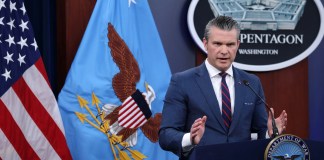
During a public briefing at the Pentagon on Monday, Defense Secretary Pete Hegseth and Gen. Dan Caine, the chairman of the Joint Chiefs of Staff, announced that more U.S. troops are heading to the Middle East. “This work is just beginning and will continue,” Caine said, adding that bigger waves of U.S. strikes are still to come.
At the same time, Hegseth stressed that Operation Epic Fury will not be like the protracted Iraq War. “This is not endless,” Hegseth said. However, he declined to rule out U.S. boots on the ground in Iran.
Iran has also expressed its willingness to continue the fight. Tehran “has prepared itself for a long war,” Iranian security chief Ali Larijani wrote on X on Monday as Iranian forces continued to launch strikes at Israel and Persian Gulf countries.
Meanwhile, “the official message coming from Jerusalem on this is that this will last as long as it takes,” Eyal Hulata, a former head of Israel’s National Security Council, told FP’s World Brief. “Having said that, Israel is not built for long wars in general—definitely not a long war as it comes to Iran. So, I think in many ways, what will determine the length of this war will be more of decisions made in Washington than decisions made in Jerusalem.”
That decision looks to be one of continuous fighting—at least, for now. “We’re destroying Iran’s missile capability, and we’re doing that hourly,” Trump said on Monday, adding that U.S. strikes are “annihilating” Tehran’s navy and ensuring that the Iranian regime “can never obtain a nuclear weapon.” Since Saturday, the United States and Israel have struck more than 2,000 targets in Iran, according to military officials. In response, Tehran has launched a slew of retaliatory attacks targeting Israel and at least eight other countries (Bahrain, Iraq, Jordan, Kuwait, Oman, Qatar, Saudi Arabia, and the United Arab Emirates).
Hundreds of people have been killed thus far, including senior Iranian leaders, such as Supreme Leader Ayatollah Ali Khamenei; six U.S. service members; and at least 165 individuals killed during a missile strike on a girls’ school in southern Iran.
The war has also spooked oil and gas markets and raised fears of a larger regional war.
The White House has offered several rationales for why it launched the war against Iran, including its nuclear program, ballistic missiles, and support for terrorist proxy groups in the Middle East. On Monday, Trump reiterated that Iran’s ballistic missile program was growing “rapidly and dramatically, and this posed a clear, colossal threat to America and our forces stationed overseas.” However, the U.S. Defense Intelligence Agency estimated last year that “should Tehran decide to pursue the capability,” it would likely take it around a decade to build missiles capable of reaching the U.S. homeland.
Hegseth and Caine, along with Secretary of State Marco Rubio and CIA Director John Ratcliffe, are expected to brief the full House and Senate on the war on Tuesday.
Today’s Most Read
The World This Week
Tuesday, March 3: Canadian Prime Minister Mark Carney begins a four-day visit to Australia before traveling to Japan for a two-day trip.
Trump hosts German Chancellor Friedrich Merz at the White House.
European Commission President Ursula von der Leyen hosts new Dutch Prime Minister Rob Jetten.
South Korean President Lee Jae-myung begins a two-day visit to the Philippines.
Wednesday, March 4: Italian Prime Minister Giorgia Meloni hosts Emirati Foreign Minister Abdullah bin Zayed Al Nahyan.
Thursday, March 5: Nepal holds parliamentary elections.
China’s 14th National People’s Congress opens its plenary meeting.
Saturday, March 7: Trump hosts Latin American leaders in Miami.
Sunday, March 8: Colombia holds legislative elections.
What We’re Following
Israel’s second front. On Monday, the Lebanese government condemned Hezbollah’s decision to enter the U.S.-Israel war against Iran, issuing one of its harshest stances yet against the militant group after Hezbollah launched rockets and drones at Israel earlier on Monday.
Hezbollah, a longtime Iranian ally and proxy, said it launched the attack in retaliation for the killing of Khamenei and “repeated Israeli aggressions.” The group’s entrance into the war marks the end of its fragile truce with Israel, which the United States brokered in November 2024. The Israeli military said no injuries or damage were reported.
Israel responded with naval attacks and airstrikes on what it said were Hezbollah targets in Lebanon, which Lebanese officials said killed 52 people.
Beirut considers Hezbollah’s actions illegal and has demanded that it relinquish its weapons. Lebanese Prime Minister Nawaf Salam convened an emergency cabinet meeting on Monday, after which he argued that only the state should decide on matters of war. He banned Hezbollah’s military activities going forward, ordered security agencies to detain the militants behind the attacks, and called on the international community to pressure Israel to stop its strikes on Lebanon.
However, Israeli forces appear unlikely to slow down their assault. “We’ve called in over 100,000 reservists for all arenas, so we’re ready to defend our border, our northern border,” Israeli military spokesperson Nadav Shoshani told reporters on Monday.
Social media restrictions? The British government kicked off a three-month public consultation on Monday into whether London should place restrictions on social media usage. These include a possible minimum age requirement; overnight curfews for users under age 16; restrictions on minors’ access to artificial intelligence chatbots; and bans on addictive design features, such as infinite scrolling and autoplay.
The consultation aims to determine “how young people can thrive in an age of rapid technological change,” British Technology Minister Liz Kendall said. Young people and their parents are encouraged to submit comments by May 26 in an effort to gauge public opinion.
In December 2025, Australia became the first country to introduce a social media ban for people under age 16. Canberra’s announcement sparked similar interest in Europe, including in France and Germany. Meanwhile, comparable identity verification laws are being pursued in Greece, Indonesia, Japan, Malaysia, the Philippines, Singapore, and several U.S. states.
Targeting Bagram. Afghan forces faced Pakistani airstrikes on Bagram Air Base on Sunday. The attack resulted in no reported casualties, according to Afghan officials, but satellite imagery obtained by the New York Times indicated that several of the base’s buildings were flattened. The attack came as cross-border assaults entered their fourth day in some of the most intense fighting between the two adversaries in years. A Pakistani military official confirmed to the Times that Islamabad had carried out multiple strikes.
Pakistani Defense Minister Khawaja Asif announced on Thursday that Islamabad is in an “open war” with Kabul, as Pakistan accuses Afghanistan of harboring the Pakistani Taliban. So far, both sides have claimed to have killed hundreds of the other country’s forces while offering low estimates for their own fatality numbers.
Until Bagram, Pakistani troops had not targeted major infrastructure, instead prioritizing smaller Afghan military sites, such as ammunition depots and outposts. But Sunday’s strikes on Bagram signaled a shift in strategy. The former U.S. military airfield was abandoned during the chaotic U.S. withdrawal from Afghanistan in 2021 and quickly taken over by the Taliban regime, which has since transformed the base into a symbol of Kabul’s military prowess. In recent months, Trump has expressed interest in reclaiming the military asset, citing its counterterrorism value and proximity to key Chinese nuclear sites. But the Taliban have rejected the presence of foreign troops on Afghan soil.
Odds and Ends
Young people are apparently not the only ones glued to their phones. During last year’s conclave to choose Pope Francis’s successor, one of the 133 cardinals in attendance was found carrying a cellphone—a massive breach of the Vatican’s strict secrecy protocols. That’s according to The Election of Pope Leo XIV, a new book published on Sunday. Authors Gerard O’Connell and Elisabetta Piqué write that Vatican officials discovered the signal of an active mobile connection inside the pocket of a cleric, who was described as being “disoriented and distressed” upon finding the phone and handing it over.
This scene was “unimaginable even for a film and never before seen in the history of modern conclaves,” O’Connell and Pique write. Time for a movie sequel?
Great Job Alexandra Sharp & the Team @ World Brief – Foreign Policy for sharing this story.