

Last week, when the Environmental Protection Agency finalized its repeal of tightened 2024 air pollution standards for power plants, the agency claimed the rollback would save $670 million.
Environmental and legal experts said that claim is just the latest example of the agency’s flawed accounting process under the Trump administration, which no longer considers the public health benefits of air pollution regulations. Instead, EPA now only considers the costs to companies.
“If you only look at one side of the ledger, it’s always going to come out one way,” said John Walke, senior attorney at the Natural Resources Defense Council and a former EPA attorney.
The standards limited emissions of mercury and other hazardous air pollutants for coal- and oil-fired power plants across the country. In its announcement, EPA said the repeal of the limits set during the Biden administration will mean “savings American families will see in the form of lower everyday living costs.”
But the rule’s expense to most companies would have been marginal, Walke said. The $670 million is spread across nearly 200 plants, and a significant portion of the cost would fall on just one outdated facility, the Colstrip Steam Electric Station in Montana, which opened in 1975.
“That would be one of the cheapest Clean Air Act rules adopted in a generation. So it really wasn’t about the cost savings,” Walke said. “Frankly, this was an ideological policy consistent with this administration’s agenda that no compliance cost is worth spending.”
Many of the plants affected by the standards were already meeting them, said Nicholas Morales, senior attorney at Earthjustice. “So by taking away the new standards, what the administration is doing is rewarding the few coal plants that had refused to clean up.”
In 2024, the Biden-era EPA estimated the tougher standards would create $300 million in health benefits and $130 million in climate benefits and would cost companies $860 million between 2028 and 2037. Exposure to the air pollutants emitted by coal and oil-fired power plants, including lead, cadmium and arsenic, can cause cancer as well as irritation to the lungs and skin and symptoms like nausea and vomiting. The EPA also found that the changes would not impact retail electricity prices and would not lead to coal plants’ closures.
EPA’s 2026 Regulatory Impact Analysis for the repeal of the Mercury and Air Toxics Standards amendments lists some of the known health consequences linked to breathing in particulate matter, from heart attacks and strokes to asthma and lung cancer. That paragraph ends with a clear statement: “The EPA did not quantify or monetize the benefits or disbenefits” of any of these health effects.
The repeal “ensures the continuation of the highly effective and robust 2012 MATS requirements,” an EPA spokesperson said in a statement to Inside Climate News, noting that the standards have protected “public health and the environment for years.” By repealing the 2024 standards, “EPA is fulfilling its core mission without compromising America’s energy or economic prosperity.”
Reviving the shrinking coal industry has been a priority in both of President Donald Trump’s terms. In the last year, he’s forced aging coal plants to keep operating, invested millions in modernizing and extending the lives of others and directed the Pentagon to spend more money on coal-generated electricity. In February, coal industry leaders presented the president with a gold trophy labeled “Undisputed Champion of Beautiful Clean Coal.”
In a statement, America’s Power CEO Michelle Bloodworth said the EPA’s rollback is “an important step toward maintaining a reliable and affordable supply of electricity and ensuring coal-based generation can continue supporting the nation’s economy and electric grid.” America’s Power is a national coal industry trade organization.
Rachel Gleason, executive director of the Pennsylvania Coal Alliance, noted that 23 states, including West Virginia and North Dakota, had challenged the 2024 amendments in court. The states argued that the Biden administration had set “impossible standards” that would “destroy the coal industry.” Gleason said the technology requirements in the update were “unnecessary and were not cost effective.”
Part of the 2024 standards were requirements for plants to update their monitoring equipment from a quarterly system to continuous. “Not only is it not a large cost for these facilities, it’s actually beneficial for the facilities themselves,” said Kevin Cromar, an associate professor of environmental medicine and population health at New York University, whose research focuses on the health impacts of air pollution and climate change. Continuous monitoring helps operators become aware of problems sooner.
This story is funded by readers like you.
Our nonprofit newsroom provides award-winning climate coverage free of charge and advertising. We rely on donations from readers like you to keep going. Please donate now to support our work.
In a preview of this month’s action last April, the Trump administration granted 47 power plants a two-year exemption from the 2024 standards. The administration argued that the Biden-era standards placed “severe burdens” on companies and threatened the “viability” of the coal industry. Missing from the president’s proclamation was any consideration of the health burdens that might be placed on communities living downwind of these plants.
Cromar, along with researchers at the University of Washington, set out to investigate what those burdens might be. The 2024 update represents a minor change when you look at the national picture, Cromar said, mainly because the “vast majority” of plants already meet the standards. “But the paper was able to show that in discrete locations, it’s not an insignificant amount of health impact,” he said.
The study found Trump’s two-year exemption would mean 2,500 more tons of air pollution and more premature death in certain parts of the country near plants that aren’t yet meeting the standards.
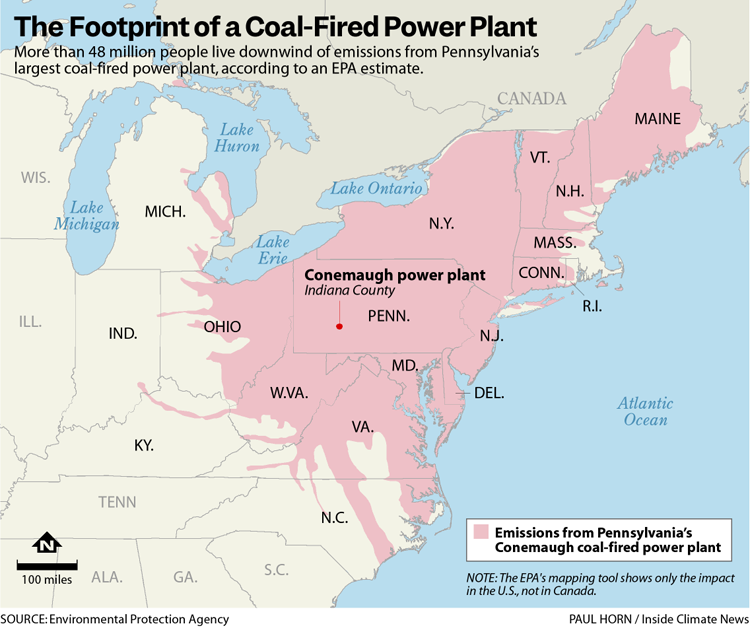
One of those places is Pennsylvania, home to 14 coal-fired power plants and a long legacy of pollution from the coal industry. Tom Schuster, director of the Sierra Club’s Pennsylvania chapter, lives in western Pennsylvania, not far from some of the state’s largest remaining coal-fired plants. “I’m just over the ridge from there. I can see the steam from the cooling towers on a cold day,” he said.
Schuster worries EPA’s decision could mean backtracking on the progress that has been made since the Mercury and Air Toxics Standards were enacted in 2012, resulting in huge reductions in mercury and hazardous air pollution emissions. In Pennsylvania, mercury remains one of the leading causes of pollution in waterways, and residents are warned to limit consumption of fish from more than 100 lakes, rivers and creeks because of mercury contamination. Mercury bioaccumulates in ecosystems—building up in the bodies of fish and shellfish—and can persist in the environment for decades.
“The gut punch of it is that most of the plants are already complying,” Schuster said. “They’ve already installed the pollution controls. They’re already complying. And by eliminating the need to demonstrate that explicitly, we’re giving them an opportunity to cut corners.”
About This Story
Perhaps you noticed: This story, like all the news we publish, is free to read. That’s because Inside Climate News is a 501c3 nonprofit organization. We do not charge a subscription fee, lock our news behind a paywall, or clutter our website with ads. We make our news on climate and the environment freely available to you and anyone who wants it.
That’s not all. We also share our news for free with scores of other media organizations around the country. Many of them can’t afford to do environmental journalism of their own. We’ve built bureaus from coast to coast to report local stories, collaborate with local newsrooms and co-publish articles so that this vital work is shared as widely as possible.
Two of us launched ICN in 2007. Six years later we earned a Pulitzer Prize for National Reporting, and now we run the oldest and largest dedicated climate newsroom in the nation. We tell the story in all its complexity. We hold polluters accountable. We expose environmental injustice. We debunk misinformation. We scrutinize solutions and inspire action.
Donations from readers like you fund every aspect of what we do. If you don’t already, will you support our ongoing work, our reporting on the biggest crisis facing our planet, and help us reach even more readers in more places?
Please take a moment to make a tax-deductible donation. Every one of them makes a difference.
Thank you,

Reporter, Pennsylvania
Kiley Bense covers climate change and the environment with a focus on Pennsylvania, politics, energy, and public health. She has reported on the effects of the fracking boom in Pennsylvania, the expansion of the American plastics industry, and the intersection of climate change and culture. Her previous work has appeared in the New York Times, the Atlantic, Smithsonian Magazine, the Believer, and Sierra Magazine, and she holds master’s degrees in journalism and creative writing from Columbia University. She is based in Pennsylvania.
Great Job By Kiley Bense & the Team @ Inside Climate News for sharing this story.